
First Road Trip Nightmare: Fresh Stone Chips on a Brand-New EV
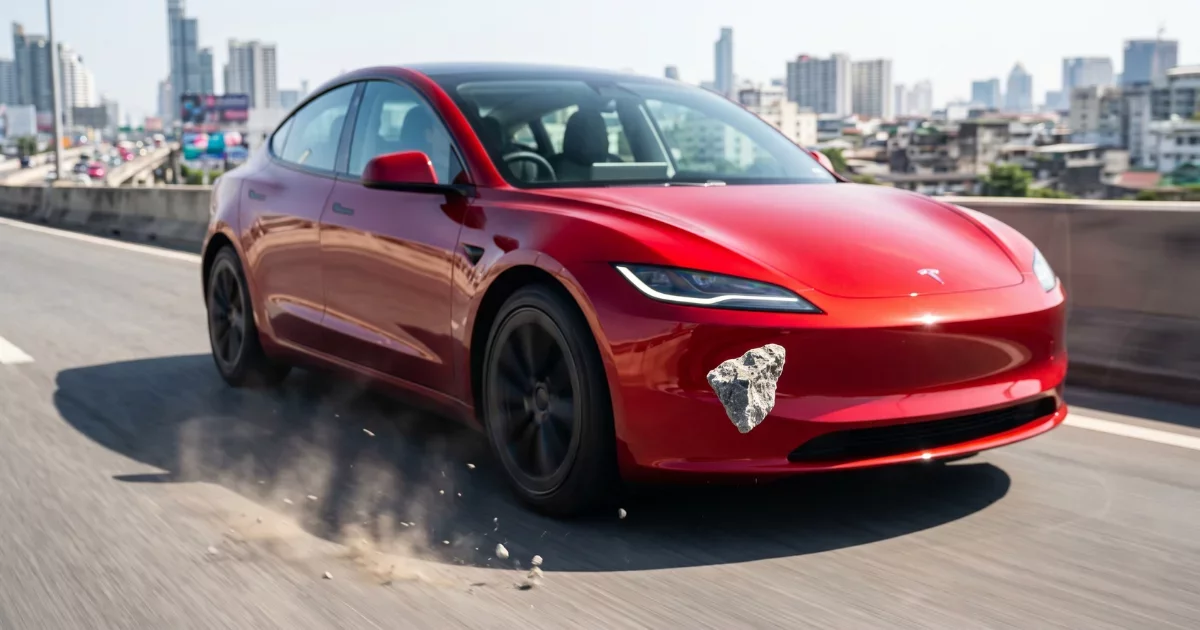
Ek recently took delivery of his long-awaited Tesla Model 3 Highland in Ultra Red. His first impression was pure admiration: the seamless, grille-less front bumper looked sleek and futuristic, resembling an aerospace capsule. Eager to enjoy his new vehicle, Ek immediately organized a weekend family getaway to Khao Yai.
The highway drive was serene. Silent acceleration and effortless torque made the journey feel effortless. But when he returned home to wash the car on Sunday evening, his excitement turned into dismay.
Wiping away bug residue from the front bumper, he uncovered several tiny dark craters. High-speed road gravel had gouged through the brilliant red metallic paint, exposing the raw black molded plastic beneath. Stepping closer to inspect the windshield, he discovered a sharp, star-shaped impact mark directly in the driver field of view, caused by a small pebble striking the glass at cruising speed.
Seeing a brand-new vehicle damaged within its first week of ownership is a painful reality many electric vehicle drivers face. This is neither bad luck nor coincidence. It is an engineering consequence stemming from the aerodynamic design of modern EVs. Why have electric vehicles become literal stone magnets compared to traditional internal combustion cars?
The Engineering Behind Stone Magnets: Why EVs Attract Road Debris
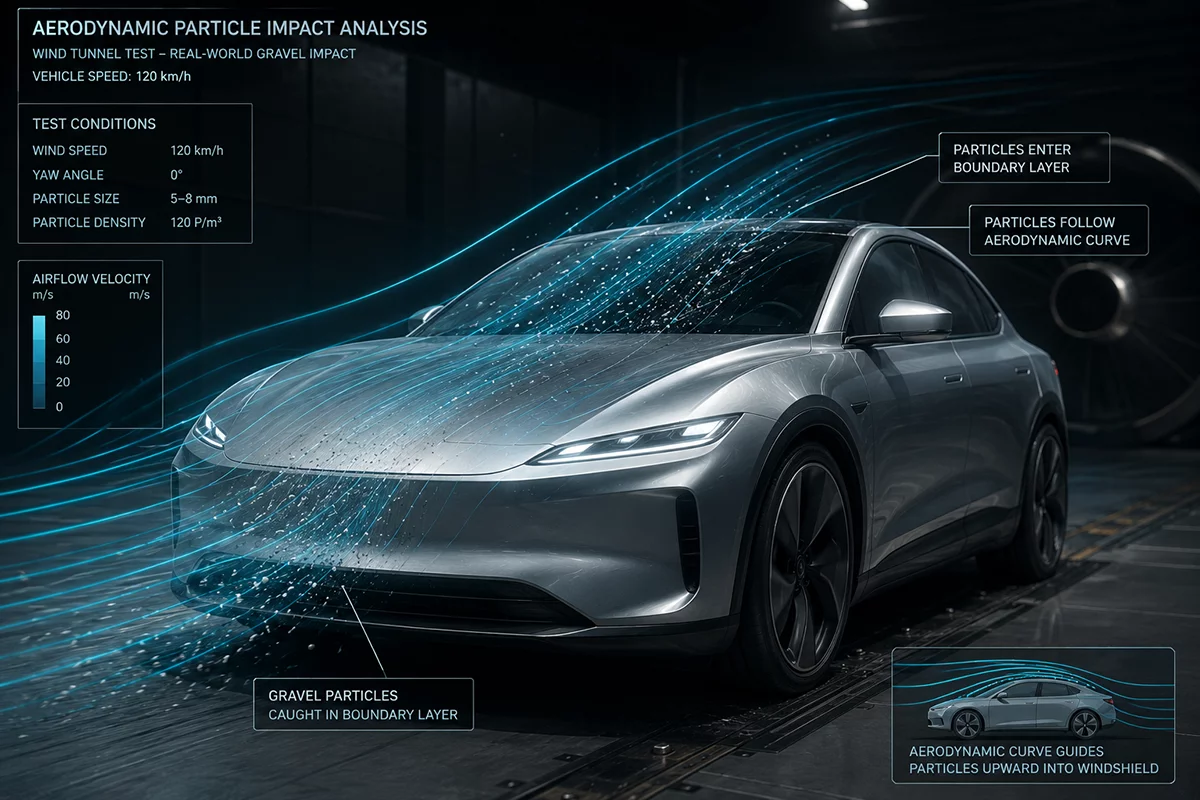
To understand why electric cars suffer more paint and glass damage, we must examine the principles of aerodynamics that guide EV vehicle architecture. Two primary engineering factors make electric cars disproportionately vulnerable to flying gravel:
1. The Missing Grille: An Exposed Painted Canvas
In traditional internal combustion engine (ICE) vehicles, the front end is dominated by open ventilation grilles made from textured black plastic or chrome mesh designed to cool radiators. These recessed, textured surfaces effectively disguise and disperse small impacts. When small stones hit a honeycomb plastic grille, they rarely leave visible damage.
Modern EVs such as the Tesla Model 3, BYD Seal, and Deepal eliminate conventional grilles to reduce aerodynamic drag. In place of a textured grille, the entire front fascia is converted into a large, continuous painted surface. This expansive vertical plane directly absorbs the impact of highway grit and loose gravel. Flying stones that previously struck disposable plastic mesh now strike glossy factory clear coats directly.
2. Low Drag Aerodynamics: The Sloping Hood Ramp Effect
Maximizing highway range per kilowatt-hour requires minimizing aerodynamic drag. Designers accomplish this by lowering front-end profiles and sharply raking the hood and windshield angles to guide airflow smoothly across the roof.
While this low drag coefficient increases efficiency, it transforms the front of the vehicle into a launch ramp for airborne road debris. When tires on leading commercial trucks kick up loose gravel, stones do not hit a blunt upright grille and drop to the road. Instead, stones are swept up by high-velocity compressed airflow moving up the sloping hood and catapulted directly into the windshield at severe impact angles. This aerodynamic dynamic explains why EV windshields suffer frequent micro-cracks and chip damage.
The Fallacy of Ceramic Coating: Why Liquid Glass Cannot Stop Stones
Many new car owners receive well-intentioned advice from dealership salespeople: “Apply ceramic or glass coating to harden your paint against rock chips.” This is one of the most persistent and costly misconceptions in automotive detailing.
The physics of surface coatings clarify why this claim is fundamentally flawed. Ceramic and glass coatings are liquid solutions composed of silicon dioxide (SiO2) applied over automotive clear coats. When cured, they form a crystalline layer measuring merely 2 to 5 microns thick, which is significantly thinner than a single strand of human hair.
What Ceramic Coatings Actually Do Well:
- Enhance surface gloss and optical depth.
- Create hydrophobic water beading that simplifies regular washing.
- Defend against bird droppings, tree sap, and industrial fallout.
- Shield factory clear coats from ultraviolet oxidation.
The Critical Limitation: Zero Impact Resistance
Consider this analogy: applying a ceramic coating is like applying sunscreen lotion to your skin. The lotion protects against sunburn and keeps skin healthy, but it cannot prevent bruising or cuts if someone throws a stone at you.
A piece of road gravel striking a vehicle at 100 km/h carries substantial kinetic energy. That concentrated force easily punctures a brittle 2-micron ceramic film, punching through the underlying clear coat and primer down to bare metal or plastic.
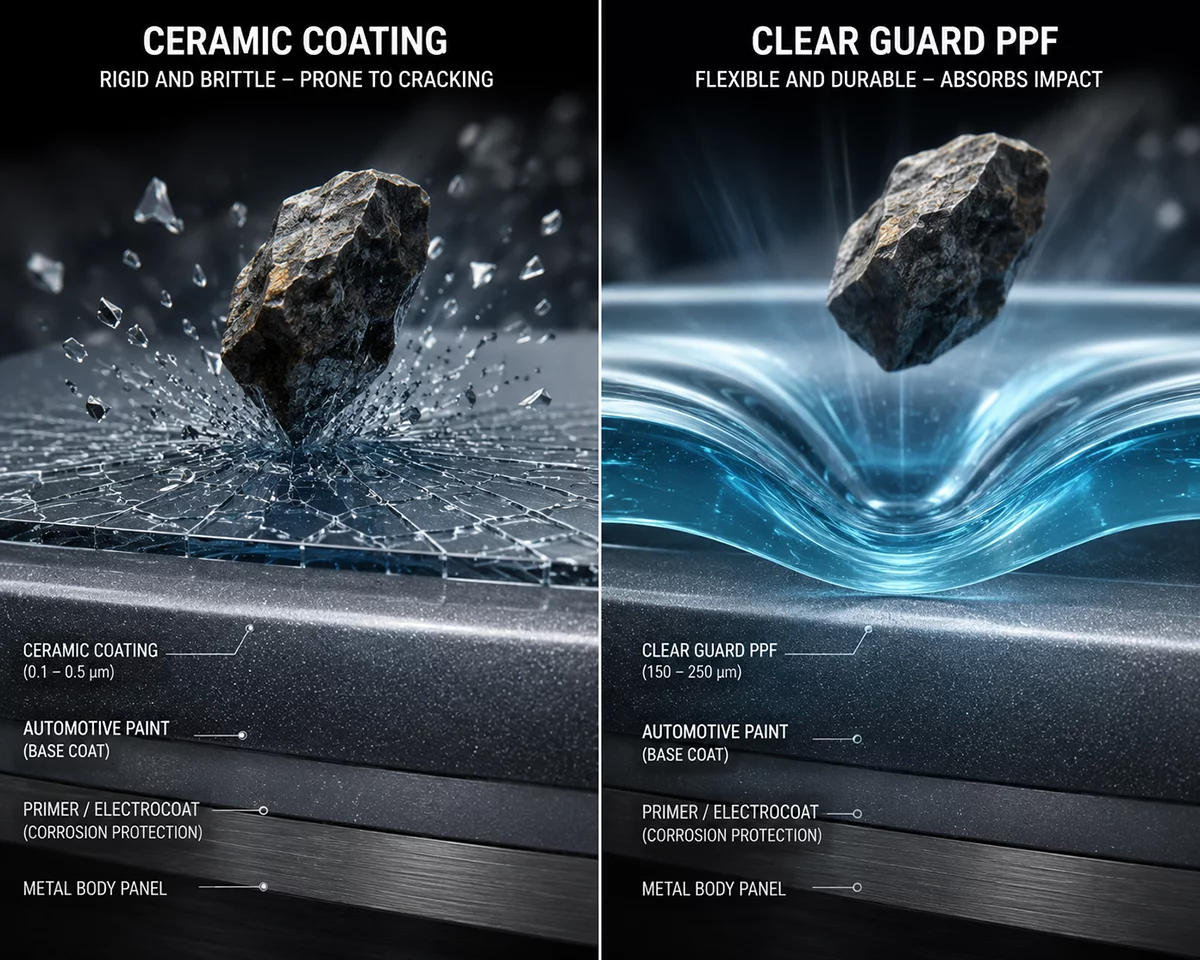
When defending against flying road debris, you do not need cosmetic lotion: you need durable physical armor. That is the engineering role of Paint Protection Film (PPF).
ULTIMATE DEFENSEClear Guard PPF: The True Physical Shield for EV Paint and Glass
Paint Protection Film (PPF) provides genuine physical barrier defense. Manufactured from high-grade thermoplastic polyurethane (TPU), it wraps vehicle panels in a clear, shock-absorbing membrane. For EV owners seeking superior surface defense, Clear Guard PPF from MAXXMA provides the comprehensive answer.
High-Density Thickness and Kinetic Energy Absorption
While ceramic coatings measure 2 to 5 microns, MAXXMA Clear Guard is constructed from premium aliphatic TPU measuring 190 microns thick, nearly 100 times thicker than liquid coatings. This substantial density functions like a protective airbag for your body panels. When a stone strikes the film, the elastomeric TPU compresses to absorb and laterally dissipate the kinetic energy, bouncing the projectile away without allowing damage to penetrate the factory paint beneath.
Self-Healing Technology: Scratches Disappear Under Heat
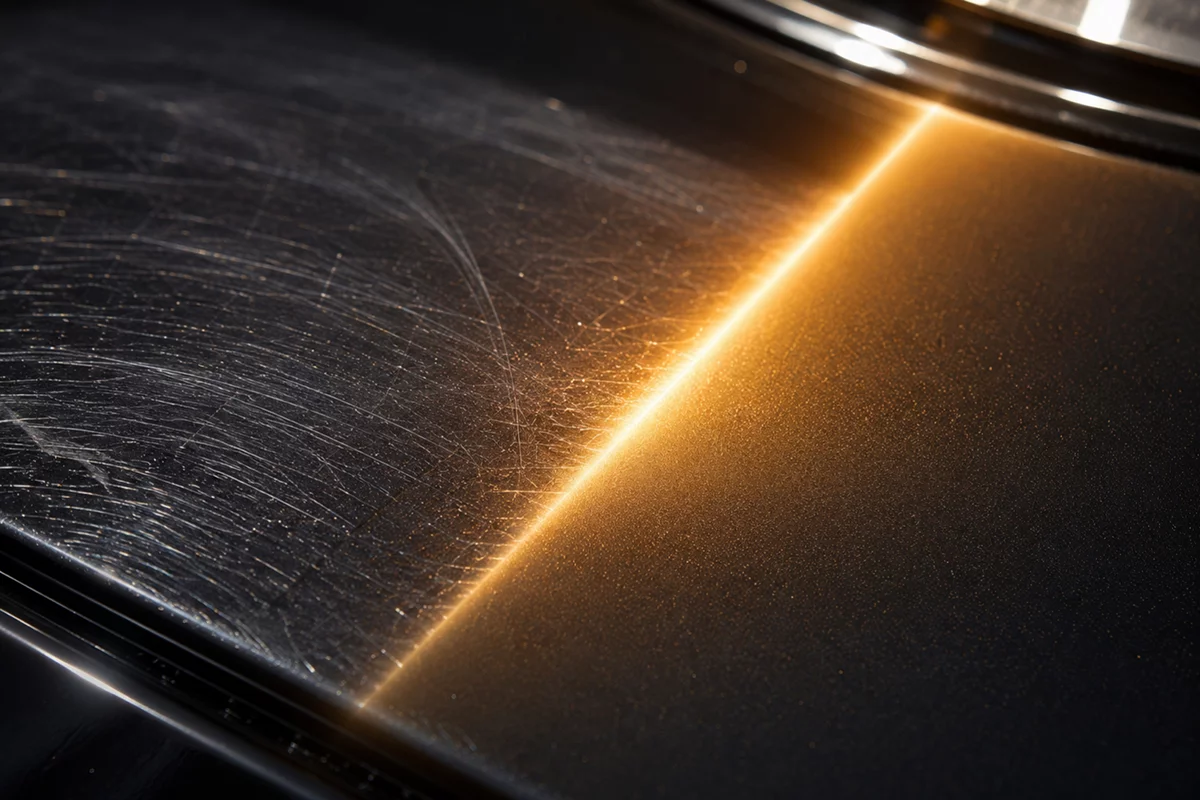
Clear Guard features an engineered top coat with advanced heat-activated self-healing properties. The molecular structure of aliphatic TPU possesses shape-memory characteristics. When subjected to light surface scratches, wash swirls, or minor abrasions, applying mild heat from sunlight, warm water, or a heat gun causes the polymer chains to re-align, completely erasing surface blemishes and restoring a mirror finish.
The “Front Package” Strategy: Maximum Protection at Sensible Cost
Wrapping an entire vehicle in premium PPF requires a significant investment. For electric vehicle owners seeking the most practical balance of cost and coverage, MAXXMA recommends the Front Package configuration. This strategy targets the critical zones that sustain 80% of road impacts:
- Front Bumper: The frontline impact surface directly facing road air intake and debris.
- Full Hood: The broad forward area that catches gravel deflected by the bumper.
- Front Fenders: Side panels exposed to gravel thrown laterally by leading tires.
- Side Mirror Caps: Outward-facing projections that frequently collide with insects and stones.
Investing in a Front Package protects your vehicle against the vast majority of highway hazards at a fraction of full-vehicle wrapping costs. You can round out this defense by installing Clear Guard Windshield protection film on the front glass and Clear Guard Sunroof film on panoramic roof panels for complete peace of mind.
BUYER CHECKLISTFive Crucial Checks Before Installing PPF on Your EV
Before entrusting your electric vehicle to an installation facility, verify these five critical standards to guarantee professional results without blade damage to your paint:
1. Confirm 100% Aliphatic TPU Material (Avoid PVC and TPH)
Low-cost films are often manufactured from cheap polyvinyl chloride (PVC) or hybrid TPH plastics. Under harsh tropical sun, these materials quickly turn yellow, become brittle, and crack. When removed, they leave stubborn adhesive residues or can peel factory clear coat. Always ensure your installer provides documented 100% Aliphatic TPU.
2. Request an On-Site Self-Healing Demonstration
Ask the shop to scratch a sample film using a brass wire brush, then apply heat with a heat gun or warm water. Genuine self-healing top coats will restore the surface completely within seconds without leaving hazy blemishes or melting the film.
3. Inspect the Clean-Room Facility Standards
PPF installation requires extreme environmental cleanliness. Professional installation centers feature fully enclosed glass installation bays equipped with overhead misting systems that suppress airborne dust particles, preventing trapped contaminants beneath the film.
4. Evaluate Software Pre-Cut vs. Custom Hand-Cut Techniques
Computer-aided pre-cut patterns ensure panels fit exact vehicle contours without requiring razor blades near your paint. For complex edges, skilled craftsmen can wrap film edges cleanly behind panels to eliminate visible seams and prevent dirt accumulation.
5. Verify Manufacturer Warranty Terms
Premium PPF manufacturers provide warranty coverage for 5 to 7 years against yellowing, cracking, peeling, and bubbling. Ensure that your installer issues an authentic warranty backed by an established national distributor.
Preserving Factory Paint and Securing Maximum Resale Value
Original factory paint is irreplaceable. It is applied in clean-room factory environments and cured at high temperatures that aftermarket body repair shops cannot replicate. Respraying panels introduces color mismatch risks and reduces vehicle resale value significantly.
Installing Clear Guard PPF is an investment in long-term vehicle preservation. It preserves showroom gloss, protects your vehicle against daily highway hazards, and keeps your EV looking brand-new for years to come.
Eliminate Stone Chip Risks Today
Consult MAXXMA specialists to explore Front Package and full-wrap configurations tailored specifically for your electric vehicle model.
Find an Authorized MAXXMA Center Near You
Ready to protect your home or vehicle?
Consult with MAXXMA experts to select the perfect film for your needs, or find an authorized dealer near you.