

Start with the energy that glazing manages
Glass brings daylight and views into homes and buildings, but also provides a path for solar energy to enter conditioned spaces. Choosing a window film requires more than deciding how light or dark the glass should look. Reflection, absorption, transmission and the subsequent flow of heat all matter.
This guide is based on the 2023 IWFA Flat Glass-Solar Education Guide. It explains solar radiation, glass and glazing systems, film manufacture, performance measures, fading and installation considerations. It gives owners, designers, facility managers and installers a common framework for reading specifications and asking informed questions. Examples from the manual do not certify a particular product; each installation requires assessment of the actual glazing system.

Flat Glass-Solar Education Guide
Published by the International Window Film Association (IWFA) · 2023 edition
The manual covers solar energy, heat transfer through glass, architectural glazing systems, film construction and manufacture, performance ratings and installation considerations.
Solar radiation includes more than visible light
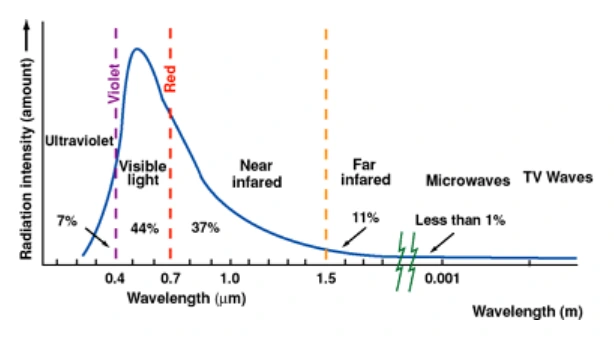
Figure: solar energy spectrum, IWFA Figure 1.5, page 6.
Solar energy is commonly discussed as ultraviolet radiation, visible light and infrared radiation. The manual’s text describes an approximate distribution of 3% UV, 44% visible and 53% infrared. These values illustrate a reference spectrum, not the certified performance of a particular glass or film. Actual spectra and test values depend on the reference standard and conditions.
Wavelength is measured in nanometres, one billionth of a metre. The manual describes UV-C at roughly 100–290 nm, UV-B at 290–320 nm and UV-A at 320–400 nm. It places visible light at approximately 380–780 nm, with overlapping boundaries depending on definition. Near infrared relevant to solar energy is approximately 780–2,500 nm; warmed glass and objects also emit longer-wavelength thermal radiation. [Pages 4–6]
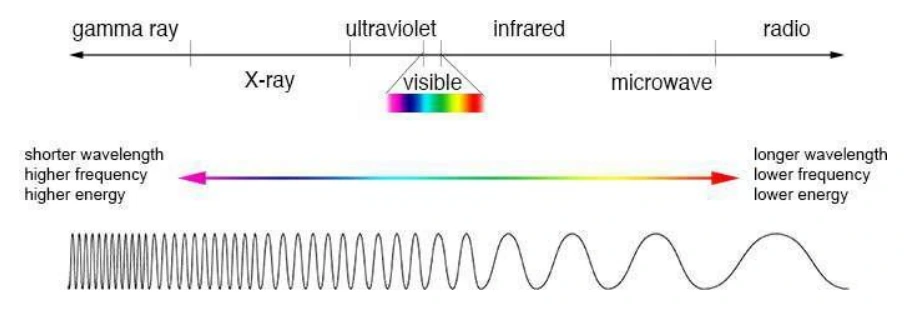
Figure: electromagnetic spectrum, IWFA Figure 1.3, page 4.
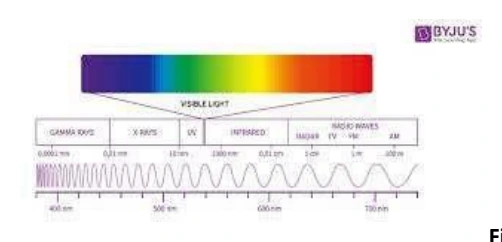
Figure: wavelength ranges, IWFA Figure 1.4, page 5.
The text and Figure 1.5 in the manual use different numerical divisions of the spectrum. Do not combine the two as one data set. For calculations, use one consistent spectrum and test method throughout.
03 · RATRAT: accounting for incident solar energy
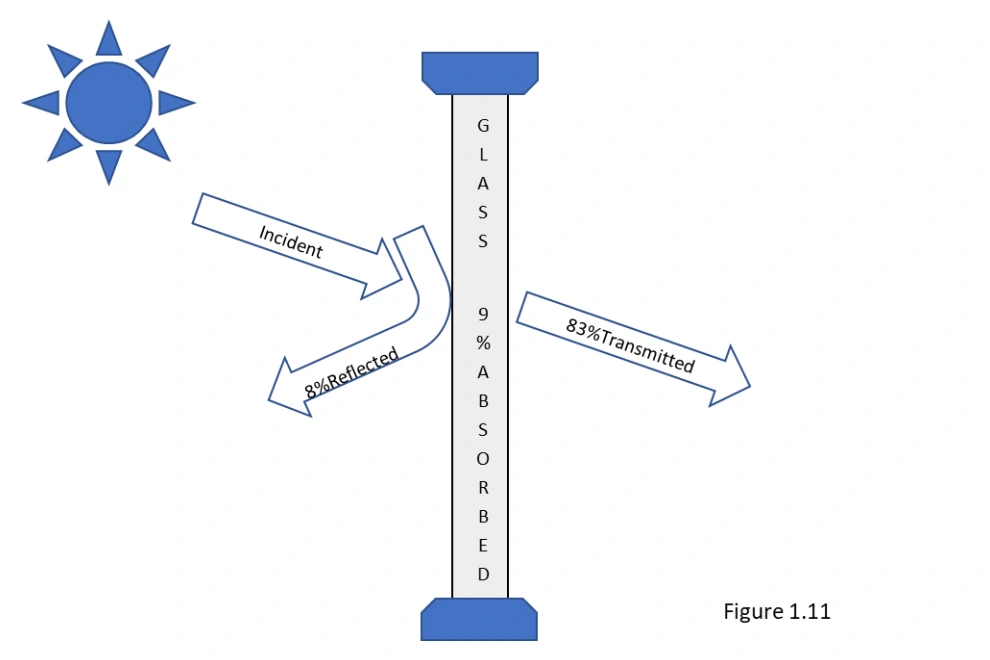
Figure: energy balance of clear glass, IWFA Figure 1.11, page 11.
When solar energy reaches a glazing system, it is reflected, absorbed or transmitted. For measurements covering the same spectrum and conditions, these shares add to 100%:
Reflectance (R) + Absorptance (A) + Transmittance (T) = 100%
Reflectance is the energy reflected away. Absorptance is the energy taken up by the system. Transmittance is the energy passing through directly. Reducing transmission does not mean the difference vanishes: it may be reflected or absorbed. The manual illustrates the balance with 1/8-inch clear glass at 8% reflected, 9% absorbed and 83% transmitted. It is an example, not a specification for every pane. [Pages 10–11]
04 · HEAT TRANSFERWhere absorbed energy goes
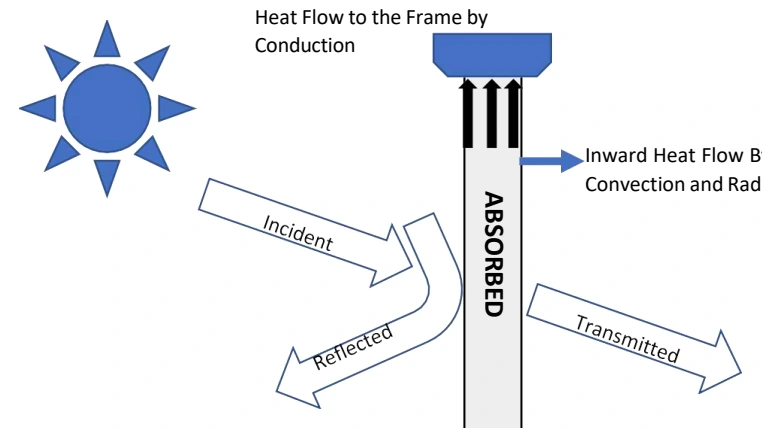
Figure: absorbed energy and heat flow, IWFA Figure 1.12, page 12.
Absorbed energy warms the glass and film. Heat may then flow towards the room, outdoors or the frame. Conduction transfers heat through materials in contact. Convection transfers heat through moving air, either naturally or with the help of wind or a fan. Radiation exchanges energy between surfaces without direct contact. Net heat flow follows temperature differences; continuous sunlight can produce a balance between incoming and outgoing energy without the glass reaching air temperature. [Pages 6–9, 12–14]
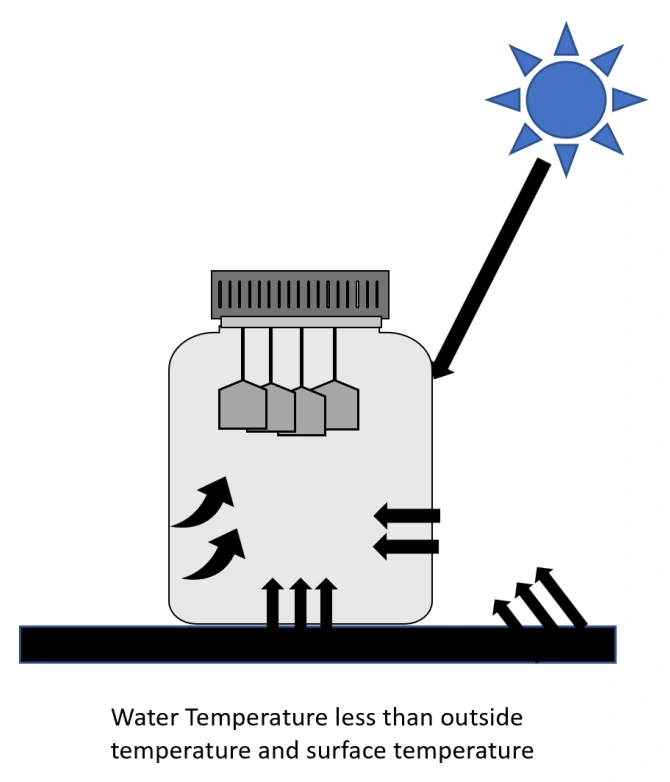
Figure: heat flows towards the cooler jar, IWFA page 8.
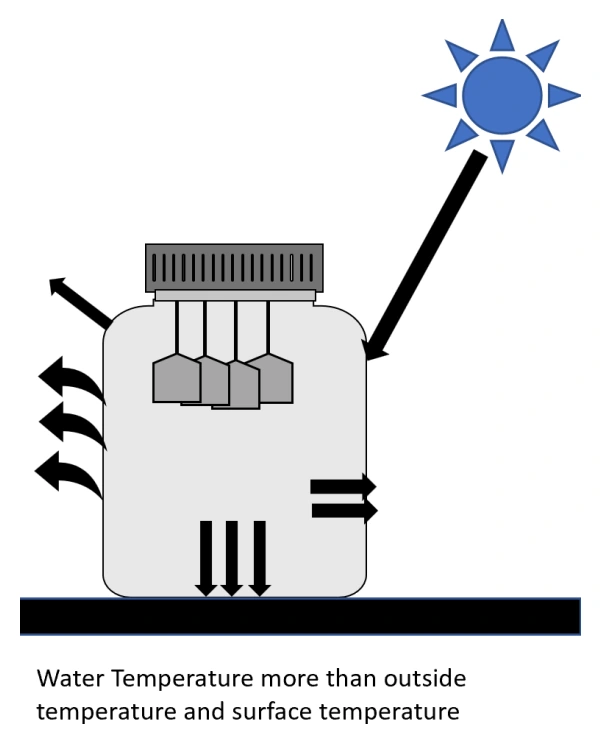
Figure: conduction and convection can change direction as the jar warms, IWFA page 9.
Solar gain and temperature-driven heat flow
In sunlight, solar radiation enters the glazing while a temperature difference between outdoors and indoors can also drive heat transfer. At night, solar gain stops, but temperature-driven heat flow and long-wave radiation remain. SHGC describes solar heat gain; U-value describes heat transfer due to temperature difference. They answer different questions and should be read together. Absorptance alone does not reveal how much absorbed heat reaches the room. [Pages 12–15, 40–41]
05 · PERFORMANCESHGC, TSER, VLT and U-value
- SHGC, the solar heat gain coefficient, is the fraction of incident solar energy admitted as heat, including direct transmission and absorbed energy subsequently released inward. A lower value means less solar heat gain under comparable conditions.
- TSER, total solar energy rejection, expresses the fraction of solar energy rejected by the system under its stated test conditions.
- VLT, visible light transmission, describes the proportion of visible light passing through. It does not describe total solar heat by itself.
- U-value describes heat transfer driven by the indoor–outdoor temperature difference, rather than direct solar gain.
- LSG, light-to-solar gain, helps describe the balance between visible light and solar heat gain.
Check the glass type, thickness, measurement method and whether a value refers to film on reference glass or the complete glazing system. Comparing numbers from different conditions can produce a misleading result.
Terms on a specification sheet
Total solar reflectance, absorptance and transmittance concern the full specified solar spectrum. Visible light reflectance (VLR) describes visible light reflected; indoor and outdoor values may differ. UV transmittance (UVT) and infrared transmittance (IRT) describe transmission within their stated spectral ranges. Do not add VLT to solar reflectance and absorptance to check RAT: all three terms must cover the same spectrum and conditions. [Page 15]
05A · THERMAL STRESSWhy assess thermal stress before installation?
Sunlight and shade can heat different parts of a pane unevenly. Film changes absorption and heat flow, so compatibility should be assessed before installation, particularly with large panes, tinted or coated glass, insulating units, partial shading or coverings close to the glass. Record glass type, dimensions, orientation, frame, edge condition and shading before recommending a film.
06 · GLASSHow glass is made and why its type matters
Modern float glass begins as molten glass flowing over molten tin to create a flat sheet. Controlled cooling reduces residual stresses and produces annealed glass. The sheet may then be strengthened, coated or combined with other layers. Float describes a manufacturing process; it does not by itself mean the pane is tempered or safety-rated. The manual traces flat glass from hand-made and blown forms to continuous modern production. [Pages 16–17]
Annealed, heat-strengthened and tempered glass
- Annealed glass is the basic slowly cooled sheet. It can be cut before installation and often breaks into large sharp pieces.
- Heat-strengthened glass is reheated and cooled under controlled conditions to create surface compression. The manual gives roughly twice the strength of comparable annealed glass; its fracture pattern can still include large pieces. Strengthening alone does not establish every safety-glazing qualification.
- Tempered glass is heated and rapidly cooled to create greater surface compression. The manual gives roughly four times the strength of comparable annealed glass, and describes smaller fragments on breakage. Its improved resistance to temperature differences does not eliminate all breakage risk.
- Chemically strengthened glass develops surface compression through ion exchange and is used in some thin-glass applications. Its fracture behaviour differs from tempered glass.
These strength comparisons are general examples, not guarantees for an individual pane. Edge condition, size, installation and test criteria matter. Cutting and edge work should precede thermal strengthening or tempering. A corner marking or polarised-film inspection can help identify glass, but project documentation or specialist assessment may be needed. [Pages 17–19]
Monolithic and laminated glass
Monolithic glass is one sheet, which may be annealed, strengthened, tempered or coated. Laminated glass joins two or more sheets with an interlayer such as PVB. Depending on its design and test performance, the interlayer can help retain fragments after breakage and contribute to acoustic or safety performance. “Laminated” describes construction; “tempered” describes treatment, so both terms can apply to the same assembly. [Pages 19–20]
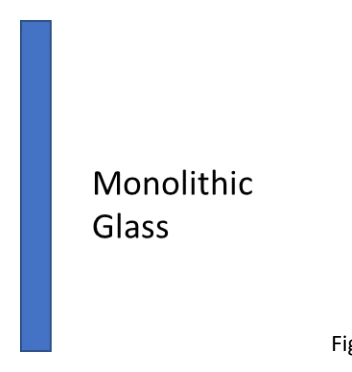
Figure: monolithic glass, IWFA Figure 2.1, page 20.
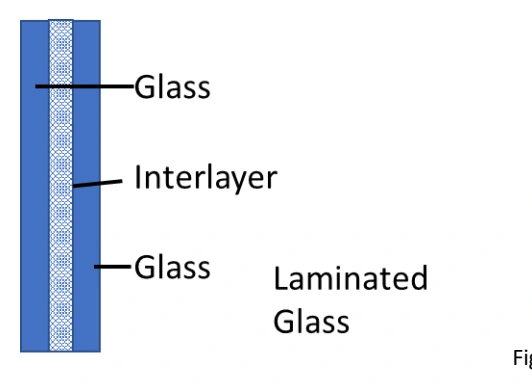
Figure: laminated glass, IWFA Figure 2.2, page 20.
07 · COATINGSTinted, reflective and Low-E glass
Tinted glass can reduce transmission partly through absorption, making the existing pane’s heat behaviour relevant before adding film. Reflective coatings use metal or metal compounds to alter reflection and transmission. A spectrally selective coating changes those properties across wavelengths to balance visible light and solar gain. [Pages 21–22]
Low-E describes a surface with low thermal emissivity. Different Low-E products are designed for different priorities: some emphasise reduced heat loss, while others also reduce solar gain. The coating’s location in the glazing assembly matters. Read the SHGC and U-value of the actual system, rather than assuming all Low-E glass performs alike. Thermochromic, photochromic and electrochromic coatings respond respectively to temperature, light and electrical input; film compatibility must be checked for the actual system.
Emissivity
Emissivity compares a surface’s thermal radiation emission with an ideal emitter. Lower emissivity can reduce long-wave radiative exchange in a suitable assembly, but does not on its own describe conduction or all solar gain. The manual illustrates this with approximate values of 0.84 for ordinary glass and 0.05 for polished aluminium. These are material examples, not MAXXMA product ratings. [Page 14]
08 · GLAZINGThe complete glazing system
Windows include glass, frames, gaskets, sealants and tapes. These components support and cushion the glass, seal gaps and accommodate movement. Frame materials and edge details also affect heat transfer. [Pages 24–25]
Single pane, IGU, triple pane and VIG
A single-pane window has one glass sheet. An insulating glass unit (IGU) has two sheets separated by a sealed air or gas space, with a spacer and edge seals. The gap reduces conductive and convective heat transfer; the result depends on the gap, fill, coatings, frame and construction. Triple-pane windows add another sheet and cavity but require suitable framing and support. Vacuum insulating glazing (VIG) uses a vacuum gap to reduce heat transfer through gas. [Pages 25–28]
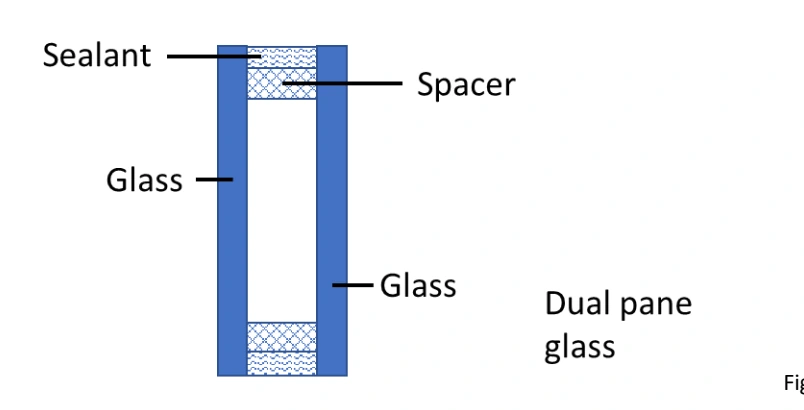
Figure: double-pane insulating glass, IWFA Figure 2.4, page 26.
For a two-pane IGU, surface 1 faces outdoors, surface 2 faces the cavity from the outer pane, surface 3 faces the cavity from the inner pane, and surface 4 faces the room. Coating and film placement can change radiation exchange and pane temperatures. Do not assume every IGU accepts the same film.
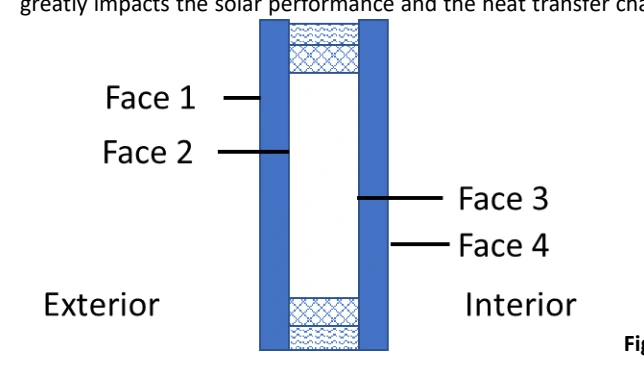
Figure: glass surface numbering, IWFA Figure 2.5, page 26.
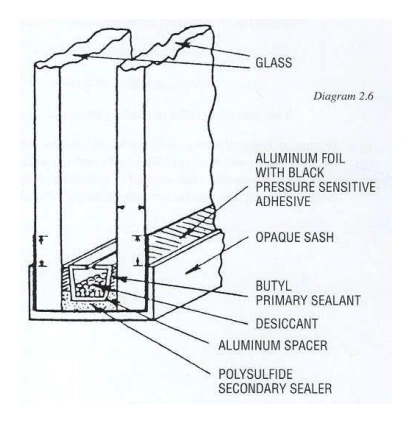
Figure: example IGU edge and seals, IWFA Diagram 2.6, page 27.
Moisture or fog between the panes may indicate an issue with the seal or desiccant. A film applied to an exterior surface cannot repair the sealed cavity or remove moisture trapped inside. Inspect the unit before filming. [Pages 25–27]
09 · MANUFACTURINGWhat architectural window film is made of
Architectural film is a multilayer material. Its polyester (PET) base may be dyed, coated, metallised, laminated and slit before an installation adhesive and protective liner are added. A film can also contain UV absorbers, colour or solar-control layers, laminating adhesive and a scratch-resistant surface. The construction varies by product. One mil is approximately 25 micrometres; 0.5 mil is approximately 12.7 micrometres. Thickness alone does not establish solar or safety performance. [Pages 29–30]
UV absorbers and scratch-resistant coatings
UV absorbers can be incorporated in PET or adhesive to protect film components and reduce UV transmission according to the system’s test data. Scratch-resistant coatings help with ordinary handling and cleaning, but are not scratch-proof. Follow the product’s care instructions. [Pages 31–33]
Dyeing, metallising and sputtering
Dyeing adds colour within or on the film. In metallising, metal is evaporated in a vacuum and condenses on PET as a thin layer. Sputtering uses a plasma in a vacuum to dislodge material from a target and deposit it on film. It can accommodate metals, alloys and compound layers. A manufacturing label alone does not establish which product is best for a particular glazing system. [Pages 31–32]
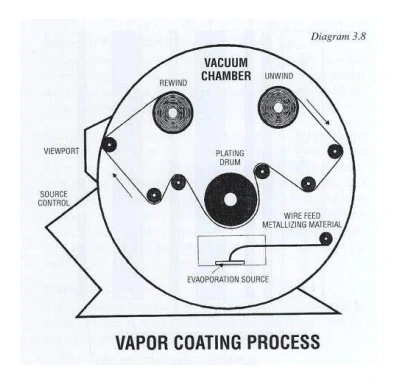
Figure: vacuum metallising, IWFA Diagram 3.8, page 31.
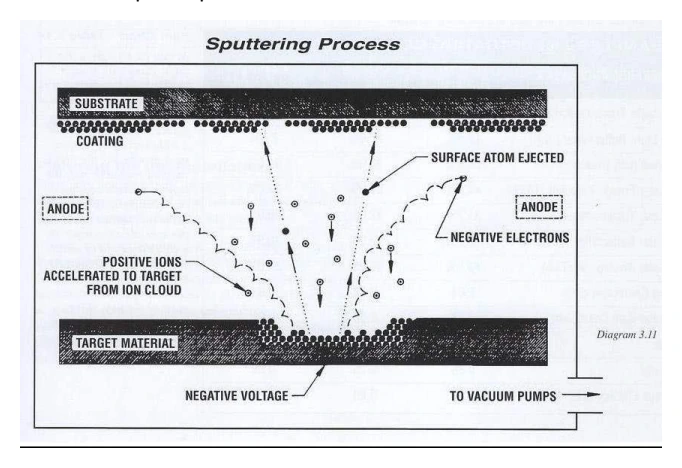
Figure: sputtering process, IWFA page 32.
Laminating and installation adhesives
Laminating adhesive bonds film layers together; installation adhesive bonds the film to glass. The manual describes pressure-sensitive and water-activated installation adhesives. Both may use a solution for positioning and squeegeeing, according to the manufacturer’s instructions. Drying, removal and installation behaviour vary by formulation. The release liner protects the adhesive and is removed before installation. [Pages 33–34]
The manual notes that some sputtered constructions can retain installation moisture longer and temporarily appear hazy. The actual curing period depends on the film, climate and workmanship. Follow the manufacturer’s instructions and explain expected curing to the customer rather than assuming every haze will disappear. [Page 38]
10 · FILM TYPESClear, coloured, ceramic, metallised and exterior films
- Clear films may be designed for UV control or as part of a safety product. Verify the actual construction and test report; clarity and thickness alone do not establish a safety rating.
- Coloured films alter appearance and light transmission, often with absorption playing a significant role. Check the existing glass and film together.
- Nanoceramic films can use infrared-absorbing particles. Performance depends on the formulation and construction; “ceramic” is not a substitute for SHGC or TSER data.
- Metallised and sputtered films can manage energy through different combinations of reflection and absorption. Visible reflectance also varies by design.
- Exterior films use coatings and adhesive systems intended for outdoor exposure. Glass type, weather, drainage and the product’s installation instructions must be considered.
Interior and exterior placement changes the order in which energy encounters the layers and can change glass temperature. Compare complete systems, not labels alone. [Pages 34–39]
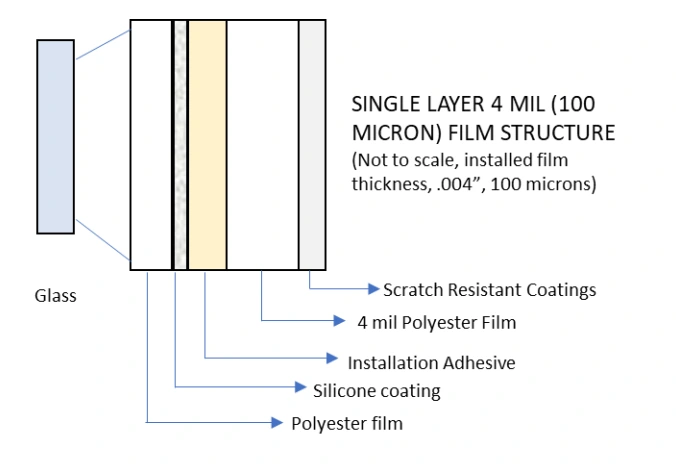
Figure: example clear film construction, IWFA page 35.
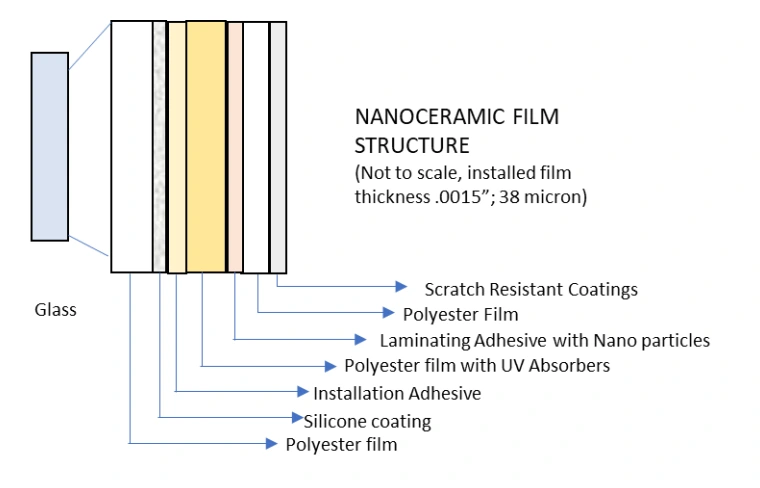
Figure: example nanoceramic film construction, IWFA page 36.
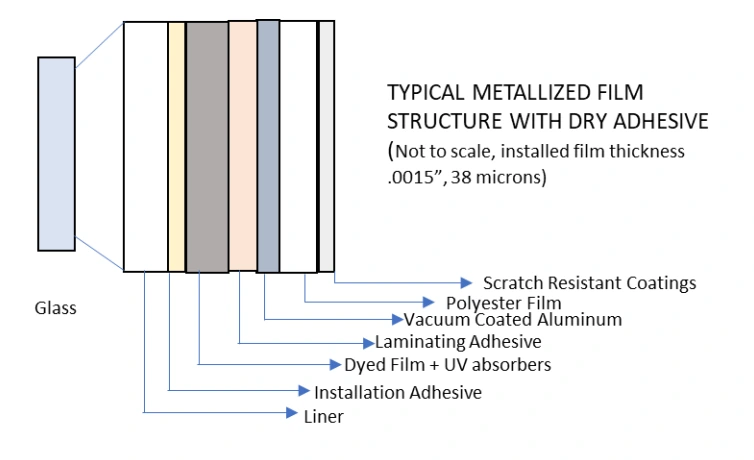
Figure: example metallised and coloured film, IWFA page 37.
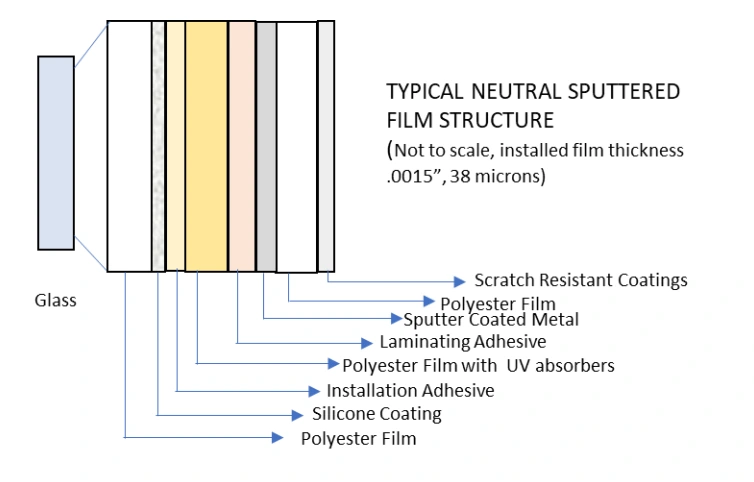
Figure: example sputtered film, IWFA page 38.
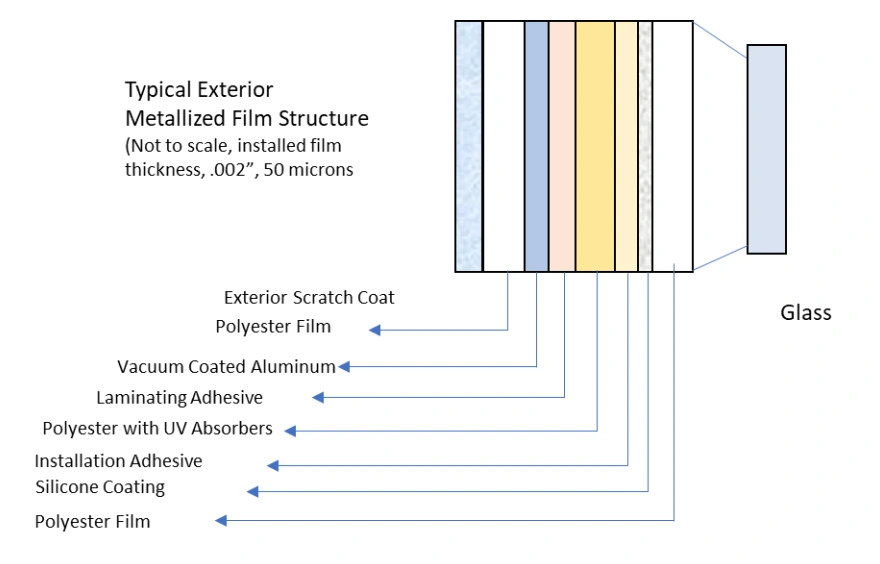
Figure: example exterior film construction, IWFA page 39.
11 · METRICSCalculating SHGC, TSER, LSG and solar heat load
The manual defines SHGC as the fraction of incident solar energy admitted indoors through direct transmission and inward flow of absorbed energy. For the same system and conditions, TSER = (1 − SHGC) × 100%. [Page 40]
If glazing A has SHGC 0.70 and glazing B has SHGC 0.40, their corresponding TSER values are 30% and 60%. The 0.30 reduction in SHGC represents 30% of the incident solar energy under the example conditions. It does not mean the building’s electricity bill falls by 30%.
For an illustrative 10 m² of glass receiving 500 W/m², a reduction in SHGC from 0.70 to 0.40 gives an estimated reduction in solar heat gain of 10 × 500 × 0.30 = 1,500 W, or 1.5 kW at that moment. If those assumed conditions remain constant for four hours, this is approximately 6 kWh of thermal energy. Air-conditioner efficiency, orientation, shade and actual usage are still needed to estimate electricity savings.
LSG = VLT ÷ SHGC, using VLT as a decimal. For VLT 60% and SHGC 0.40, LSG = 0.60 ÷ 0.40 = 1.5. LSG helps describe the relationship between visible light and solar heat gain; it does not predict comfort or whole-building electricity use by itself. [Page 41]
Shading coefficient (SC) compares solar heat gain with a reference clear-glass condition. Check the applicable standard. U-value describes temperature-driven heat transfer, while R-value = 1/U-value when compatible units are used. Do not interchange SI and imperial values without conversion. [Pages 40–41]
Heat units and air-conditioning capacity
The manual defines a BTU as the energy required to raise one pound of water by one degree Fahrenheit. BTU per hour is a rate. One refrigeration ton is 12,000 BTU per hour of cooling capacity, not the electrical power consumed. Electricity estimates need actual equipment efficiency, operating hours and other building loads. [Page 41]
To compare options, use the same glass area and incident radiation assumptions, compare SHGC values for matching reference systems, and calculate the solar load difference first. Only then estimate electrical consumption using evidence-based equipment efficiency and operating conditions.
Comparing specification sheets
Identify the reference glass and thickness, whether the rating covers glass alone or a full window, the test method, incidence angle, solar spectrum and units. The manual discusses NFRC procedures and other regional standards; results from different spectra or conditions cannot necessarily be compared directly. Infrared rejection measured at one wavelength or a narrow band is not total solar energy rejection. [Pages 15, 42–43]
12 · DESIGNOrientation, daylight and real use
Sunlight varies with time, season, orientation, incidence angle, cloud and shade. A highly glazed office and a house with less window area can see different results from the same film. Large projects benefit from an assessment using actual building data and an appropriate energy model. [Pages 28–29, 42–43]
Set priorities for each space. An office may need less screen glare; a living room may prioritise daylight and views; a shop may need to consider colour and its exterior appearance. View samples on the actual glazing in different light and weather conditions.
Glare depends on the brightness within the field of view and the eye’s adaptation. VLT helps compare light transmission, but direction, background, colour and room layout also affect comfort. A darker film may reduce glare in some situations while making the room darker than desired. [Pages 41–44]
Reflective film can improve privacy when the outside is brighter than the inside. At night, when the room is illuminated and outside is dark, the viewing direction may reverse. It should not be described as guaranteed one-way privacy around the clock. [Pages 43–44]
13 · UV AND FADINGUV and the fading of interior materials
Ordinary glass filters some UV wavelengths, but performance varies with glass and film. Use the test report for the actual system and the defined wavelength range. Window film is not a substitute for other appropriate sun-protection measures. [Pages 5, 44]
Fading is not caused by UV alone. Visible light, heat, moisture, dye stability and airborne chemicals can affect materials differently. Fabric, leather, wood, art and inks do not deteriorate at the same rate. Film can help slow some damage, but no film or glazing product guarantees that all fading will stop. Placement, shading and light control remain important. [Pages 44–45]
14 · COMPATIBILITYGlazing that needs special attention
Thermal stress develops when temperatures vary across a pane, for example when the centre is sunlit and the framed edge remains cooler. Risk depends on glass type and thickness, pane size, edge condition, frame, partial shade, interior coverings, coatings and film absorption. A fracture pattern can help a specialist investigate, but cannot establish the cause by itself. [Pages 22–24, 46–47]
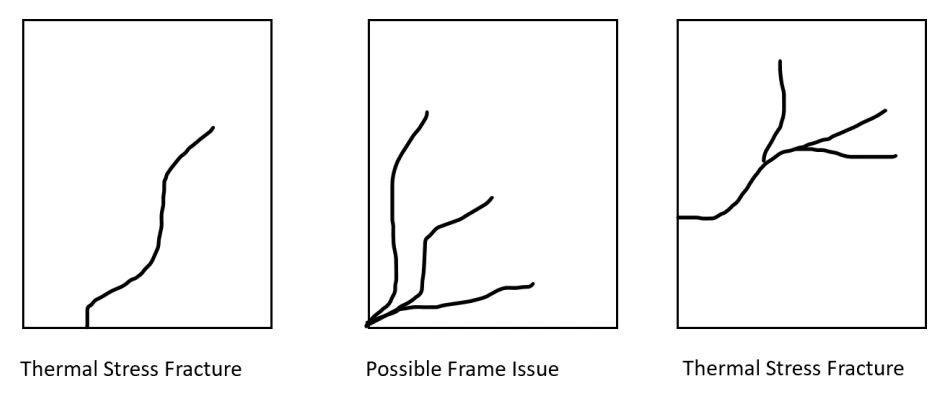
Figure: example glass fracture patterns, IWFA Figure 2.3, page 24.
The manual also describes rare spontaneous breakage associated with nickel-sulfide inclusions in tempered glass, distinct from impacts and thermal stress. A conclusion requires inspection and site evidence. [Pages 22–23]
The manual cautions against installing interior solar-control film on exterior-facing wired glass because of breakage risk. Patterned or textured glass may not offer a sufficiently smooth bonding surface; inspect the smooth face and the intended product. Acrylic and polycarbonate can outgas, expand differently from film and scratch during removal, so use only film specifically approved for that material. [Pages 45–46]
Skylights and sloped glazing require attention to overhead work, laminate construction, weather exposure and standing water on exterior film. Louvres expose film edges to weather. Large or thick panes need assessment of both installation forces and thermal risk. [Page 46]
For an IGU, document each pane’s glass type and thickness, coating position, cavity or gas fill, dimensions, orientation, shading and the film’s absorption. Request a film-to-glass compatibility assessment from the manufacturer or a qualified specialist. Do not apply highly absorbing automotive film to architectural glazing without confirmation that the combination is suitable. [Page 47]
15 · CHECKLISTChecklist before selecting film
- Identify the existing glass, thickness, coatings and insulating construction.
- Record orientation, sunlight exposure and shade from nearby structures or overhangs.
- Set priorities for comfort, glare, views, privacy and daylight.
- Compare SHGC, TSER, VLT and U-value under equivalent test conditions.
- Request a thermal-stress and film-to-glass compatibility assessment.
- Review product documentation and warranty scope for the proposed system.
Applying the guide to MAXXMA solutions
MAXXMA’s linked product database includes REFINED CERAMIC METALLIZE. Start by surveying the actual glass and the space’s needs, then compare the documented performance of suitable variants. Do not select from colour or a sample image alone.
Prepare glazing details, photographs, sun exposure and the problem observed on site for the MAXXMA team. Explore MAXXMA architectural film and the energy calculator. Calculator results are estimates based on stated assumptions, not a guarantee of actual building savings.
17 · FAQFrequently asked questions
Does a darker film always reject more heat?
No. Darkness primarily concerns visible light. Compare the SHGC and TSER of the actual glazing systems under equivalent conditions.
Is the lowest SHGC always the best choice?
Not necessarily. Daylight, views, room use and existing glass should also be considered.
Why assess thermal stress if the glass has never broken?
Film can change absorption and heat flow. A compatibility assessment helps evaluate temperature differences before installation.
Can TSER values from different product sheets be compared directly?
Only when the reference glazing and test conditions are comparable. Ask the supplier to clarify the data if they are not stated.
References
- International Window Film Association (IWFA). Flat Glass-Solar Education Guide. 2023. Original PDF.
Figures are reproduced from the IWFA guide for educational reference, with page and figure identifiers in their captions.
Ready to protect your home or vehicle?
Consult with MAXXMA experts to select the perfect film for your needs, or find an authorized dealer near you.