

01 · The Luxury Penthouse Incident: A Loud “Crack!” and the Mystery of Broken Glass from the Wrong Film
On a sunny Sunday afternoon over the Chao Phraya River, Kittisak, CEO of a tech company, was sipping coffee in his luxury penthouse in Charoen Nakhon. The massive floor-to-ceiling float glass (3.5 meters high) providing a panoramic city skyline view turned into a massive heat conductor, forcing the tens of thousands of BTU air conditioning system to work hard all day.
Seeking an urgent solution, Kittisak hired a general installer team to apply “premium ceramic car film” left over from his favorite sports car to the penthouse windows. The installer assured him, “This black ceramic film is dark outside, clear inside, and rejects up to 95% of heat in cars. It will definitely work for your house windows.”
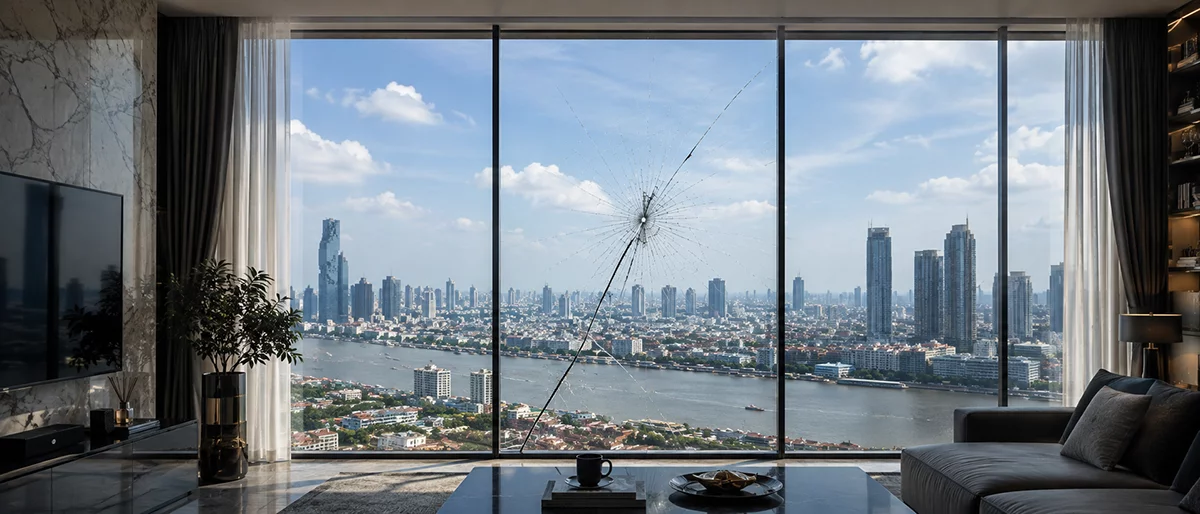
For the first two weeks, the results seemed perfect. Glare was noticeably reduced, and the room felt highly private. But one afternoon, when the outside temperature hit 39°C and direct sunlight struck the glass, a sharp, deep “Crack!” echoed through the living room.
Upon inspection, Kittisak found a massive spiderweb thermal crack running diagonally from the bottom edge of the large glass pane to the center, without any signs of external impact. This event was not a matter of bad luck or poor-quality glass, but a direct physical result known as Thermal Stress Breakage. This occurs when an automotive window film with high heat absorption is installed on architectural glass not designed to handle it.
The crucial material science question homeowners, building managers, and automotive enthusiasts must fully understand is: Why does a film that works brilliantly on car windows become the “trigger” that destroys building glass? And in today’s world, is there a window film technology that can overcome this limitation to be perfectly utilized in both worlds?
02 · The Material Science of Glass: Why Do Automotive and Architectural Glass Behave So Differently?
To understand the root of the problem, we must consider the micro-structure and mechanical load-bearing capacity of both glass types, according to guidelines and standards from global institutes like ASHRAE (American Society of Heating, Refrigerating and Air-Conditioning Engineers) and NFRC (National Fenestration Rating Council).
1. Automotive Glass (Automotive Tempered & Laminated Glass) — High Thermal Stress Tolerance
Glass used in the automotive industry is primarily divided into two types: Tempered Glass for side and rear windows, and Laminated Glass for the windshield.
During the tempered glass manufacturing process, clear glass sheets are heated up to 650–700°C and then rapidly cooled with forced air (Quenching). This process causes the outer glass layer to contract, creating massive Compressive Stress around the glass surface (up to 69–100+ MPa or over 10,000 psi), while the inner core experiences Tensile Stress.
The special properties of automotive tempered glass include:
- Temperature Differential Tolerance (ΔT): It can handle a temperature difference between the hottest and coldest points on the glass pane of over 150°C – 200°C without breaking.
- Convective Cooling: While the car is moving, wind constantly hitting the glass surface helps dissipate the heat absorbed by the film and glass back into the atmosphere rapidly.
Physical Safety Mechanism on Automotive Glass (Automotive Convective Cooling Flow)
2. Architectural Glass (Architectural Annealed Float Glass & IGUs) — Vulnerability to Accumulated Heat
In contrast, most architectural glass installed in condominiums, residential homes, or standard office buildings is Annealed Float Glass or Insulated Glass Units (IGUs).
Float glass is manufactured by cooling it slowly to relieve internal stress, making it easy to cut, but it lacks the Compressive Stress Layer for surface protection found in tempered glass. Furthermore, edge cutting in factories or on-site often leaves Micro-Flaws/Micro-Cracks along the glass edge hidden inside the aluminum frame.
When considering thermal conditions per ASHRAE:
- Temperature Differential Limit (ΔT Safe Limit): Standard float glass can only tolerate a temperature difference on the same pane of 35°C – 40°C. If the center of the glass exceeds the edge temperature beyond this limit, the glass will immediately experience Thermal Stress Breakage.
- Stationary Boundary Layer: Building glass is stationary. On sunny, windless days, the air around the glass becomes a Thermal Boundary Layer, preventing the heat absorbed by the film from dissipating, transferring it directly back into the float glass.
Thermal Stress Breakage Crisis When Using Heat-Absorbing Film on Building Glass
Solar energy strikes conventional car film installed on building glass
Film absorbs high heat and transfers massive thermal energy into Annealed Float Glass
Creates massive expansion pressure pushing toward edges
Aluminum frame blocks sun, keeping edge cool
Critical Temperature Differential Achieved ΔT > 45°C
Exceeds max safe limit for architectural float glass (Annealed Glass Safe Limit = 35°C)
3. Solar Absorptance vs Solar Reflectance
Standards from IWFA (International Window Film Association) and NFRC clearly state that solar energy consists of 3 main components:
- Ultraviolet (UV): 300–380 nm range (approx. 3% of energy)
- Visible Light (VLT): 380–780 nm range (approx. 44% of energy)
- Near Infrared (NIR): 780–2500 nm range (approx. 53% of energy)
Standard-grade automotive films often use IR Absorbers, such as organic dyes or carbon particles, to absorb infrared radiation into the film. This is safe for car windows because wind helps dissipate the heat. However, when this high heat-absorbing film is applied to building float glass, the accumulated heat causes the center of the glass to exceed 80°C, while the edges embedded in the aluminum frame remain cool. The Tensile Stress at the glass edge skyrockets beyond tolerance, eventually tearing the pane apart.
03 · Shouldering with Installers: Dismantling the Myth “Car and Building Films Must Be Strictly Separated”
In the professional window film installer community, a teaching passed down for decades is: “Car film is for cars, building film is for buildings. Never mix them up!”
We must respect and acknowledge that this mindset is absolutely correct when referring to “legacy films” or “standard market grade films” because both types were designed for entirely different physical scenarios:
1. Adhesive Technology Matrix Differences
According to IWFA standards, window films primarily use 2 types of adhesives:
- Pressure-Sensitive Adhesive (PSA) in conventional car films: A highly tacky adhesive with strong initial grip upon pressure. It is designed to allow installers to heat shrink the film easily to match the curved shape of car windows. However, older PSA adhesives tend to be thicker, which can cause optical distortion when applied to large, flat building glass, or react with glass cleaners to form an orange peel effect over time.
- Water-Activated / Crystal-Dry Film (CDF) in conventional building films: A dry adhesive requiring water to activate the chemical reaction. It offers the highest optical clarity (Zero Optical Distortion) without ripples, ideal for flat building glass. But the adhesive lacks the flexibility to be heat-shrunk onto curved front or rear car windshields.
Material Science Limitations Comparison of Legacy Window Films
Legacy Matrix| Properties | Legacy Automotive Film | Legacy Architectural Film |
|---|---|---|
| Adhesive System | PSAPressure-Sensitive (Focuses on tackiness, flexibility, and shrinking) | CDFWater-Activated (Focuses on optical clarity) |
| Thermal Dynamics | High Absorptive | High Reflective |
| Heat Formability | ✓ Heat Shrinkable | ✕ Rigid Structure (Cannot be heat shrunk) |
| Risk on Architectural Float Glass | ⚠️ Very High (Thermal Stress Crack Risk) | ✅ Safe (Low Solar Absorptance) |
2. A New Era: Myths That Cannot Keep Up With Nano Material Science
While the traditional installer’s teachings were true in the past, in modern material science, this paradigm has become an outdated mindset.
The reason these old limitations have been shattered isn’t because installers were wrong, but because Nano-Material Cross-Platform Engineering can now create modern window films with high heat reflection properties typical of building films, while retaining the flexibility, dark privacy, and easy heat shrinkability of automotive films.
Sticking to old rules without embracing advanced material science innovations causes consumers to miss out on utilizing the most effective window films for protecting both vehicles and architectural properties.
04 · MAXXMA Breakthrough: When Architectural Durability Merges With Automotive Elegance
At MAXXMA, we refuse to accept traditional technological constraints. Our material engineering team asked a crucial question: What if we designed a window film starting with the rigorous durability standards of “architectural glass”, and then evolved that structure to be flexible, beautiful, and elegant for “luxury vehicles”?
This is the genesis of MAXXMA Cross-Platform Technology that powers our core product series, including MAXXMA Black Panther, MAXXMA Polarized, and MAXXMA Independent Plus.
1. Nano-Scale Film Architecture (Inorganic Multi-Sputtered Matrix)
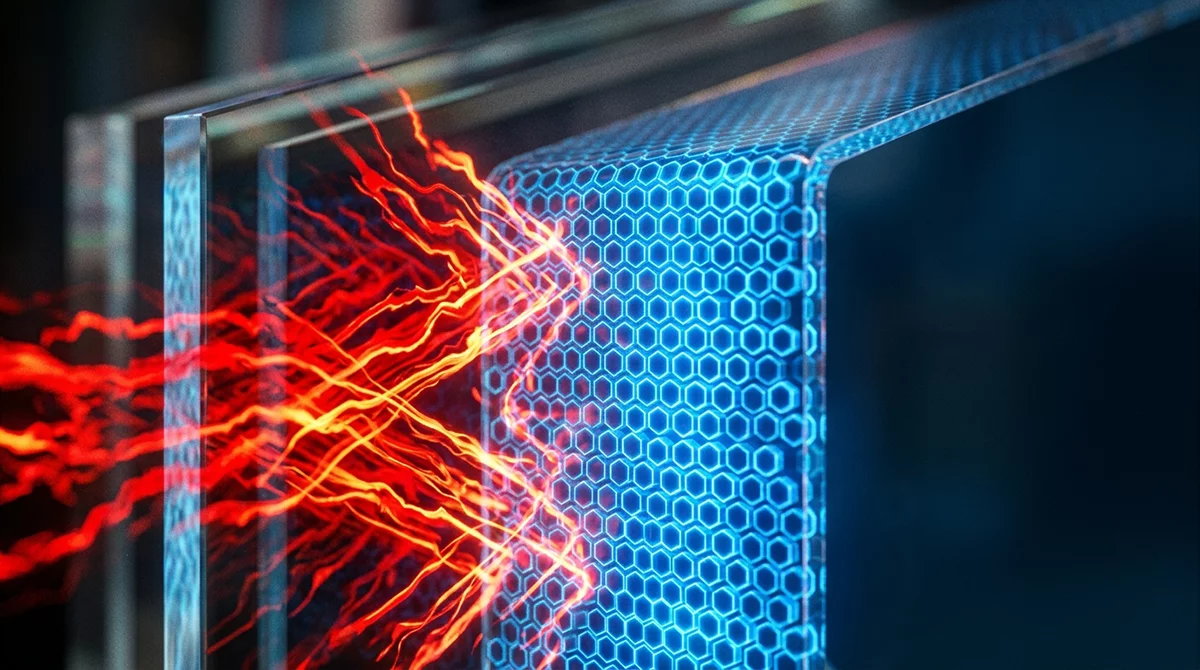
Instead of using organic heat absorbers that degrade easily, MAXXMA utilizes Magnetron Sputtering technology to layer nano-scale transition metals and ceramic particles onto an Optical Grade PET Substrate.
- Spectrally Selective Reflection: True nano-ceramic particles act as “heat wave reflecting prisms” that specifically target and cut out Near-Infrared (NIR) and Ultraviolet (UV) rays, while allowing visible light to pass through according to the desired VLT.
- Low Absorption Coefficient (Ae < 42%): By shifting the mechanism from “heat absorption” to “surface rejection and reflection”, MAXXMA films have a very low heat accumulation rate on the glass, decisively overcoming the Thermal Stress Breakage risk on float architectural glass.
2. Hybrid Cross-Linked Dual-Purpose Adhesive System
MAXXMA has researched and developed a specialized Hybrid Cross-Linked PSA/CDF adhesive system that combines the strengths of both worlds:
- Ultra-High Optical Clarity: Delivers crystal-clear HD vision with zero distortion, even when installed on massive architectural glass facing narrow glare angles.
- Thermo-Flexible Shrinkability: Provides perfect adhesion and elasticity, easily conforming via heat shrinking to the curved glass of supercars and EVs seamlessly without bubbles.
- UV-Stabilized Durability: The adhesive layer contains UV Inhibitors, preventing it from drying, cracking, peeling, or turning orange, even after decades of intense sun exposure.
3. The Comparison Equation: Over-Engineered for Cars
It’s analogous to installing an aerospace-grade titanium engine into a sports car. When a window film designed to endure 24/7 scorching sun on stationary building glass for 10–15 years is applied to automotive glass:
The MAXXMA Innovation Fusion Equation
- Max TSER up to 80%+ with no heat retention on the glass
- HD Night-Vision clarity from inside the vehicle or a dark room
- No shrinking, bubbling, or turning purple throughout its 7-10 year lifespan
The result is massive Over-Engineered performance. Your car receives a thermal defense system that not only rejects up to 99% of NIR radiation but also boasts a long lifespan, doesn’t fade or shrink, and provides vastly superior night driving clarity compared to conventional car films on the market.
1. Color Stability Differences (Inorganic Color Stability vs Dye Fading)
Standard window films often mix Organic Dyes to achieve a dark, aggressive look. However, the chemical bonds of organic dyes are quickly destroyed by UV-A and UV-B rays, causing the film to experience Purple Shift within 2–3 years and continuously lose heat rejection performance.
MAXXMA exclusively utilizes an Inorganic Nano-Ceramic Matrix, possessing highly stable crystalline bonds that do not react with sunlight and heat. Thus, the MAXXMA Black Panther and MAXXMA Polarized series maintain their intense black color, clarity, elegance, and consistent heat rejection performance for a lifespan spanning decades.
2. Digital Signal Perfection (100% Signal Pass-Through Guarantee)
Older metallized films may offer good heat reflection, but their reflective metal layers act as a Faraday Cage, severely obscuring and blocking high-frequency radio waves.
In today’s era where Electric Vehicles (EV) and Smart Homes rely on constant connectivity, MAXXMA has engineered the nano-ceramic structure of its metal-free series (such as MAXXMA Polarized) to be Non-Conductive & Non-Interfering (the exception is MAXXMA Refined automotive film, a Ceramic Metallized film that contains metal and affects GPS and Easy Pass, most of all in MX-BL05, MX-BL20 and MX-CG05):
- No EasyPass / M-Flow Issues: 100% RFID signal pass-through without needing to cut holes in the film.
- GPS & 5G Stability: Supports high-precision navigation and wireless connectivity inside the cabin or home with Zero Signal Attenuation.
- Safe for ADAS: Does not interfere with modern vehicle safety cameras and radar systems.
3. Redefining Value: True TSER (Total Solar Energy Rejected)
Consumers are often misled by claims like “99% heat rejection,” which in reality usually only refers to Infrared Rejection (IRR) across a narrow wavelength band. But the NFRC and global energy experts measure true performance using TSER (Total Solar Energy Rejected).
TSER = (Solar Reflectance) + (Solar Absorptance × Inward Heat Re-radiation Factor)
All MAXXMA films are tested according to NFRC 100/200 standards, displaying accurate TSER values that account for UV, visible light (VLT), and infrared (IR). This ensures that every square inch of MAXXMA film applied to your car or building glass acts as a genuine heat shield, reducing A/C load, minimizing internal heat retention, and effectively saving electricity or EV battery power.
06 · Executive Summary: 3 Material Science Forms Comparison Table
A deep-dive summary of the differences between window film types to assist your investment decision for your home, commercial building, and beloved vehicle:
Heat Control StructureOrganic Dyes + NIR Absorber (Dye/IR Absorber)
Thermal Stress Risk on Building Glass🔴 Very High (Risk of float glass cracking)
Heat Management MechanismHeat Absorption within the film (Heat Absorption)
Adhesive & BondingLegacy PSA (May cause ripples on flat glass)
5G / GPS / EasyPass Pass-Through🟡 Medium (May interfere if metal layer exists)
Color Stability (Color Fading)🔴 Fades and turns purple in 2-3 years
Versatility & ApplicationOnly for automotive tempered glass
Heat Control StructureMetallized Coating / Reflective Metal (Metallized PET)
Thermal Stress Risk on Building Glass🟢 Low (Calculated for low Absorptance)
Heat Management MechanismMirror Reflective (Mirror Reflective)
Adhesive & BondingDry CDF (Low flexibility, cannot be heat shrunk)
5G / GPS / EasyPass Pass-Through🔴 Low (Reflects and blocks radio waves)
Color Stability (Color Fading)🟡 Can develop edge oxidation/rust over time
Versatility & ApplicationOnly for flat architectural float glass
Heat Control StructureMulti-Sputtered Inorganic Nano-Ceramic Particles
Thermal Stress Risk on Building Glass🟢 Very Low (NIR Reflection + Low Absorptance)
Heat Management MechanismSpectral Selective Rejection
Adhesive & BondingHybrid Cross-Linked (HD clarity + smooth heat shrinking)
5G / GPS / EasyPass Pass-Through🟢 100% Pass-Through (No metal interference)
Color Stability (Color Fading)🟢 Does not fade, stays dark black for 7-10 years
Versatility & Application🟢 Perfect for both vehicles and luxury buildings
07 · Frequently Asked Questions (FAQ)
Q1: Can MAXXMA Polarized film be safely installed on condominium or residential glass?
It can be installed 100% safely. The MAXXMA Polarized Series is engineered on an Architectural Grade Substrate utilizing inorganic spectral-selective nano-ceramic coatings. This results in a Solar Absorptance rate lower than the danger threshold, preventing Thermal Stress Breakage on architectural float glass while providing high privacy, elegance, and outstanding heat rejection.
Q2: Why is applying standard car film to building glass a Thermal Stress Breakage risk?
Most building glass is Annealed Float Glass, which can only tolerate a temperature differential (ΔT) of 35°C – 40°C on the same pane. Standard car films use IR Absorbers to hold heat within the film. When applied to stationary building glass with no convective cooling, the accumulated heat causes the center of the glass to rapidly expand while the frame-bound edges stay cool. This creates massive tensile stress beyond its limits, cracking the glass from the inside.
Q3: What’s the difference between TSER (Total Solar Energy Rejected) and IR Rejection (IRR), and why do experts emphasize TSER?
IR Rejection (IRR) is the percentage of infrared radiation blocked across specific wavelengths (accounting for about 53% of solar heat), which can sometimes be artificially manipulated with heat absorbers. But TSER (NFRC standard) measures the rejection of total solar energy (including UV, visible light, and IR) by factoring in both reflection and re-radiation mechanisms. Therefore, TSER is the most accurate and genuine indicator of true heat rejection performance.
Q4: Does MAXXMA window film affect digital signals, EasyPass, or GPS in cars and Smart Homes?
It depends on the series. MAXXMA nano-ceramic series such as MAXXMA Polarized utilize Non-Conductive Nano-Ceramic particles completely free of metal layers. This allows high-frequency radio waves, microwaves, GPS satellites, 5G, Wi-Fi, M-Flow digital keys, and EasyPass signals to pass through flawlessly without any blockage or attenuation. MAXXMA Refined automotive film (Ceramic Metallized) contains metal, so it affects GPS navigation and Easy Pass toll payment, most of all in the high-metal codes MX-BL05, MX-BL20 and MX-CG05.
08 · Conclusion & Elevate Your Experience: Consult MAXXMA Experts for Limitless Protection
Choosing window film for a luxury vehicle or premium residence is more than just selecting a dark shade or comparing price per square foot; it is an investment in advanced material science to protect your assets, reduce energy consumption, and provide maximum safety for occupants.
With MAXXMA Cross-Platform Materials Science technology, you no longer need to be trapped in legacy myths. MAXXMA window film products deliver the heat rejection performance of high-rise building standards coupled with the clarity, beauty, aggressive darkness, and elegance of world-class automotive standards.
Elevate your comfort and asset durability today
Get in-depth consultation, architectural glass risk assessments, or test MAXXMA window film performance with our specialized experts for free.🔹 For Individual Customers / Car & Condo Owners (B2C):
For more information and installation appointments via LINE Official: Consult MAXXMA B2C Experts (@maxxma)🔹 For Dealers, Architects, and Project Contractors (B2B Dealer):
Contact our project sales team to request film testing samples: Contact MAXXMA B2B Project Sales (@knx5503n)
09 - References
Ready to protect your home or vehicle?
Consult with MAXXMA experts to select the perfect film for your needs, or find an authorized dealer near you.