
The Hidden Risks of Glass Houses: When Open Architecture Meets Material Fragility
Contemporary glass house architecture and luxury residences frequently incorporate floor-to-ceiling glass facades. Expansive glazing captures panoramic garden views, invites abundant natural daylight, and creates seamless indoor-outdoor living spaces that elevate everyday wellbeing.
However, beneath this aesthetic elegance lies an engineering reality: glass possesses inherent material brittleness. For households with young children, elderly family members, or energetic pets, unexpected hazards are an ongoing concern:
- Accidental collisions from running children or heavy toys striking glass panes with high velocity.
- Severe weather events such as tropical windstorms, falling tree branches, or flying airborne debris.
- Thermal stress fractures caused by temperature differentials between shaded glass edges and sun-drenched center panes.
- Forced entry and burglary vulnerabilities at ground-floor glass entryways.

When glass breaks, the greatest danger is rarely the initial crack itself. The critical hazard is falling, scattering glass shards, which can cause severe lacerations in a fraction of a second. Understanding glass anatomy and taking proactive safety measures is fundamental for every modern homeowner.
Real-life event: Strong wind gusts blow a residential window loose, nearly striking an elderly resident (Source: Ch7HD News).
Glass Anatomy: How Annealed, Tempered, and Laminated Glass Differ Under Impact
Before designing an effective safety strategy, we must examine how various architectural glass types behave upon impact according to international materials standards:
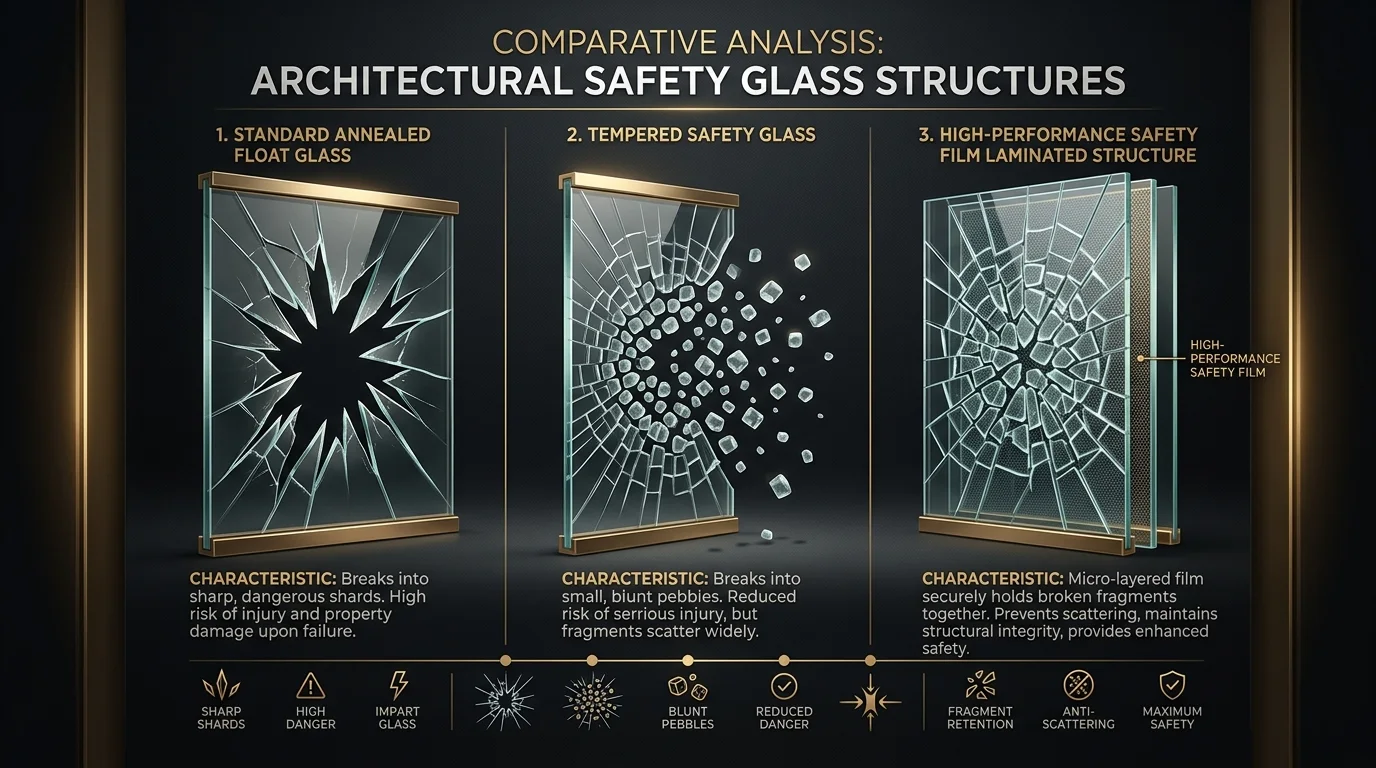
1. Standard Annealed Float Glass
Standard float glass is manufactured through slow cooling. It provides basic structural strength based on thickness. However, when impact exceeds its load threshold, it shatters into large, razor-sharp jagged shards. These heavy shards pose life-threatening hazards if they fall from elevated heights onto occupants below.
2. Fully Tempered Safety Glass
Tempered glass undergoes extreme thermal processing exceeding 650 degrees Celsius followed by rapid air quenching, creating strong compressive surface stress. While 4 to 5 times stronger than standard float glass, its fracture behavior causes the entire sheet to crumble into small, blunt granular dice. Although this reduces deep cuts, spontaneous breakage can cause the entire glass sheet to instantly collapse to the floor, leaving an open building envelope and potentially raining heavy granules onto nearby occupants.
3. Laminated Glass and Safety Window Film Retrofit
- Factory Laminated Glass: Two sheets of glass bonded together with an interlayer of Polyvinyl Butyral (PVB). When broken, shards adhere firmly to the interlayer without falling.
- Safety Window Film Retrofit: The most cost-effective and non-invasive solution for existing homes, eliminating the need to replace entire window assemblies. High-tensile safety film (4 Mil to 8 Mil thick) coated with a heavy-duty polymer adhesive acts as an elastic retention shield, holding broken shards locked in place even after severe structural fractures.
The Science of Safety Film: How High-Tensile PET Holds Broken Glass Together
Architectural safety and security film differs fundamentally from standard decorative or solar control film in both molecular construction and material gauge:
Premium anti-scratch coating that resists daily cleaning friction, maintaining crystal-clear optical transparency for years.
Specialized polyester matrix with tensile strength exceeding 25,000 PSI, engineered to absorb and dissipate violent impact shockwaves.
Thick, optically clear Pressure-Sensitive Adhesive that forms a deep molecular bond with the glass substrate, locking fragments in place.
When an impact fractures the glass pane, kinetic energy spreads outward across the elastic PET film surface. The high-bond PSA adhesive holds every fractured shard in place, preventing hazardous fragments from dislodging and causing injuries.
Science vs. MythScience vs. Myth: 4 Common Misconceptions About Architectural Glass Safety
To help homeowners make informed architectural decisions, let us evaluate the 4 most frequent safety misconceptions:
| Common Myth | Engineering Reality and Practical Application |
|---|---|
| Myth 1: Safety film makes glass 100% unbreakable and completely shatterproof. | Reality: No film can defy material physics to make glass unbreakable. Glass can still crack under excessive force. The primary purpose of safety film is fragment retention, ensuring sharp shards remain anchored together without raining down. |
| Myth 2: Modern homes equipped with tempered glass do not need safety film. | Reality: When tempered glass fractures (whether from impact or spontaneous nickel-sulfide inclusion stress), the entire pane disintegrates and collapses instantly. Applying safety film over tempered glass keeps the granules locked into a single cohesive sheet. |
| Myth 3: Standard solar control tint provides the same safety protection as safety film. | Reality: Standard solar tint is only 1.5 to 2 Mil thick, engineered strictly for heat and glare reduction. True architectural safety films start at 4 Mil to 8 Mil with 3 to 5 times higher tensile strength and thicker impact adhesives. |
| Myth 4: Safety film stops burglars completely like heavy steel security grilles. | Reality: Safety film serves as an intrusion delay mechanism. Intruders must strike the glass repeatedly, creating loud noise and losing precious time, which often prompts them to flee or triggers security alarms. |
The Importance of Installation Craftsmanship and Edge Anchoring Systems
The ultimate performance of safety film relies not only on film quality, but also on expert installation and perimeter frame anchoring:
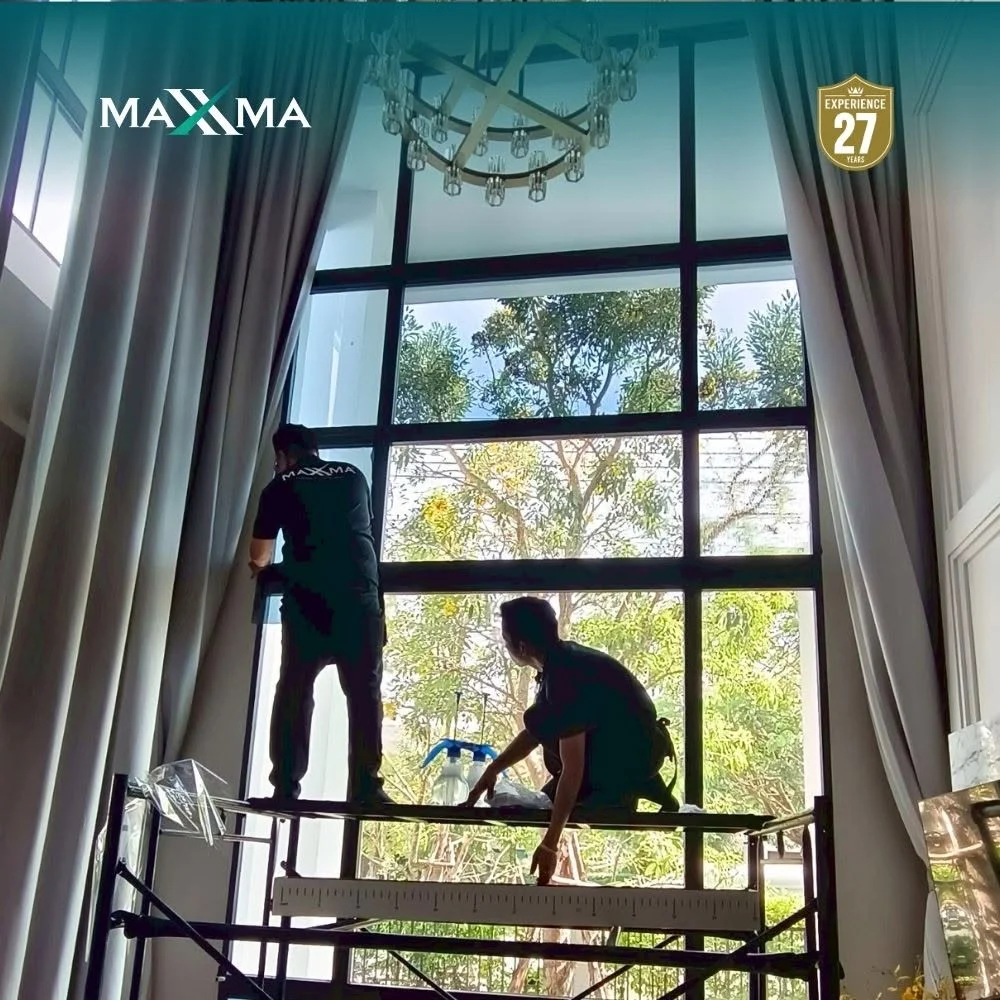
- Daylight Installation (Standard Glazing Boundary): The film is trimmed 1 to 2 millimeters from the rubber gasket. This standard method provides excellent shard retention against accidental residential impacts.
- Wet-Glaze Anchoring (Structural Silicone Attachment): High-strength structural silicone sealant is applied along the seam connecting the safety film directly to the aluminum window frame. If the glass shatters, the entire pane remains securely anchored to the perimeter frame, preventing the whole panel from blowing out during storms.
- Certified Installation Expertise: Applying heavy 4 Mil to 8 Mil films demands high-pressure water extraction techniques to prevent trapped moisture pockets and allow the high-bond adhesive to cure to full laboratory-rated strength.
MAXXMA Window Film Specification Matrix for Safety and Thermal Rejection
For homeowners seeking both certified safety protection and superior solar heat rejection:
| Film Series (Model) | Film Category | Thickness | UV Rejection | IR Rejection | Total Solar (TSER) | Safety and Retention Performance |
|---|---|---|---|---|---|---|
| MAXXMA Safety 4 Mil | Clear Architectural Safety | 4.0 Mil | 99% | 20% | 25% | Standard fragment retention for homes and condominiums |
| MAXXMA Safety 8 Mil | Heavy-Duty Clear Safety | 8.0 Mil | 99% | 25% | 30% | High-impact resistance, intrusion delay, and windstorm protection |
| Polarized MX-PR05 | Nano-Ceramic Safety Hybrid | 2.0 Mil | 99% | 99% | 97% | Maximum 99% IR rejection with high tensile shard retention |
| Polarized MX-PR20 | Nano-Ceramic Safety Hybrid | 2.0 Mil | 99% | 99% | 91% | Glare reduction, superior heat control, and daytime privacy |
| Polarized MX-PR40 | Nano-Ceramic Safety Hybrid | 2.0 Mil | 99% | 99% | 82% | Medium neutral tone, clear views for sunlit living rooms |
| Polarized MX-PR60 | Nano-Ceramic Safety Hybrid | 2.0 Mil | 99% | 99% | 73% | High visible light transmittance showcasing lush garden views |
| Black Panther MX-BP05 | Nano-Carbon Ceramic | 1.5 Mil | 99% | 90% | 91% | Deep stealth black privacy, reduces glare and accidental collisions |
| Refined MX-BL05 | Sputtered Metallized Ceramic | 1.5 Mil | 99% | 88% | 90% | One-way reflective daytime privacy with high solar rejection |
To consult with specialists and explore tailored safety film configurations, visit our MAXXMA Architectural Safety Window Films section.
Real InstallationReal Installation Showcase: Safety and Solar Control Demonstration
Explore real-world installations and product demonstrations presented by our master technicians:
On-site video showcasing MAXXMA safety films and architectural solar solutions for reinforced building protection.
5-Step Emergency Action Plan When Residential Glass Breaks
If an unexpected impact fractures a window pane in your home, follow these 5 safety steps immediately:
Secure the Area and Evacuate Children and Pets
Alert everyone in the house immediately and keep children, pets, and elderly family members at least 3 to 5 meters away from the damaged glass perimeter.
Do Not Touch or Pull Broken Glass with Bare Hands
Avoid pushing, pulling, or shaking fractured shards with bare hands. If moving nearby objects is required, always wear heavy leather gloves and eye protection.
Verify Whether Safety Film Is Holding the Glass
If safety window film is present, the broken shards will remain held in place. Leave the glass pane untouched in its frame to avoid disturbing the adhesive bond.
Photograph Damage for Insurance and Contractor Records
Take clear wide-angle and close-up photographs and video records of the fracture patterns for insurance claims and replacement measurements.
Contact Certified Glass and Window Film Technicians
Arrange for professional glazing technicians to safely remove the damaged pane, install a new glass panel, and apply certified safety film.
Frequently Asked Questions (FAQ)
Q1: Does safety window film prevent glass from cracking?
A: Safety film is not designed to guarantee that glass will never crack under extreme force. Instead, it serves as an engineered fragment retention matrix. The high-tensile PET substrate and specialized polymer adhesive bond firmly to the glass, preventing fractured pieces from falling or scattering dangerously.
Q2: Which window zones should be prioritized for safety film in homes with children?
A: Priority should be given to glass from floor level up to 1.5 meters in height. Key locations include sliding glass patio doors, floor-to-ceiling living room walls, glass balustrades, tempered glass shower enclosures, and hallway corridors.
Q3: How does clear safety film differ from standard clear solar control film?
A: Standard clear solar film focuses on UV and thermal reduction, typically measuring only 1.5 to 2 Mil in thickness. Dedicated safety films range from 4 Mil to 8 Mil thick, providing significantly higher tensile strength and tear resistance to withstand blunt impacts and anchor heavy glass loads.
Q4: Does applying safety film increase the risk of thermal stress breakage?
A: High-clarity clear safety films feature very low solar absorption, meaning they do not induce thermal stress on glass. When applying dark or high-absorption solar films to standard annealed glass, a certified technician should audit thermal stress compatibility prior to installation.
Q5: What is the lifespan and warranty of MAXXMA architectural safety films?
A: MAXXMA architectural safety films provide a durable service lifespan of 5 to 7+ years without yellowing, cracking, or delaminating, backed by official warranty coverage. Review warranty details at the MAXXMA Warranty Portal.
💬 Complimentary Consultation with MAXXMA Architectural Safety Specialists Need tailored advice on selecting safety film thickness, auditing glass risk zones, or requesting on-site measurements? Contact our engineering team directly on LINE Official: @maxxma
Talk to the MAXXMA team
and choose the right film for your project
References and Standards
- European Window Film Association (EWFA), Thermal Stress: Film-to-Glass Compatibility Guide: https://www.ngs.inc/wp-content/uploads/2017/12/GlassBreakageExplanation.pdf
- International Window Film Association (IWFA), Flat Glass Solar Control and Safety Education Manual: https://iwfa.com/wp-content/uploads/2024/04/Flat-Glass-Solar-Control-Education-Manual-1.pdf
- National Fenestration Rating Council (NFRC) and Lawrence Berkeley National Laboratory (LBNL), Applied Window Film Safety and Energy Ratings: https://efficientwindows.org/window-film/
- ASTM International, ASTM C1048 Standard Specification for Heat-Strengthened and Fully Tempered Flat Glass and ANSI Z97.1 Safety Performance Specifications for Glazing Materials: https://www.astm.org/
Ready to protect your home or vehicle?
Consult with MAXXMA experts to select the perfect film for your needs, or find an authorized dealer near you.