
When Tint Darkness Fails to Keep You Cool
Imagine taking delivery of your brand-new electric vehicle from the showroom. The silent acceleration, minimalist cockpit, and responsive digital dashboard make every minute behind the wheel feel like the future.
To prepare for tropical heat, you ask the dealer for the darkest film available:
“Give me the darkest 80% tint all around: that should keep it cool.”
Yet during your first midday drive along a congested expressway in 38°C heat, reality hits. Your right arm feels as if it is baking right through the door glass. Even with the climate control set to 20°C and fans humming at high speed, your forehead is warm. Most alarming of all: the battery percentage and remaining range on your instrument cluster are tumbling far faster than expected.
This is the hidden trap of conventional dyed film. While it darkens visible light to give the appearance of privacy, it provides minimal protection against infrared heat radiation. Visible light is shaded, but invisible heat rays pour unchecked into the vehicle. Your modern EV becomes a mobile greenhouse, forcing the climate control system to consume heavy battery power just to maintain baseline comfort.
Common Misconception: Darkness Equals Heat Rejection
Visible Light Transmission (VLT) measures how dark a film looks, not how much heat it rejects. An uncertified dark dyed film can let over 70% of solar heat pass through, while an advanced optical-grade ceramic film with light tint can deflect more than 90% of infrared heat.
Sunlight Is Not Just Light: The Spectrum Heating Your Cabin
To understand why conventional films fall short, we must examine how solar radiation reaches Earth. Solar energy is distributed across three primary electromagnetic spectrum bands:
Ultraviolet Rays: UV (3%)
Carries minimal thermal sensation, but causes severe sunburn, skin aging, and irreversible fading across leather seats, vinyl consoles, and interior textiles.
Visible Light (44%)
The light spectrum visible to human eyes. Contributes moderate heat and causes blinding glare that fatigues the driver and washes out digital screens.
Infrared Radiation: IR (53%)
The true thermal culprit. Infrared is completely invisible to the human eye, yet constitutes more than half of the total solar heat energy felt directly on your skin.
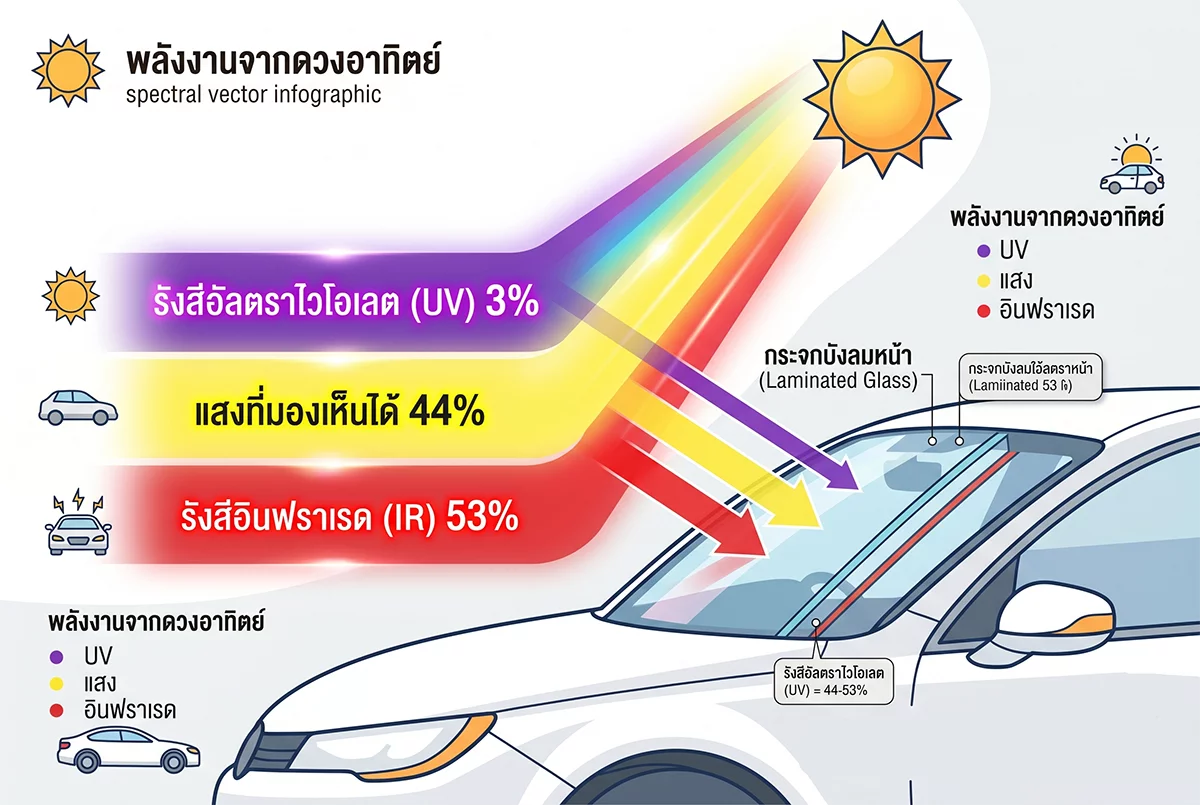
Traditional dyed films attempt to control heat solely by darkening the visible light band (44%). That leaves the dominant 53% of infrared energy pouring freely through your car windows. Darkening glass without addressing infrared radiation is why dark cars often remain unbearable in tropical heat.
METRICS THAT MATTERWhat Is TSER? The Single Metric That Matters
Rather than relying on isolated marketing metrics, international testing standards rely on TSER (Total Solar Energy Rejected).
Calculated in accordance with ASTM and NFRC testing standards, TSER accounts for:
- Reflected solar energy across UV, visible, and infrared bands
- Direct solar energy transmitted through the glazing
- Solar energy absorbed by the glass and film, including secondary heat radiation toward the cabin interior
A film advertising “99% IR rejection” measured at a single narrow wavelength may achieve an overall TSER of only 50% if it lets significant visible heat through. TSER gives you the true, verified percentage of total heat rejected by the combined glass assembly.
The Technological Breakthrough: Nano-Ceramic Particles
To protect an electric vehicle properly, solar film must block infrared energy without metallic layers. This is where Nano-Ceramic technology proves indispensable:
Microscopic, non-conductive ceramic nanoparticles (such as antimony tin oxide and customized metallic nitrides) are infused directly into the film matrix. These particles selectively absorb and scatter infrared radiation at molecular level while allowing radio frequencies to pass unimpeded.
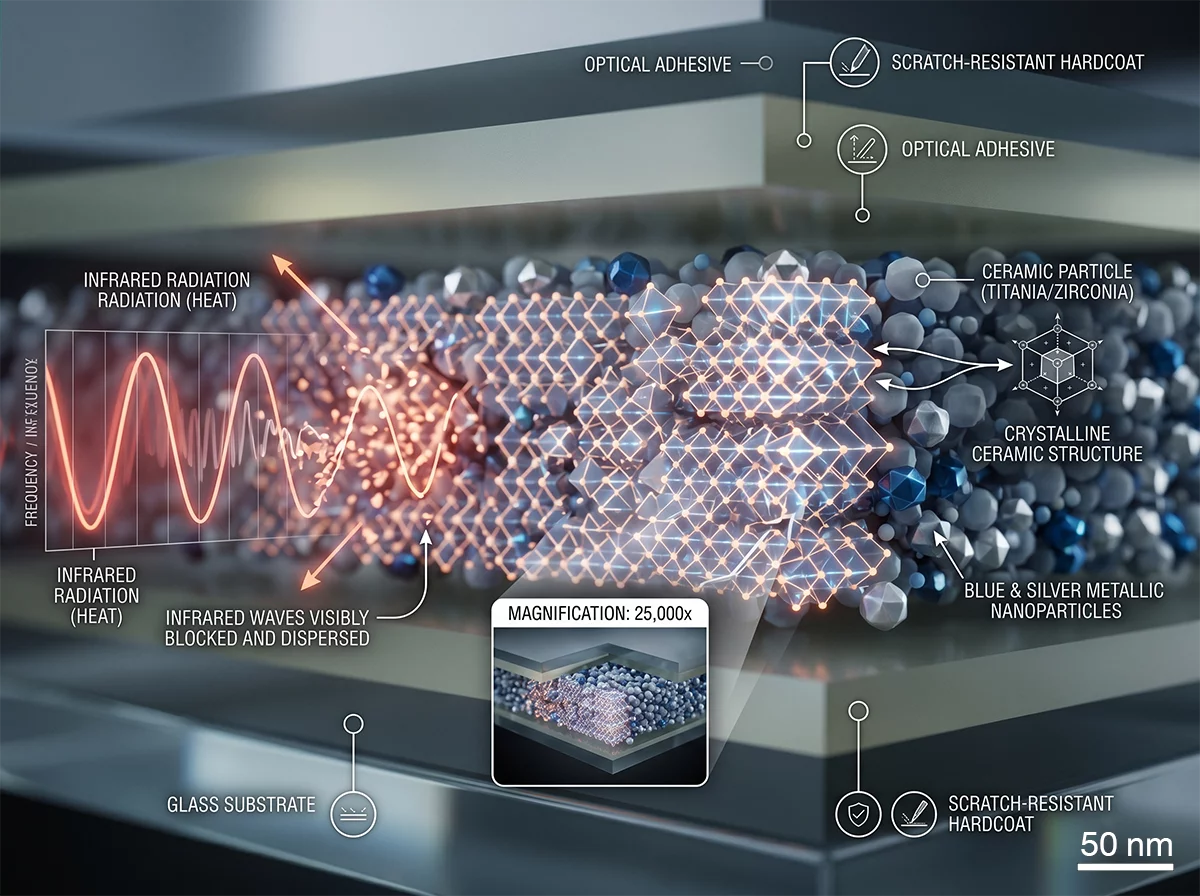
Because nano-ceramic films contain no metallic foil, they create zero electromagnetic interference. Your 5G cellular link, GPS navigation, tire pressure monitors, ADAS cameras, and keyless entry systems function with 100% precision.
EV EFFICIENCYEnergy Recovered: How High-Spec Film Restores EV Range
In a traditional internal combustion vehicle, the air conditioning compressor is driven mechanically by a belt connected to the gasoline engine. Surplus heat from fuel combustion masks how much energy cooling consumes.
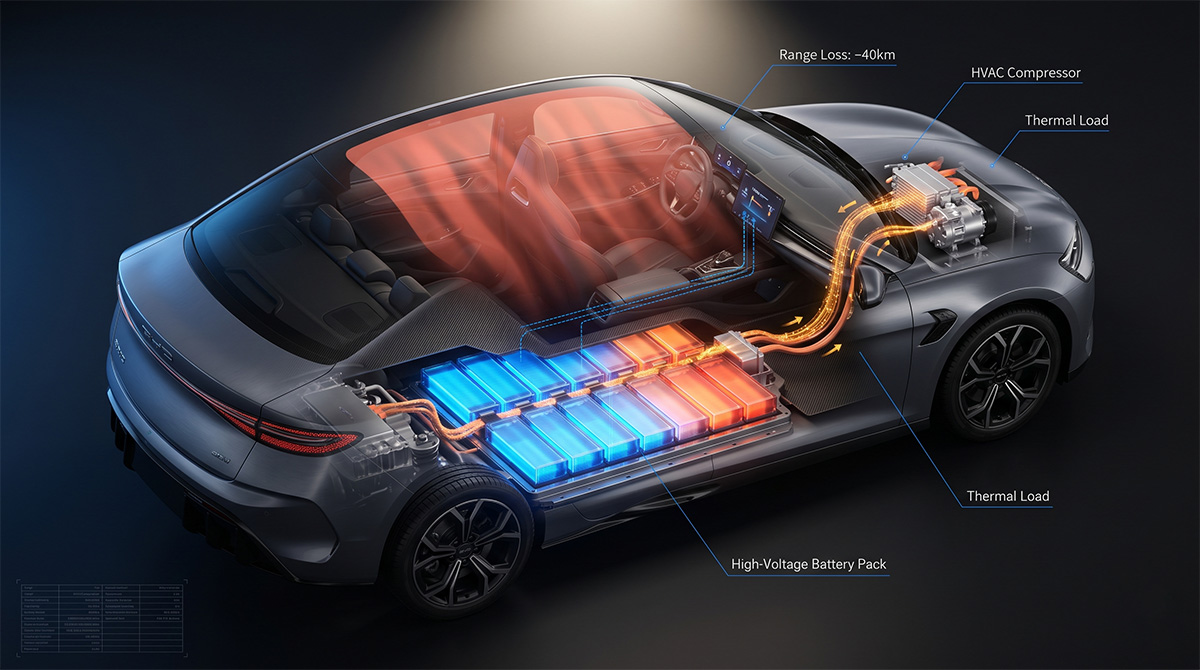
In an electric vehicle, the situation is completely different: every single watt counts. The high-voltage air conditioning compressor (HVAC) draws electricity directly from the same high-voltage traction battery pack that powers your drive motors.
The Physics of Cabin Range Drain
In extreme tropical sun, an EV climate system can consume 2 to 4 kWh per hour to combat incoming heat. During a two-hour stop-and-go commute in midday traffic, cooling alone can drain 4 to 8 kWh from the battery pack: roughly equivalent to losing 25 to 50 kilometers of driving range without the wheels rolling an extra meter.
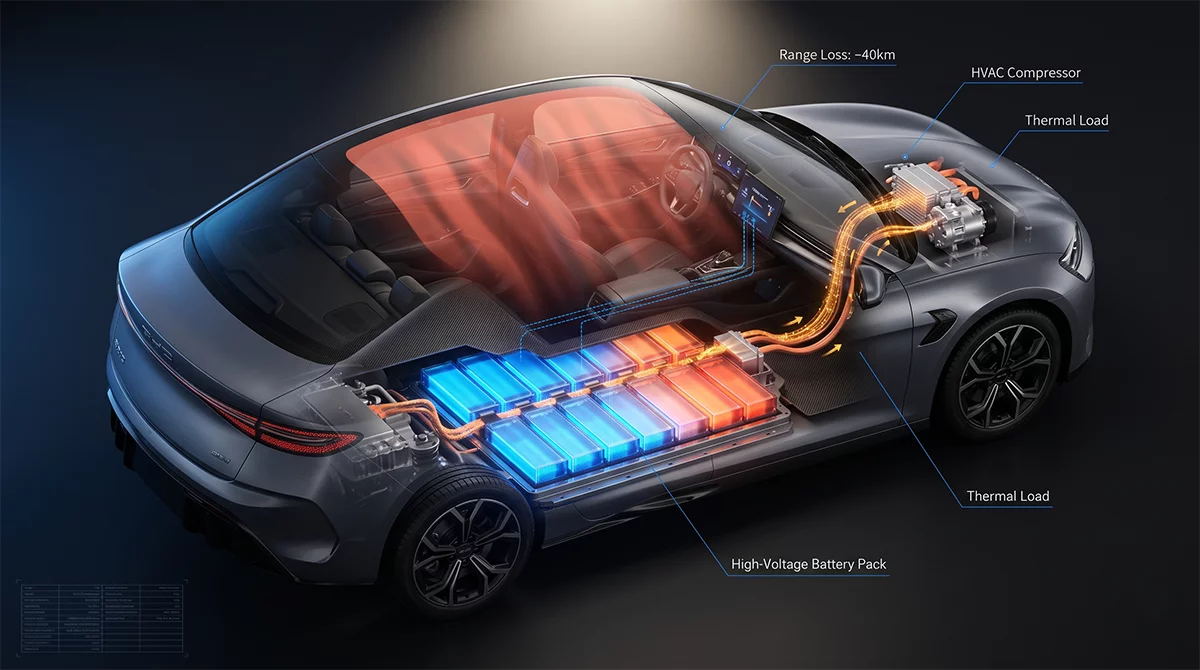
By installing high-TSER nano-ceramic film, solar heat gain is arrested at the glass surface. The cabin reaches target temperature within minutes, allowing the smart climate compressor to throttle back to an energy-saving maintenance mode.
TESTED PERFORMANCETested Heat Performance: The MAXXMA Standard
Laboratory heat lamp trials demonstrate the dramatic difference between standard tinted film and MAXXMA nano-ceramic formulations:
Watch the MAXXMA Thermal Demonstration
See calibrated thermal sensors record temperature differentials between ordinary glass and MAXXMA digital-friendly ceramic film.
Watch the MAXXMA Heat Test VideoProven Solutions for Electric Vehicle Owners
MAXXMA provides two specialized automotive film series engineered specifically for electric vehicles and connected smart cockpits:
MAXXMA Polarized
Flagship Pure Nano Ceramic film engineered for extraordinary optical clarity and maximum glare control, ideal for oversized EV windshields and digital cockpits.
- TSER up to 97%
- Infrared Rejection up to 99%
- Ultra-low interior reflection prevents dashboard glare
- 2 mil semi-safety thickness for added glass strength
MAXXMA Black Panther
Deep sporty black Nano Carbon Ceramic formulation combining high privacy with exceptional heat rejection and night clarity.
- TSER up to 91%
- Infrared Rejection up to 87%
- Distinctive dark exterior profile with crystal-clear view out
- Zero signal interference for 5G, GPS, and Easy Pass
Protecting Panoramic Glass Roofs: Clear Guard Sunroof
Many modern EVs come with massive, unshaded panoramic glass roofs that trap heat inside the cabin. Installing Clear Guard Sunroof Protection Film on the outside of the glass stops solar radiation before it ever enters the glass assembly, rejecting up to 90% of infrared heat while protecting the glass against stone chips.
Five Questions to Ask Before Tinting Your EV
Before scheduling an appointment with an installation shop, ask these five critical questions:
- Is the film 100% metal-free? Verify that the film uses pure ceramic or carbon technology so that it will never degrade GPS, cellular connectivity, or keyless functions.
- What is the certified TSER rating across the whole glass assembly? Request laboratory-tested TSER data, not just an isolated infrared rating at a single wavelength.
- Does the film control internal reflection? EVs feature large horizontal displays and windshield rake angles: low internal reflectivity is essential to prevent washed-out navigation screens.
- Does the shop have EV installation expertise? Electric vehicle cockpits house sensitive computers, ADAS modules, and micro-wiring behind the dashboard. Technicians must use proper moisture shields and battery tenders during the installation process.
- Is there an exterior roof solution? For panoramic roofs, ask about exterior thermoplastic polyurethane (TPU) protection to deflect heat before it conducts through the glass.
Frequently Asked Questions
Why does an 80% dark film still leave my car feeling hot inside?
Darkness measures the blockage of visible light (44% of solar energy). The remaining 53% of solar energy is invisible infrared radiation. If a dark film lacks an effective infrared-filtering ceramic coating, thermal energy will pass directly through the glass, heating your cabin regardless of how dark the windows appear.
Does ceramic window film interfere with GPS, 5G, or keyless sensors?
Authentic nano-ceramic film is completely non-conductive and metal-free. It has zero impact on GPS satellite communication, 4G/5G mobile data, Bluetooth, Easy Pass transponders, or smart key sensors, making it the ideal choice for connected vehicles.
How much driving range can a high-TSER film actually recover?
In hot tropical conditions, reducing cabin temperatures by 5°C can lessen HVAC electrical consumption by up to 1.5 to 2 kW per hour. On longer trips or in heavy traffic, this energy saving translates to an estimated 30 to 50 kilometers of preserved driving range per battery charge.
Should an EV panoramic sunroof be tinted from the inside or the outside?
Both approaches offer benefits. Installing an exterior TPU film like Clear Guard Sunroof reflects solar radiation before it enters the glass pane, preventing glass heat soak. Pairing it with a high-grade interior ceramic tint provides complete dual-shield protection against radiant heat and intense light glare.
Eliminate Tropical Heat and Maximize Your EV Range Today
Equipping your electric vehicle with high-performance window film is one of the most effective upgrades you can make. It protects your battery pack, extends real-world driving range, and ensures your journeys remain cool and relaxing.
Ready to protect your home or vehicle?
Consult with MAXXMA experts to select the perfect film for your needs, or find an authorized dealer near you.