
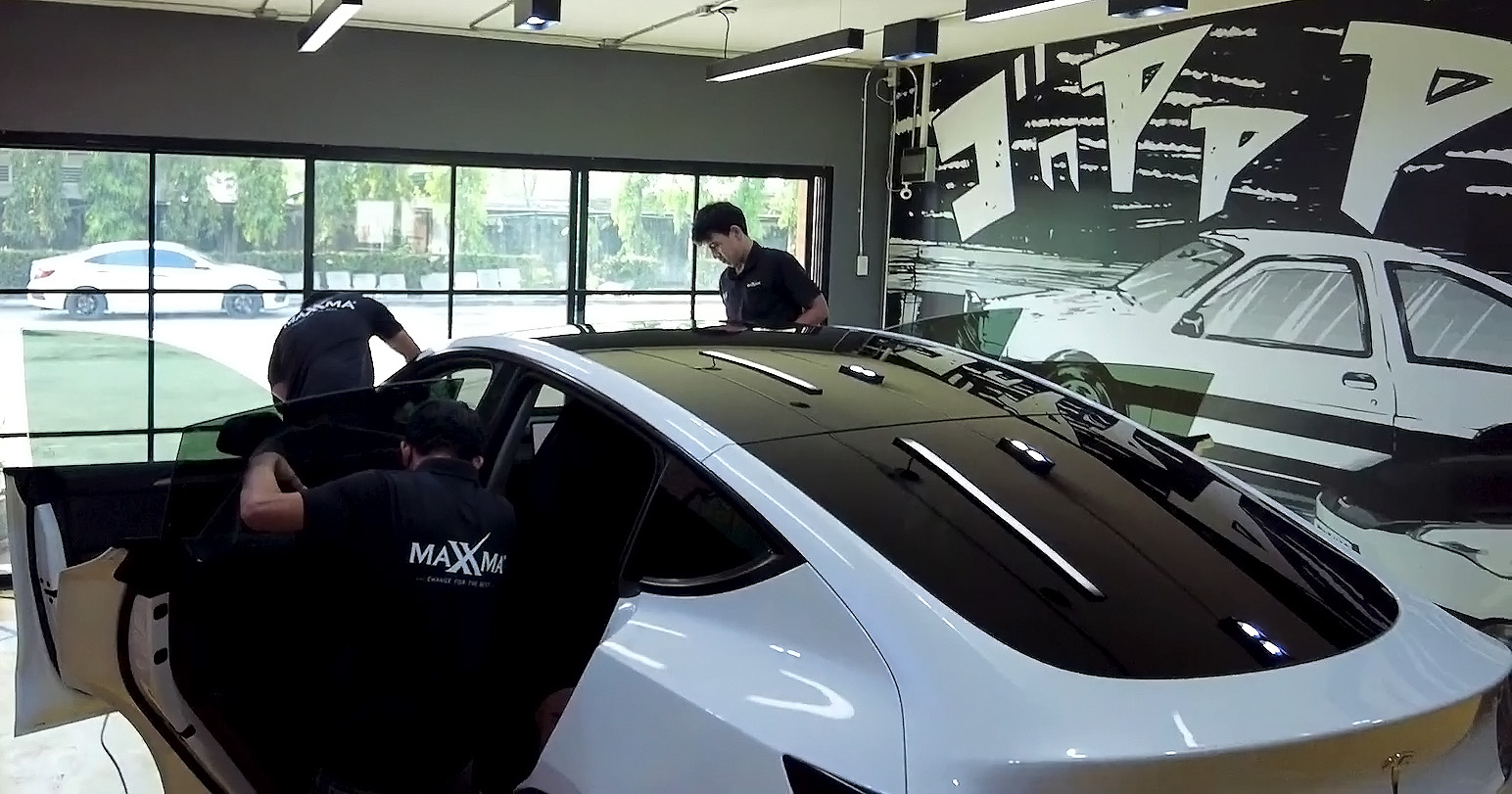
The Highway Reality: When Open Glass Architecture Meets Flying Debris
Consider the common scenario of taking delivery of a brand-new electric crossover like the BYD Atto 3 or Tesla Model Y. For most owners, the panoramic glass roof is a defining highlight: its vast transparent surface fills the cabin with natural light and delivers an open, aircraft-like ambiance on highway getaways.
Yet cruising on an elevated expressway at 110 km/h, an abrupt sharp crack against the roof glass can instantly shatter that serenity. Flying gravel thrown up by leading commercial traffic strikes the expansive glass overhead. Because panoramic roof panels sit nearly parallel to the airstream, airborne rocks strike with intense kinetic energy, transforming an enjoyable family road trip into an unexpected, high-stress repair ordeal.
Laboratory strike verification: High-velocity gravel impact demonstration on glass protected by MAXXMA Clear Guard film.
HIDDEN VULNERABILITIESThe Engineering Breakdown: Three Hidden Vulnerabilities of Panoramic Glass Canopies
Automotive manufacturers specify large panoramic glass canopies to convey an ultra-modern aesthetic and reduce complex steel roof assemblies. From a window film and glass safety perspective, however, these expansive surfaces present three serious operational challenges:
1. High-Velocity Stone Strike Vulnerability
Panoramic roofs feature massive surface areas positioned in direct alignment with aerodynamic air flow. During high-speed highway travel, screws, gravel, and metal fragments cast off by preceding commercial haulers become high-velocity projectiles. Because roof panels cannot easily deflect impacts through angled rake like front windshields, localized stresses can trigger spontaneous shattering of tempered glass assemblies.
2. The Radiant Solar Heat Trap
Nearly all factory panoramic glass panels come with dark-dyed privacy glass. Many motorists assume this factory tint provides substantial thermal insulation. In physical reality, dark glass functions as a massive thermal heat sink. Under intense tropical sunlight, the glass absorbs solar radiation until surface temperatures surpass 60°C to 70°C, constantly re-radiating thermal energy down onto passengers’ heads. Even with climate controls set to full fan speed, occupants feel continuous radiative heat discomfort.
3. Accelerated Battery Drain and Range Loss
For electric vehicles, cabin climate management draws directly from high-voltage traction batteries. As relentless thermal radiation permeates the glass roof, the thermal management system commands the air-conditioning compressor to run continuously at elevated capacity. Under harsh midday sunlight, sustained climate load can reduce effective driving range by 15% to 20%, costing valuable highway kilometers between charging hubs.

The Fallacy of Interior Cloth Shades: Why Clip-In Curtains Fail the Physics Test
Many electric vehicle owners attempt to mitigate cabin heat by purchasing aftermarket clip-in mesh sunshades or reflective folding fabric inserts. While inexpensive, interior fabric screens address only symptoms while generating unintended drawbacks:
- Thermal Energy is Already Trapped Inside: Solar radiation has already penetrated the glass before reaching the fabric shield. The sunshade simply prevents direct sunlight on hair, while intense thermal energy remains trapped inside the cabin envelope, elevating overall cabin temperature.
- Headroom Compromise: Bulky fabric frames reduce valuable vertical ceiling clearance, neutralizing the airy, expansive atmosphere that made the panoramic roof appealing in the first place.
- Zero Mechanical Impact Defense: Fabric shades offer zero defense against road gravel strikes. When the glass fractures, shards may drop into the mesh, but the glass panel is already ruined.
True thermal and mechanical mitigation requires stopping heat and impact energy before they penetrate the vehicle’s structural glass.
EXTERIOR PROTECTIONThe Science of Exterior Defense: Why Primary Protection Belongs on the Outside
In solar control engineering, the fundamental rule is clear: optimal protection arrests energy prior to absorption into the material substrate. Traditional interior window film can only manage solar energy that has already traversed the glass matrix.
MAXXMA Clear Guard Sunroof is an advanced, heavy-duty Paint Protection Film engineered specifically for exterior glass installation:
- Impact Absorption and Force Dissipation: The thick aliphatic Thermoplastic Polyurethane (TPU) matrix behaves like a flexible shock-absorbing bumper. Upon projectile strike, the elastomeric chains compress and dissipate concentrated impact forces laterally across the film layer, keeping underlying glass intact.
- Pre-Absorption Solar Deflection: Mounted on the outside face of the glass, the specialized top coat deflects solar infrared rays before the glass can absorb thermal energy, reducing roof glass surface temperatures by 10°C to 15°C compared to interior-only installations.
- Solar-Activated Self-Healing: Minor scratches and wash swirls in the top coat heal naturally under ambient solar warmth, preserving mirror-smooth optical transparency over years of highway exposure.
The Double-Defense Architecture: Dual-Layer Roof Armor
For maximum cabin cooling and glass security, MAXXMA technicians recommend the Double-Defense System: combining an exterior impact-deflecting armor with high-performance interior nano-ceramic solar film.

Layer 1: Exterior Clear Guard Sunroof Armor
Mounted to the outdoor glass surface, this aliphatic TPU layer deflects 100% of typical road gravel strikes while reflecting ultraviolet rays before they contact the factory privacy glass.
Learn more about Clear Guard Sunroof specifications →
Layer 2: Interior MAXXMA Polarized Nano-Ceramic Film
Applied to the cabin-side glass surface, this layer blocks residual infrared wavelengths while canceling reflective glare. Passengers enjoy crystal-clear views of the open sky without squinting or thermal discomfort.
Explore MAXXMA Polarized nano-ceramic film details →
BUYER CHECKLISTFive Critical Checks Before Installing Panoramic Roof Film
Not all protective films are formulated to withstand the intense horizontal ultraviolet and thermal loads of an expansive roof canopy. Verify these five standards before investing:
- 1. Demand 100% Aliphatic TPU Material: Avoid lower-grade PVC or hybrid TPH films that turn yellow, brittle, and crack within months under intense tropical sunlight, potentially damaging glass surfaces during removal.
- 2. Require Verified Thickness: Effective roof impact defense requires a dedicated film thickness of at least 6.5 to 8.0 mils to provide adequate physical mass for energy dissipation.
- 3. Insist on Clean-Release Adhesive Formulations: The mounting adhesive must remain stable across long-term thermal cycles without leaving stubborn residues or bonding aggressively to factory glass coatings.
- 4. Confirm Curved-Surface Installation Competence: Installing wide-format film over compound convex roof glass requires advanced heat-forming and edge-trimming expertise to prevent wind lift at highway speeds.
- 5. Verify Written Warranty Protection: Select certified installation centers providing clear warranty documentation covering material adhesion and film integrity.
Frequently Asked Questions
Can Clear Guard Sunroof film be installed over already-cracked roof glass to repair it?
No. Clear Guard Sunroof is strictly a preventative defense layer. Once glass has fractured, structural tensile strength is permanently compromised. While applying film over damaged glass might temporarily hold loose shards together, it cannot restore factory structural integrity. Fractured panels should be replaced by authorized technicians, followed immediately by protective film installation.
Does exterior roof film interfere with rain sensors, cameras, or antenna arrays?
No. Panoramic roof glass assemblies do not feature wiper mechanisms. Clear Guard Sunroof is non-metallized and optically transparent, ensuring zero signal disruption for overhead cellular antennas, satellite positioning receivers, or cabin ambient light sensors.
What is the expected service lifespan of Clear Guard Sunroof film?
Under regular maintenance routines, premium aliphatic TPU roof film delivers approximately 5 to 7 years of reliable protection. Periodic inspections at authorized MAXXMA installation centers ensure optimal adhesion and long-term surface clarity.
Resolve Panoramic Roof Vulnerabilities Before Highway Travel
Do not allow an unexpected gravel strike or unrelenting midday solar radiation to compromise your electric vehicle journey. Protect your investment with proven exterior glass armor from MAXXMA.
Discover additional automotive surface protection insights at the MAXXMA Knowledge Hub.
Ready to protect your home or vehicle?
Consult with MAXXMA experts to select the perfect film for your needs, or find an authorized dealer near you.