
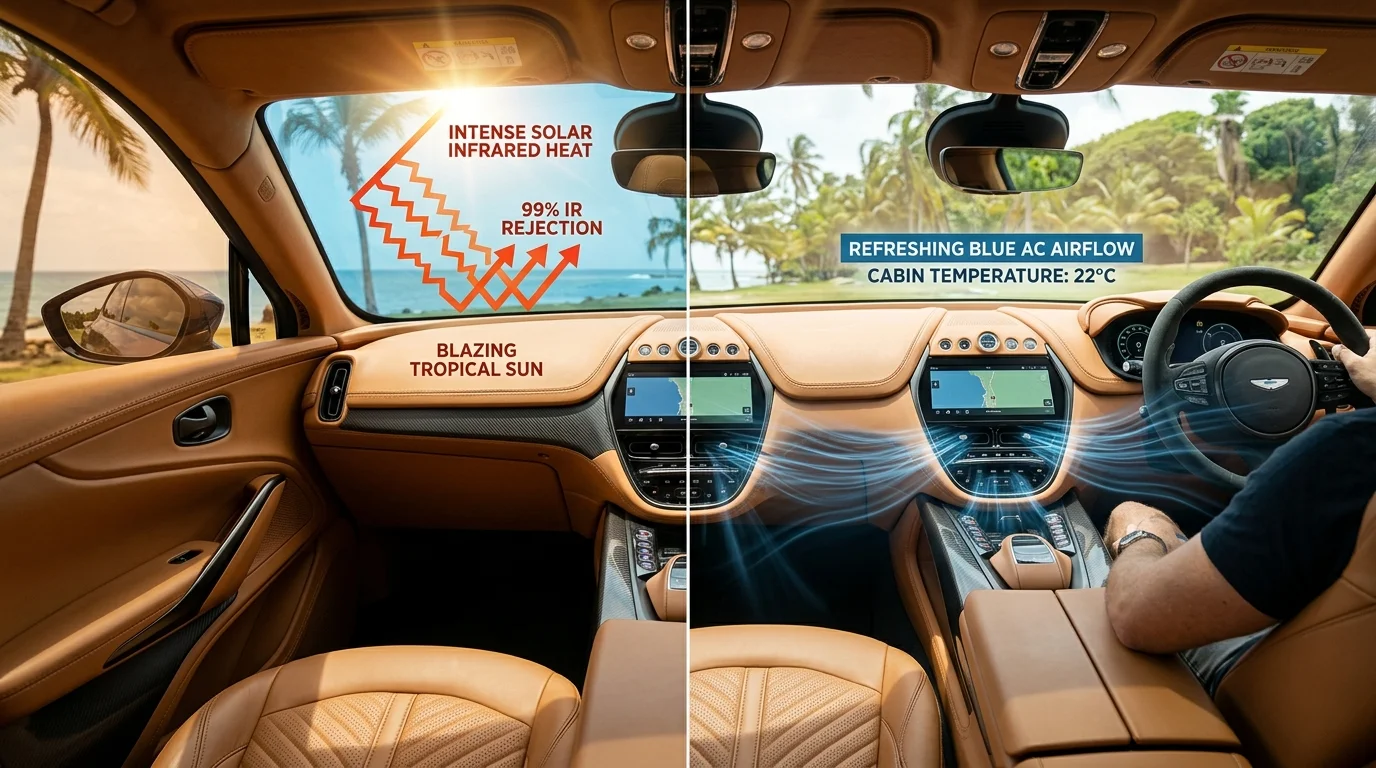
01 Engineering Direct Answer: How Window Film Impacts A/C Load & Cabin Thermodynamics
The short, direct answer based on automotive thermal engineering is: “It has a direct, substantial, and measurable impact.”
Automotive window film does not merely dim visible light or offer passenger privacy. Functionally, it serves as a primary thermal radiation barrier that intercepts solar energy before it penetrates the automotive glass and saturates the vehicle interior.
💡 Engineering Highlights of High-Performance Solar Control Film
- Reduces Peak A/C Thermal Load by 20% to 30%: Cuts down the initial cooling power requirement from 4.5 kW to under 3.2 kW during extreme heat soak conditions.
- Accelerates Cabin Pull-Down Speed by 25% to 40%: Reduces the time needed to reach a comfortable cabin temperature (24°C) from 18 minutes to just 8 to 11 minutes.
- Lowers Dashboard Soak Temperature by 10°C to 20°C: Suppresses dashboard surface temperatures from 68°C to below 45°C, preventing dangerous re-radiation into the passenger breathing zone.
- Extends Electric Vehicle (EV) Driving Range by 5% to 15%: Substantially relieves the high-voltage battery pack from heavy HVAC power draw during hot weather driving.
02 Solar Radiation Physics & Cabin Heat Trap Mechanism
To comprehend why a vehicle without high-performance window film places an immense burden on the air conditioning system, we must examine the physics of the solar spectrum and the automotive greenhouse effect.
Solar radiation reaching the earth’s surface comprises three primary bands:
- Ultraviolet (UV) Radiation (300 to 380 nm): Accounts for approximately 3% of total solar energy. While its direct heat contribution is minimal, UV is the primary cause of skin erythema, eye damage, and interior material degradation (cracking and fading).
- Visible Light (380 to 780 nm): Accounts for approximately 44% of solar energy. It provides illumination for driving, but unfiltered intense light carries significant thermal energy.
- Infrared (IR) Radiation (780 to 2500 nm): Accounts for approximately 53% of solar energy. This is the primary driver of thermal sensation that causes skin burning and cabin heat soak.
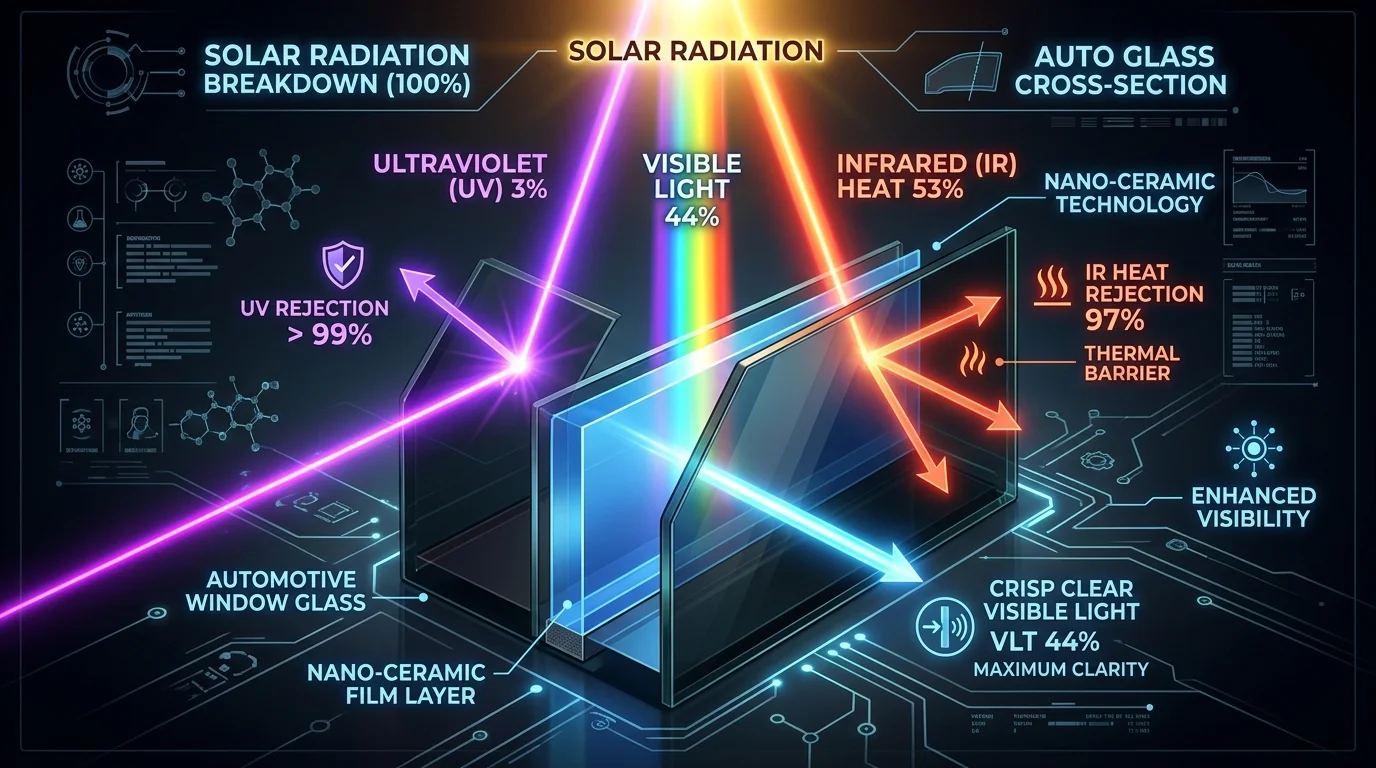
Figure 1: Breakdown of solar radiation spectrum and the protective mechanism of advanced nano-ceramic automotive window film.
The Automotive Greenhouse Effect & Mean Radiant Temperature (MRT)
Standard automotive float glass is transparent to short-wave solar radiation (visible and near-infrared). When sunlight passes through clear or low-grade tinted glass:
- The energy is absorbed by dark interior components such as the black leather dashboard, steering wheel, and seating surfaces.
- These components heat up to extreme levels (frequently exceeding 65°C to 75°C in tropical climates) and convert the short-wave solar energy into long-wave thermal radiation (far-infrared).
- Standard glass is opaque to long-wave radiation, trapping heat inside the cabin. This is the classic Automotive Greenhouse Trap.
Even when the air conditioner blows cold air from the vents, passengers often still feel uncomfortably hot. This phenomenon is explained by Mean Radiant Temperature (MRT): human thermal comfort is determined not only by ambient air temperature, but by radiant heat emitted from surrounding surfaces. When your dashboard and windshield are radiating heat at 65°C directly toward your face and chest, no amount of forced cold air can fully restore physical comfort.
03 Empirical Research Evidence: NREL, SAE, and KMUTT Laboratory Findings
Rather than relying on marketing claims, let us examine peer-reviewed empirical scientific data:
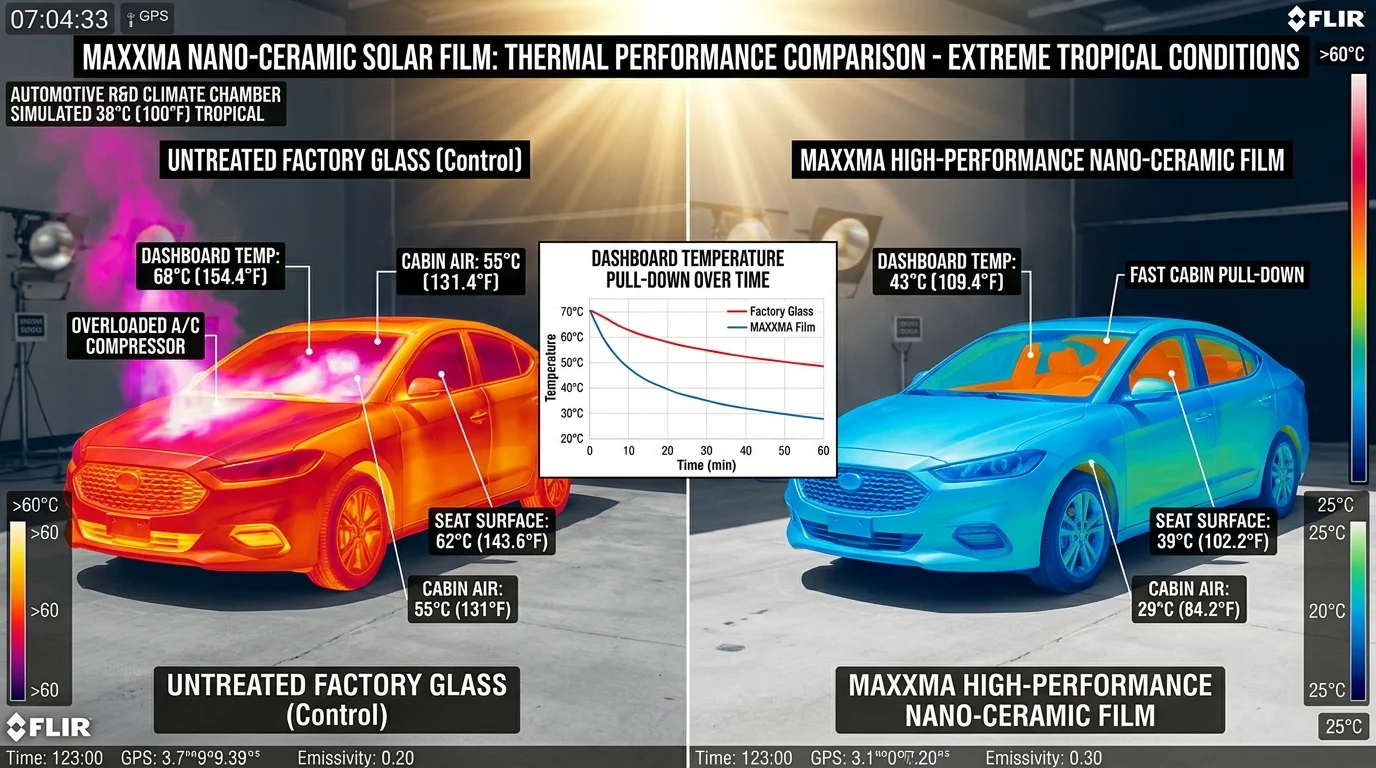
Figure 2: FLIR infrared thermography comparison of dashboard heat soak and cabin pull-down performance between baseline glass and MAXXMA ceramic film.
1. National Renewable Energy Laboratory (NREL) “Cool Car Project”
Research conducted by the U.S. Department of Energy (DOE) and NREL on vehicle auxiliary loads demonstrated that:
- Solar radiation entering through automotive glazing accounts for up to 70% of total cabin cooling load in passenger vehicles.
- Applying high-performance solar control films with advanced selective infrared rejection reduced interior soak temperatures by up to 11.2°C (20.1°F).
- Peak air conditioning compressor capacity could be downsized by 20% to 30%, saving significant mechanical weight and engine load.
2. SAE International (Technical Paper 2007-01-1194)
Engineers John Rugh and colleagues evaluated vehicle temperature and fuel economy:
- Reducing solar heat gain through advanced window films lowered cabin pull-down time by more than 35%.
- Over standard urban and highway drive cycles in summer conditions, air conditioning fuel consumption decreased by 2.5% to 4.0%, directly reducing tailpipe emissions and engine wear.
3. OEC-CERT / KMUTT Laboratory Testing
Standardized spectrophotometric testing (ISO 9050 / ASHRAE standards) performed by the King Mongkut’s University of Technology Thonburi (KMUTT) on MAXXMA automotive window films confirmed:
- Solar Heat Gain Coefficient (SHGC): Reduced from 0.82 (clear 6 mm automotive float glass) down to 0.25 to 0.38, representing an extraordinary thermal barrier.
- Total Solar Energy Rejected (TSER): Achieved verified values up to 80% to 97% across tested ceramic and polarized formulations.
04 Science vs. Myth: 3 Widespread Myths Debunked
❌ Myth 1: “Just crank the A/C fan to maximum speed. Installing expensive window film is unnecessary.”
Engineering Reality: Setting the A/C blower to maximum speed only accelerates forced convection of air. It does nothing to stop radiant heat transfer (MRT) from entering through the glass. If high-intensity infrared radiation continues to hit your body and dashboard, the compressor must operate at maximum displacement continuously, accelerating clutch wear, increasing engine fuel burn, and leaving passengers with dry eyes and irritated respiratory passages.
❌ Myth 2: “Darker window film always blocks more heat than lighter film.”
Engineering Reality: Visible light represents only 44% of solar energy, whereas infrared accounts for 53%. Conventional dyed films merely darken the glass, absorbing heat until the glass itself re-radiates it inward. Conversely, advanced nano-ceramic films with high visible light transmission (VLT 40% to 50%) can reject over 95% of infrared radiation without impairing nighttime visibility.
❌ Myth 3: “Electric Vehicles (EVs) have remote pre-cooling via smartphone, so window film is irrelevant.”
Engineering Reality: Remote pre-cooling draws high-voltage battery power while parked. Without solar control film, the cabin heats up again within 5 to 7 minutes after parking, and the high-voltage compressor must draw 3 to 5 kW during driving to combat continuous solar gain, reducing driving range substantially.
05 Impact on Electric Vehicles (EV Range & Battery Thermal Management)
In modern Electric Vehicles (EVs), the HVAC air conditioning compressor is powered directly by the high-voltage traction battery pack (350V to 800V DC).
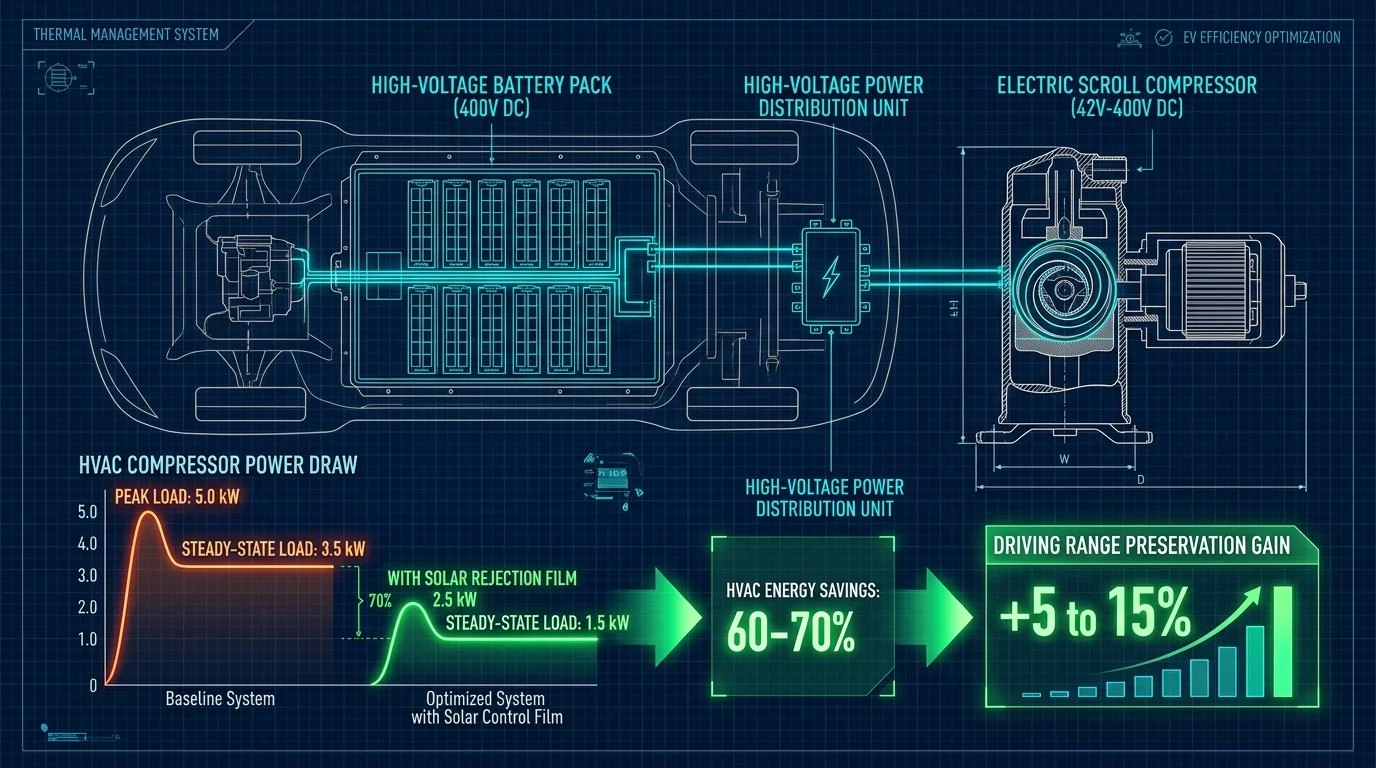
Figure 3: Power flow diagram illustrating HVAC compressor consumption from EV high-voltage battery and energy recovery through ceramic window film.
According to SAE Paper 2013-01-0553:
- Operating vehicle air conditioning in ambient temperatures of 35°C to 40°C can consume up to 20% to 30% of battery capacity during suburban driving.
- High-performance nano-ceramic window film on the windshield, side windows, and panoramic glass roof reduces cabin thermal saturation by up to 45%.
- This thermal protection decreases compressor energy consumption by 1.2 to 2.0 kWh per hour, extending real-world driving range by 5% to 15% on hot summer days.
06 Comprehensive Engineering Comparison Matrix
Desktop Engineering Comparison Table
| Engineering Metric | Baseline Clear Glass | Conventional Dyed Film | MAXXMA Polarized Ceramic |
|---|---|---|---|
| IR Rejection (900-1400 nm) | 15% - 20% | 25% - 40% | 95% - 99% |
| Total Solar Energy Rejected (TSER) | 18% | 30% - 42% | 65% - 82% |
| Dashboard Soak Temperature (1 hr sun) | 68°C - 75°C | 58°C - 65°C | 42°C - 46°C |
| Cabin Pull-Down Time to 24°C | 18 - 25 min | 14 - 18 min | 7 - 10 min |
| Compressor Workload Factor | 100% (Continuous High) | 80% - 88% | 55% - 65% |
| Digital Signals (Easy Pass, GPS, 5G) | 100% Pass | 100% Pass | 100% Pass (Non-Metallic) |
Mobile Performance Cards
🚗 Baseline Clear Automotive Glass
- IR Rejection: 15% to 20%
- TSER: 18%
- Dashboard Temp: 68°C to 75°C
- Cool-Down Time: 18 to 25 minutes
- Compressor Load: 100% continuous heavy load
🕶️ Conventional Dyed Window Film
- IR Rejection: 25% to 40%
- TSER: 30% to 42%
- Dashboard Temp: 58°C to 65°C
- Cool-Down Time: 14 to 18 minutes
- Compressor Load: 80% to 88%
⚡ MAXXMA Polarized Nano Ceramic
- IR Rejection: 95% to 99%
- TSER: 65% to 82%
- Dashboard Temp: 42°C to 46°C
- Cool-Down Time: 7 to 10 minutes
- Compressor Load: 55% to 65% (substantially reduced)
07 Recommended MAXXMA Automotive Window Film Series
To effectively reduce air conditioning workload and achieve rapid cabin cooling, MAXXMA provides three flagship product tiers:
1. MAXXMA POLARIZED (Nano Ceramic): Flagship Luxury Tier
Engineered with advanced optical Polarization filtering and dense inorganic nano-ceramic particles.
- Up to 99% Infrared Rejection (IRR) and 99% UV radiation blockage.
- Reflective Glare Filter: Specifically eliminates harsh reflections from windshield glass and wet roads.
- 2-mil Semi-Safety Substrate: Twice as thick as standard 1-mil films for added shatter resistance.
- 100% Signal Friendly: Non-conductive, 100% compatible with Easy Pass, M-Flow, GPS, and ADAS sensors.
- 7-Year Comprehensive Warranty
- Price range: 9,500 to 21,000 THB.
- Learn more: View specifications at MAXXMA POLARIZED.
2. MAXXMA BLACK PANTHER (Nano Carbon Ceramic): Performance Tier
Deep sporty black carbon-ceramic film designed for privacy and high thermal efficiency.
- Up to 90% Infrared Rejection and 99% UV radiation protection.
- Color-Stable Formulation: Non-fading, non-metallized, zero risk of corrosion.
- 7-Year Warranty
- Price range: 7,500 to 16,900 THB.
- Learn more: View specifications at MAXXMA BLACK PANTHER.
3. MAXXMA REFINED (Ceramic Metallized): Essential Value Tier
A high-value balance of heat rejection and clear visibility across various tint shades.
- Up to 90% Heat Reduction and 99% UV blockage.
- 7-Year Warranty
- Price range: 5,500 to 12,500 THB.
- Learn more: View specifications at MAXXMA REFINED.
4. Clear Guard Sunroof PPF: Glass Roof Thermal & Impact Shield
For panoramic sunroofs and glass-roof electric vehicles, Clear Guard Sunroof installs on the exterior glass surface to reflect solar radiation before it enters the glass substrate.
- Learn more: View specifications at Clear Guard Sunroof.
08 4-Step Driver Checklist: Assessing Your Vehicle’s Thermal Protection
If you observe these symptoms in your daily commute, your current window film has likely deteriorated or lacks sufficient infrared rejection:
- 1The cabin remains uncomfortably hot after 10 minutes of maximum blower speed: Cold air from the vents cannot overcome heavy radiant heat emitting from your dashboard and seats.
- 2Skin burning sensation on arms and thighs while driving: Indicates that high-energy infrared radiation is passing through the glass unimpeded.
- 3Film has turned purple, bubbly, or hazy: The organic dyes have degraded under UV exposure, leaving the glass virtually unprotected.
- 4A/C compressor clutch cycles continuously or runs without cycling off: The cooling system is forced to run at peak output to offset continuous thermal gain.
09 Frequently Asked Questions (FAQ)
Does automotive window film actually extend the lifespan of the car A/C compressor?
Yes, significantly. The A/C compressor is a mechanical component subjected to extreme internal pressures and friction. When the vehicle cabin experiences severe thermal soak, the compressor must operate at maximum displacement for extended durations. This elevates underhood temperatures, degrades compressor lubricant, and wears out the clutch assembly prematurely. High-performance solar control film allows the system to reach target temperatures quickly, cycling into maintenance mode and prolonging compressor life.
How much fuel can high-performance ceramic film save?
Peer-reviewed research by SAE International (Paper 2007-01-1194) and NREL indicates that mitigating solar heat gain through advanced automotive window film reduces overall fuel consumption by approximately 2.5% to 4.0% during summer driving cycles. For daily commuters and high-mileage commercial fleets, these fuel savings provide a solid return on investment over the life of the film.
For Electric Vehicles (EVs), does ceramic film meaningfully increase driving range?
Yes. EV air conditioning compressors draw electrical power directly from the high-voltage traction battery pack. During initial pull-down in hot conditions, the compressor can draw between 3 kW and 5 kW. By suppressing solar heat ingress with high-TSER nano-ceramic film, compressor electrical load is reduced by 60% to 70%, recovering 5% to 15% of driving range on hot summer afternoons.
Why do passengers feel hot even when the A/C air is blowing cold?
Air conditioning vents provide convective cooling by lowering the air temperature. However, human thermal comfort is heavily influenced by radiant heat transfer (Mean Radiant Temperature). If solar infrared radiation penetrates through non-receptive glass, it directly heats the skin and surrounding interior surfaces, creating a persistent burning sensation regardless of air temperature.
What tint percentages should I select for optimal cooling and safe night driving?
For the windshield, we recommend 40% or 50% opacity (VLT 40% to 60%), such as MAXXMA Polarized MX-PR40, ensuring crystal-clear clarity for nighttime driving and rainy conditions. For side and rear windows, 60% or 80% opacity (VLT 5% to 20%), such as MX-PR20 or MX-PR05, delivers maximum infrared rejection and passenger privacy.
10 Video Demonstration: Heat Rejection Test
Watch real physical testing of MAXXMA window film under concentrated heat simulation from high-intensity heat spotlights.
11 Summary & Action: Upgrading Cabin Comfort & Compressor Longevity
Selecting the right automotive window film is not merely a matter of vehicle aesthetics: it is an investment in automotive thermal efficiency, mechanical longevity, and energy management.
High-performance nano-ceramic window films block up to 99% of infrared radiation, significantly relieving air conditioning workload, speeding up cabin cool-down by up to 40%, protecting premium interior materials, and delivering noticeable fuel and battery savings.
Consult MAXXMA Automotive Window Film Specialists
For expert guidance tailored to your specific vehicle model, climate needs, and driving habits, reach out to our authorized network:
- Find an Authorized MAXXMA Dealer Nationwide
- Consult directly via LINE Official: @maxxma
- Compare automotive film specifications at MAXXMA Product Comparison Matrix
12 Academic References
- National Renewable Energy Laboratory (NREL): Cool Car Project: Vehicle Ancillary Load Reduction & Thermal Management. U.S. Department of Energy. https://www.nrel.gov/transportation/cool-cab.html
- SAE International Paper 2007-01-1194: Rugh, J., Hovland, V., & Galloway, K. Vehicle Temperature and Fuel Use Reduction Using Solar Reflective Glazing and Window Film. https://www.sae.org/publications/technical-papers/content/2007-01-1194/
- SAE International Paper 2013-01-0553: Bouwman, M., et al. Impact of Solar Control Glazing on Electric Vehicle Cabin Climate and Driving Range. https://www.sae.org/publications/technical-papers/content/2013-01-0553/
- King Mongkut’s University of Technology Thonburi (KMUTT) & OEC-CERT: Spectrophotometric Test Report on Solar Heat Gain Coefficient (SHGC) and Total Solar Energy Rejection (TSER) for MAXXMA Solar Control Films.
Ready to protect your home or vehicle?
Consult with MAXXMA experts to select the perfect film for your needs, or find an authorized dealer near you.