
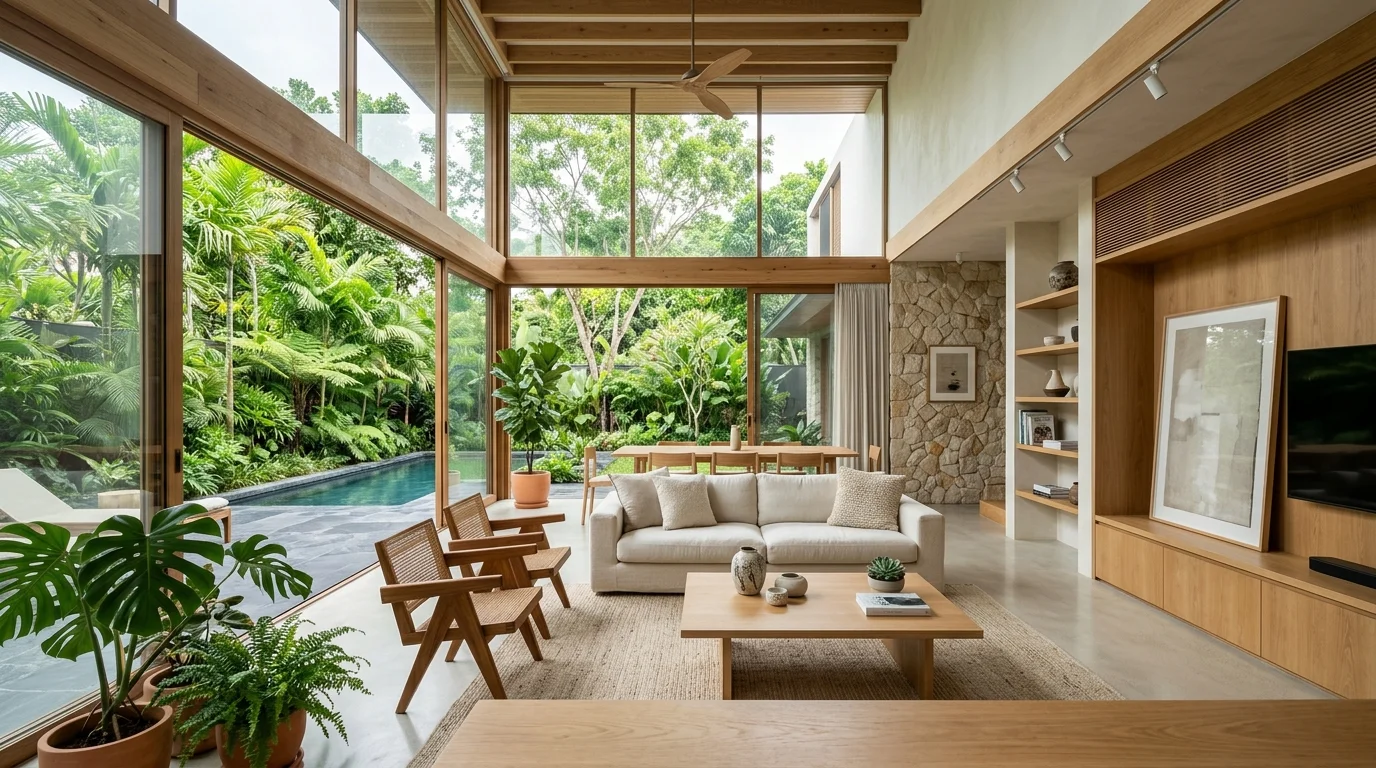
There is a phrase we often hear when admiring a meticulously designed house: “This house is so cool and breezy, you barely need to turn on the AC.”
This compliment sounds proud because it reflects good building orientation, eaves that shade the sun, and excellent energy savings. However, as the global climate grows hotter and air pollution like PM2.5 becomes an annual occurrence, a critical question arises for homeowners and building managers: On days with extreme outdoor conditions, or when the health of those inside is compromised, is relying solely on natural breezes still a safe answer?
Introduction: The Hot House Problem and the Trap of AC Reliance
When discussing solutions for a hot home, we often fall into a trap that divides management into two extremes:
- The Purely Natural Extreme: Trying not to turn on the air conditioner at all, enduring the heat, and leaving windows open for wind constantly.
- The Machine-Reliant Extreme: Sealing the house completely and running the AC 24 hours a day, leading to skyrocketing electricity bills and rapid air conditioner wear and tear.
Building science realities point out that a home that is comfortable and safe for long-term health does not require choosing one extreme over the other, but rather integrating systems to work together systematically.
Medical research on Air Conditioning in Nursing Homes and Mortality During Extreme Heat, published in JAMA Internal Medicine (2026), studied the impact of heat waves on the elderly and vulnerable populations of over 73,000 individuals. It found empirical evidence that during periods of extreme heat, buildings or care facilities without air conditioning systems had significantly higher risks of mortality and cardiovascular failure compared to those with air conditioning. This data shifts the perspective on air conditioners from being merely a comfort appliance to a life-safety device during heat crises.
The core of creating a cool home is therefore not rejecting the air conditioner, but designing a multi-layered thermal protection system to block heat accumulation in the house right at the first barrier, reducing the cooling load, and saving electricity sustainably.
The Science of Heat: Why Glass is the Building’s Weakest Link
When evaluating the energy efficiency of single-family homes, condominiums, and office buildings, solid walls and roofs equipped with thermal insulation can resist heat quite well. However, the weakest link in the building envelope, where the most heat flows through, is the glass openings.
Solar heat energy striking the glass consists of 3 main spectrum bands:
- Ultraviolet (UV) Rays: Accounting for about 3% of solar energy. While they don’t provide direct heat, they are the primary cause of skin cell damage, fading furniture, wood floors, and curtains, as well as cracking frames.
- Visible Light: Accounting for about 44% of solar energy. It provides illumination for the eyes, but too much can cause glare and heat accumulation.
- Infrared (IR) Rays: Accounting for about 53% of solar energy. These are direct heat waves that make us feel a burning sensation on our skin when near glass windows.
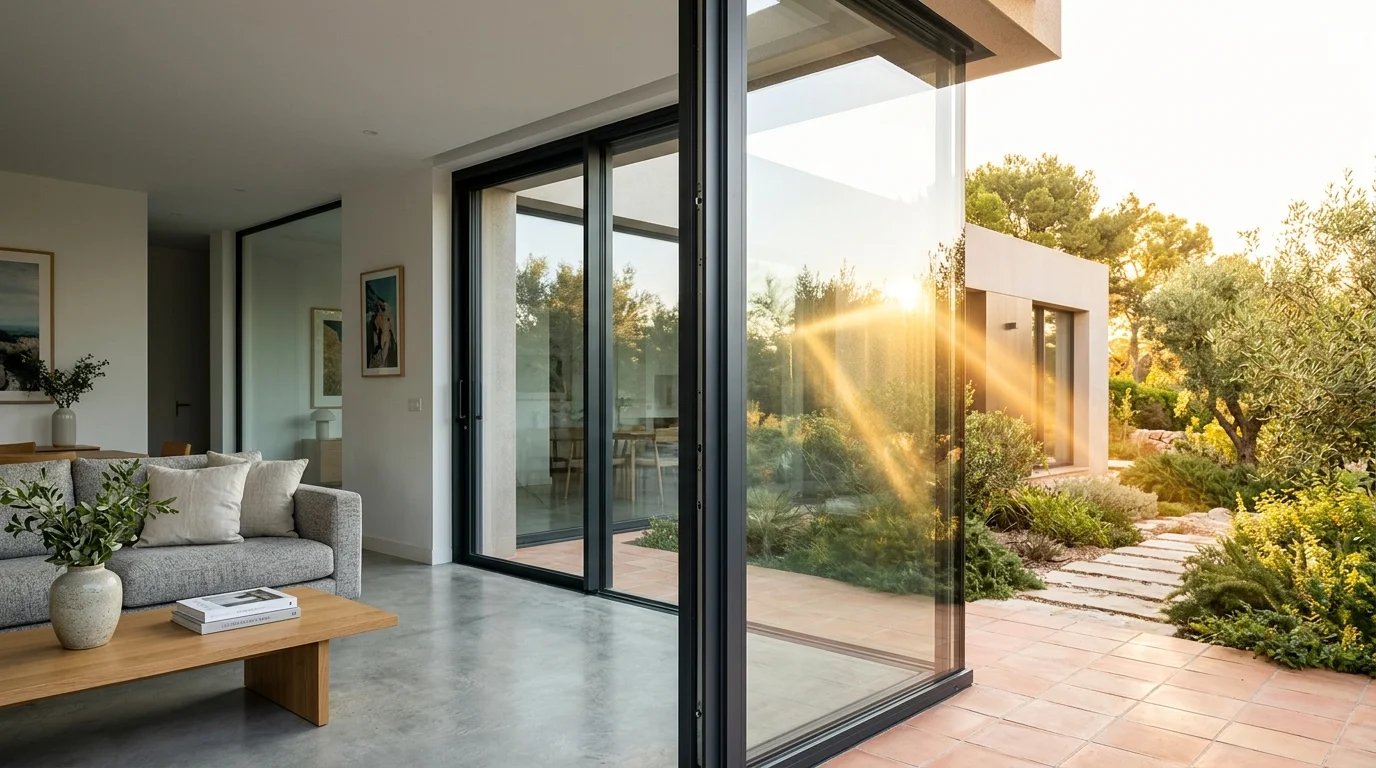
When heat rays pass through ordinary clear glass into a room, short-wave radiation is absorbed by the floors, walls, and indoor furniture, which then radiate it back out as long-wave thermal radiation. Ordinary glass does not easily allow long waves to reflect back out. This phenomenon is known as the indoor greenhouse effect. Consequently, the room temperature rises continuously. Even with the AC on, it must work constantly and heavily to extract the accumulated heat.
Science vs. Myth: 4 Popular Misconceptions About Cooling a Home
To properly plan home and building renovations, let’s examine building science facts against common misconceptions:
| Misconception | Scientific Fact | Correct Recommendation |
|---|---|---|
| Installing thick curtains or blackout blinds is enough to block heat. | Curtains are inside the glass. Once sunlight passes through the glass, heat accumulates between the curtain and the glass, radiating into the room anyway. | Install window film to reflect and block heat rays at the glass surface before heat penetrates the room. |
| Setting the AC to 16-18°C cools the room faster. | Air conditioning systems deliver cooling at a constant rate. Setting the lowest temperature does not cool the room faster but forces the compressor to work continuously without cutting off. | Set the temperature to 25-26°C, use a fan to help circulate air, and prevent heat from entering through the glass. |
| A good house shouldn’t use the AC at all. If you use it, the design has failed. | In extreme heat conditions or areas with high PM2.5 pollution, opening the house to the wind can bring both heat and health-damaging dust indoors. | Design the home to accommodate natural ventilation on good days while having a complete heat-blocking system when the AC is needed. |
| The darker the window film, the better it blocks heat compared to clear film. | Film color only correlates with visible light transmission. Heat rejection depends on coating technologies like nano-ceramic or ceramic metallized layers. | Choose film by looking at the SHGC coefficient (lower is better) and TSER (higher is better) according to NFRC standards. |
Multi-Layered Thermal Protection System
Modern energy-efficient building management approaches use a 3-level thermal protection shield principle to create comfortable living conditions while reducing electricity bills:
Level 1: Initial Heat Blockage at the Glass Surface with Architectural Window Film
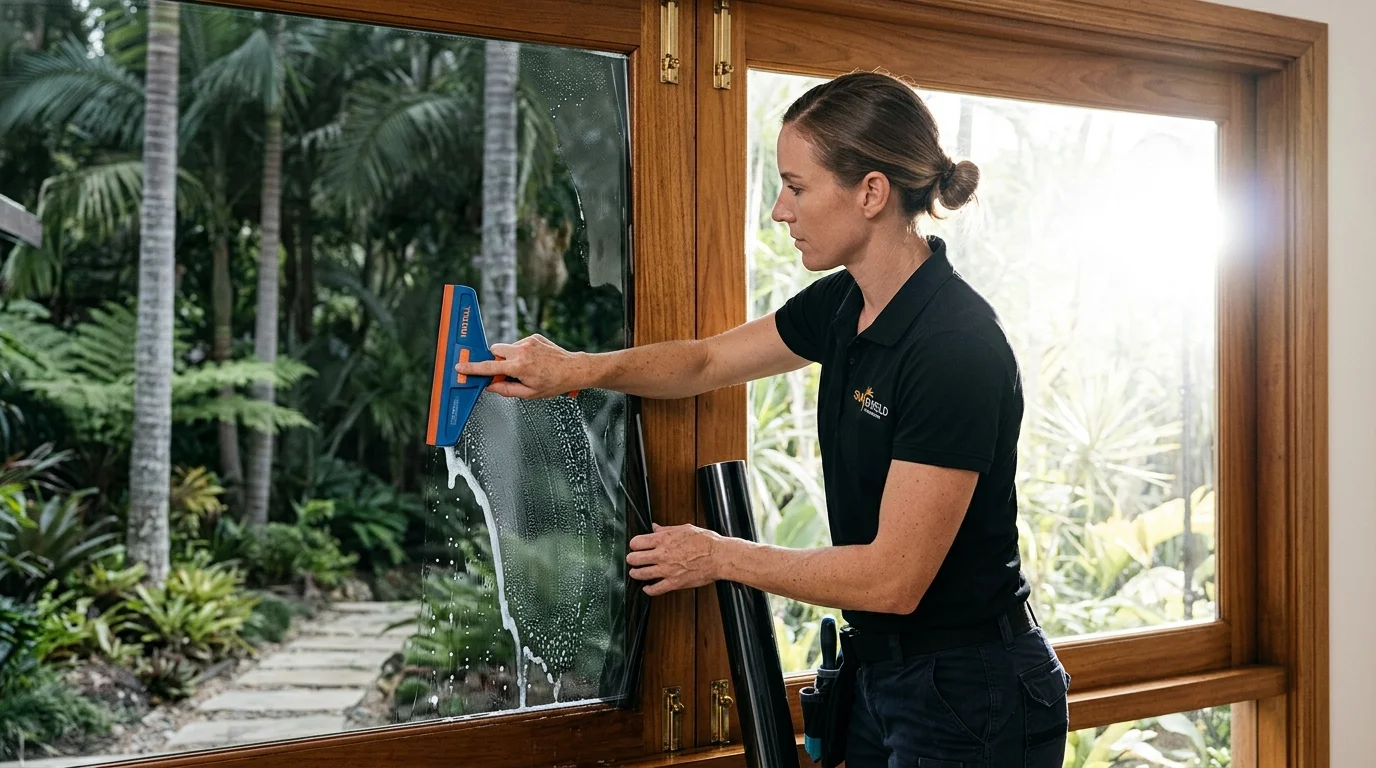
Installing window film in homes and buildings is like creating an anti-radiation insulation layer. Nano-ceramic and ceramic metallized technologies act to filter light waves, reflect infrared waves outwards, and absorb heat at the glass surface before it radiates into the room. This noticeably reduces interior surface temperatures.
Level 2: Managing Enclosed Spaces and Properly Timed Ventilation
During mornings or evenings when outside temperatures are lower than inside, you can open windows to vent accumulated heat. However, during intense sunlight from 10:00 AM to 4:00 PM, openings should be kept tightly closed, allowing the window film and wall structures to act as insulation to retain the cold air inside.
Level 3: Efficient Air Conditioning Systems
When external heat is blocked from Level 1, the cooling load on the air conditioner is massively reduced. The AC doesn’t have to work in high gear; it can reach the set temperature faster, and the compressor cycles efficiently, resulting in a clear reduction in monthly electricity bills.
Window Film Spec Reading Guide for Homeowners and Building Managers
Choosing window film for a house or building to get worthwhile results requires considering scientific standard values certified by international organizations such as the National Fenestration Rating Council (NFRC) and the International Window Film Association (IWFA):
- VLT (Visible Light Transmission):
- Expressed as a percentage. The higher the value, the brighter the room and the clearer the outside view.
- Condominiums and standard residential homes usually choose a range of 20% to 60% to balance brightness and privacy.
- SHGC (Solar Heat Gain Coefficient):
- A value between 0 and 1 representing the proportion of solar heat that penetrates through the glass into the building.
- The lower the SHGC, the better the heat rejection. This is the most crucial index for calculating AC energy savings.
- TSER (Total Solar Energy Rejection):
- The percentage of total solar heat energy rejected across all spectrum bands (UV + Visible Light + IR).
- High-quality architectural film should have a TSER of 50% to 80%+.
- IR Rejection:
- The blockage of infrared heat rays, helping reduce the burning sensation when sitting or relaxing near glass windows.
- UV Rejection:
- High-quality film standards must be able to block 99% of UV rays to protect the skin and preserve interior furnishings.
- Glass Safety Against Thermal Stress:
- The European Window Film Association (EWFA) advises that film selection must consider the original glass type to prevent cracking from excess heat accumulation at the glass edges.
Technical Specifications Table: MAXXMA Architectural Series Window Film
Specification table for window films specifically designed for installation in residential homes, condominiums, and office buildings, referenced from standard testing databases:
| Film Model | Material Technology | VLT | SHGC | TSER | UV Rejection | Warranty Period |
|---|---|---|---|---|---|---|
| MX-BL20 | High Heat Reflection Ceramic Metallized | 20% | 0.31 | 69% | 99.0% | 10 Years |
| MX-BL40 | Natural Light Ceramic Metallized | 40% | 0.45 | 56% | 99.0% | 10 Years |
| MX-I970 | Ultra Clear Nano Ceramic | 70% | 0.56 | 44% | 99.0% | 7 Years |
MAXXMA MX-BL20
Maximum Heat RejectionMAXXMA MX-BL40
Natural LightMAXXMA MX-I970
Ultra ClearNote: Energy efficiency testing data is based on OEC-CERT / KMUTT standards and international NFRC methodology.
Technical Specifications Table: MAXXMA Nano Ceramic Innovative Series Film
For spaces requiring the ultimate in infrared ray rejection performance, or films that provide clarity without interfering with digital signals:
| Film Model | Material Technology | VLT | IRR | SHGC | TSER | UV Rejection |
|---|---|---|---|---|---|---|
| Polarized MX-PR05 | Ultra Dark Nano Ceramic, Glare Reduction | 5% | 99% | 0.33 | 97% | 99.0% |
| Polarized MX-PR20 | Premium Nano Ceramic, Comfortable Viewing | 20% | 99% | 0.36 | 91% | 99.0% |
| Polarized MX-PR40 | Nano Ceramic, Balanced Natural Light | 40% | 99% | 0.43 | 82% | 99.0% |
| Polarized MX-PR60 | Bright Clear Nano Ceramic | 60% | 99% | 0.50 | 73% | 99.0% |
| Black Panther MX-BP05 | Bold Black Nano Carbon Ceramic | 5% | 87% | 0.376 | 91% | 99.0% |
| Black Panther MX-BP20 | High Privacy Nano Carbon Ceramic | 20% | 85% | 0.398 | 83% | 99.0% |
| Black Panther MX-BP35 | Medium Brightness Nano Carbon Ceramic | 35% | 83% | 0.452 | 77% | 99.0% |
| Refined MX-BL05 | Elegant Gloss Ceramic Metallized | 5% | 88% | 0.232 | 90% | 99.0% |
| Refined MX-BL20 | Deep Heat Blocking Ceramic Metallized | 20% | 77% | 0.38 | 80% | 99.0% |
| Refined MX-BL40 | Natural Light Ceramic Metallized | 40% | 75% | 0.45 | 70% | 99.0% |
Polarized Series (MX-PR)
99% IRRBlack Panther Series (MX-BP)
High PrivacyRefined Series (MX-BL)
Maximum ValueGuidelines for Choosing Cool Home Solutions by Target Group
1. Single-Family Home and Townhome Residents
- The Problem: Large glass windows in living rooms and master bedrooms face the harsh afternoon sun from the south and west. Accumulated temperature keeps the room hot well into the evening.
- Recommended Solution:
- Install MAXXMA MX-BL20 or Polarized MX-PR20 window film for south- and west-facing windows to achieve high Total Solar Energy Rejection (TSER) of up to 69% to 91%.
- Create living rooms or elderly bedrooms as heat-safe zones, maintaining temperatures stably between 25 and 26°C.
2. Condominium and Apartment Residents
- The Problem: High-rise buildings receive full sunlight all day without tree shade, but residents want to preserve city views and avoid excessively dark rooms.
- Recommended Solution:
- Install bright-toned window films like MAXXMA MX-BL40 or Polarized MX-PR40 / MX-PR60, providing 40% to 60% VLT. They are comfortable on the eyes, do not obstruct nighttime views, yet block up to 99% of infrared rays.
3. Business Clients, Facility Managers, and Corporations (B2B)
- The Problem: Electricity costs from air conditioning systems account for 50% to 60% of total operating expenses. Allowing heat to enter through glass forces chillers to work heavily all the time.
- Recommended Solution:
- Install ceramic metallized films like MAXXMA MX-BL20 or Refined Series, which feature an SHGC as low as 0.23 to 0.31, achieving ROI on electricity bills in a short period and extending the maintenance lifecycle of AC systems.
Interactive 3D Visual Brief
Heat Ray Rejection Mechanism at the Glass Surface
The journey of solar energy as it hits glass installed with MAXXMA nano-ceramic film is broken down and precisely managed across each spectrum band:
💡 Smart Display System: Desktop users can interact with the 3D model, while for mobile devices, the system adjusts to a high-resolution static diagram for smooth performance and battery savings.
Frequently Asked Questions (FAQ)
Q1: Can installing architectural window film really save on air conditioning electricity bills?
Answer: It provides significant savings. Since solar heat entering through glass is the main load on air conditioning systems, installing films with low SHGC values can reduce heat intake by over 50% to 80%. This drops room temperatures by 3 to 5 degrees Celsius. The AC reaches its target temperature faster, the compressor cycles normally, and power consumption decreases consistently.
Q2: Will architectural window film cause the glass to crack from thermal stress?
Answer: Thermal stress cracking risks occur when there is uneven heat accumulation across a glass pane, especially on standard glass with chipped or rough edges. MAXXMA’s expert technicians evaluate the glass type, sun direction, and shading before selecting a film model with the appropriate heat absorption rating, according to European Window Film Association (EWFA) standards, making it safe for all glass types.
Q3: How does ceramic window film differ from ordinary dyed film?
Answer: Ordinary dyed films use pigments to absorb light, making the film look dark but offering very little actual infrared heat rejection. Additionally, the color quickly fades and degrades within 1 to 2 years. In contrast, MAXXMA’s ceramic films use genuine nano-ceramic particles embedded firmly in the film layer, capable of rejecting up to 99% of infrared rays. The film will not fade, turn purple, and has a long lifespan of 7 to 10 years.
Q4: Can window film be installed alongside existing curtains or blinds?
Answer: They work together perfectly. The window film acts as the first line of defense, reflecting heat rays and blocking 99% of UV rays. This prevents your interior curtains and blinds from accumulating heat and fading or becoming brittle from the sun, flawlessly enhancing light control and privacy.
Summary and Next Steps
Creating a truly cool home is not about enduring the heat to avoid turning on the AC, nor is it about letting the AC work heavily while you bear massive electricity bills. It’s about smart heat management through a multi-layered thermal protection system.
Investing in MAXXMA architectural window film with low SHGC and high TSER cuts heat at the very first barrier. It transforms your favorite windows into an efficient heat shield, pays for itself through energy savings, and creates a safe space ready to sustainably care for your family’s health.
Related Tools and Resources
- Architectural Film Energy Savings Calculator: Calculate estimated annual electricity savings based on glass area and film model.
- Window Film Spec Comparison System: Compare detailed VLT, TSER, IR Rejection, and SHGC values across all models.
- Article and Film Selection Guide Hub: Read in-depth information about glass science and energy savings.
Academic References (References)
- JAMA Internal Medicine (2026): Air Conditioning in Nursing Homes and Mortality During Extreme Heat. Research on the impacts of heat waves and the necessity of air conditioning systems for building occupant health and safety.
- Lawrence Berkeley National Laboratory (LBNL) & Efficient Window Coverings: Applied Window Film Performance Labels and Energy Efficiency. Academic data on SHGC evaluations and building heat load reduction via applied window films. View reference
- National Fenestration Rating Council (NFRC): Window Film Consumer and Energy Ratings Guide. Testing and certification standards for solar heat gain coefficients. View reference
- European Window Film Association (EWFA): Thermal Stress: Film-to-Glass Compatibility and Fracture Prevention. Standard manual for thermal compatibility between window films and architectural glass types. View reference
- International Window Film Association (IWFA): Flat Glass Solar Control Education Manual. Educational guide on solar control for flat glass. View reference
Ready to protect your home or vehicle?
Consult with MAXXMA experts to select the perfect film for your needs, or find an authorized dealer near you.