
The Glass House Dilemma: Desiring Open Views While Losing Personal Privacy
Relaxing in a sun-drenched living room enclosed by floor-to-ceiling glass, overlooking landscaped gardens with natural daylight streaming in, represents the pinnacle of modern luxury residential architecture. Expansive glazing breaks visual boundaries, creates seamless indoor-outdoor transitions, and amplifies natural illumination.
However, in premium gated communities and urban residential developments where neighboring houses and estate roadways sit in close proximity, homeowners frequently confront “The Fishbowl Effect”:
- Neighbors, passing pedestrians, and vehicles can easily peer inside, observing private family activities throughout the day.
- Constant visual exposure undermines personal comfort, making residents feel self-conscious and unable to truly relax in their own living spaces.
- The standard workaround has historically been drawing heavy two-layer blackout curtains all day long. This completely defeats the architectural purpose of building with glass, turning multi-million-baht light-filled spaces into dark, enclosed boxes requiring artificial lighting 24/7.
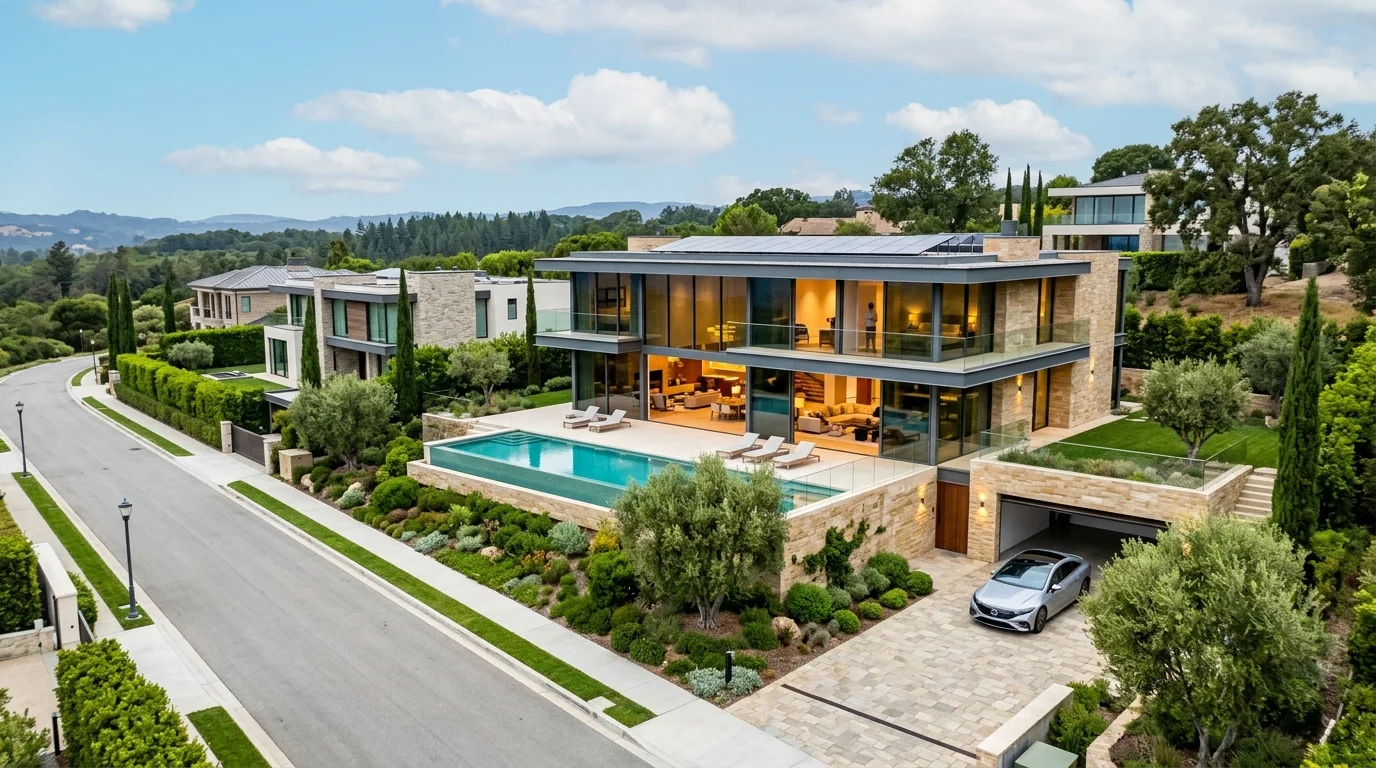
The central challenge in luxury interior design is: How can we safeguard family privacy without confining ourselves behind dark blackout curtains?
Optical PhysicsThe Science Behind “One-Way Film”: Understanding the Law of Light Differential
A common misconception among homeowners is the belief that one-way vision film functions like magic glass with a permanent one-directional optical valve that works identically 24 hours a day.
In reality, one-way film operates strictly on optical physics and the Light Intensity Differential between the two sides of a glass pane:
- Daylight Conditions: Outdoor sunlight is extremely intense (ranging from 50,000 to over 100,000 Lux), whereas typical indoor residential lighting ranges from 300 to 500 Lux. When bright exterior light hits a window film containing a sputtered metallized reflective layer, the film bounces back reflections of the surrounding landscape, sky, and neighboring homes. Outside observers see only a clean mirror-like reflection. Meanwhile, individuals inside look through the darker side into the bright exterior, experiencing crisp, unobstructed panoramic clarity.
- Nighttime Conditions: Once the sun sets, the optical balance reverses. The interior becomes significantly brighter than the dark outdoors. The film reflects indoor lighting back toward people inside, while individuals standing outside in the dark can see straight through into the lit interior.
Intense natural daylight strikes the glass. Outside observers only see crisp mirror-like reflections of surrounding scenery, preventing inward visibility.
Soft, comfortable ambient lighting. Homeowners enjoy unhindered, crystal-clear 100% panoramic views of their outdoor gardens and skyline.
Understanding these optical fundamentals allows homeowners and architects to implement an intelligent, layered privacy strategy tailored to both daytime and nighttime conditions.
Science vs. MythScience vs. Myth: 3 Common Misconceptions About Glass House Privacy
To make the most informed architectural choices, let us examine the common myths surrounding residential glass privacy:
| Popular Myth | Scientific Reality and Practical Application |
|---|---|
| Myth 1: One-way film provides 100% two-way privacy around the clock, day and night. | Reality: One-way film relies entirely on lighting differential. Nighttime privacy requires a layered approach, combining window film with sheer linen curtains or strategic exterior landscape uplighting. |
| Myth 2: Achieving daytime privacy requires ultra-dark 80% to 90% tint that turns rooms into dark caves. | Reality: Sputtered metallized films with 30% to 42% exterior reflectance, such as MAXXMA Refined, provide total daytime privacy even at moderate darkness levels (VLT 20%), keeping rooms bright and vibrant. |
| Myth 3: Heavy fabric curtains alone are sufficient; solar window film is unnecessary. | Reality: Curtains block line of sight but fail to stop intense infrared heat and UV radiation from passing through glass. High-performance film rejects heat at the glass surface before it builds up indoors. |
4 Effective Ways to Create Glass House Privacy Without Sacrificing Your View
Modern architectural glazing demands a harmonious blend of specialized materials, interior decor, and biophilic elements:
1. One-Way Solar Reflective Film
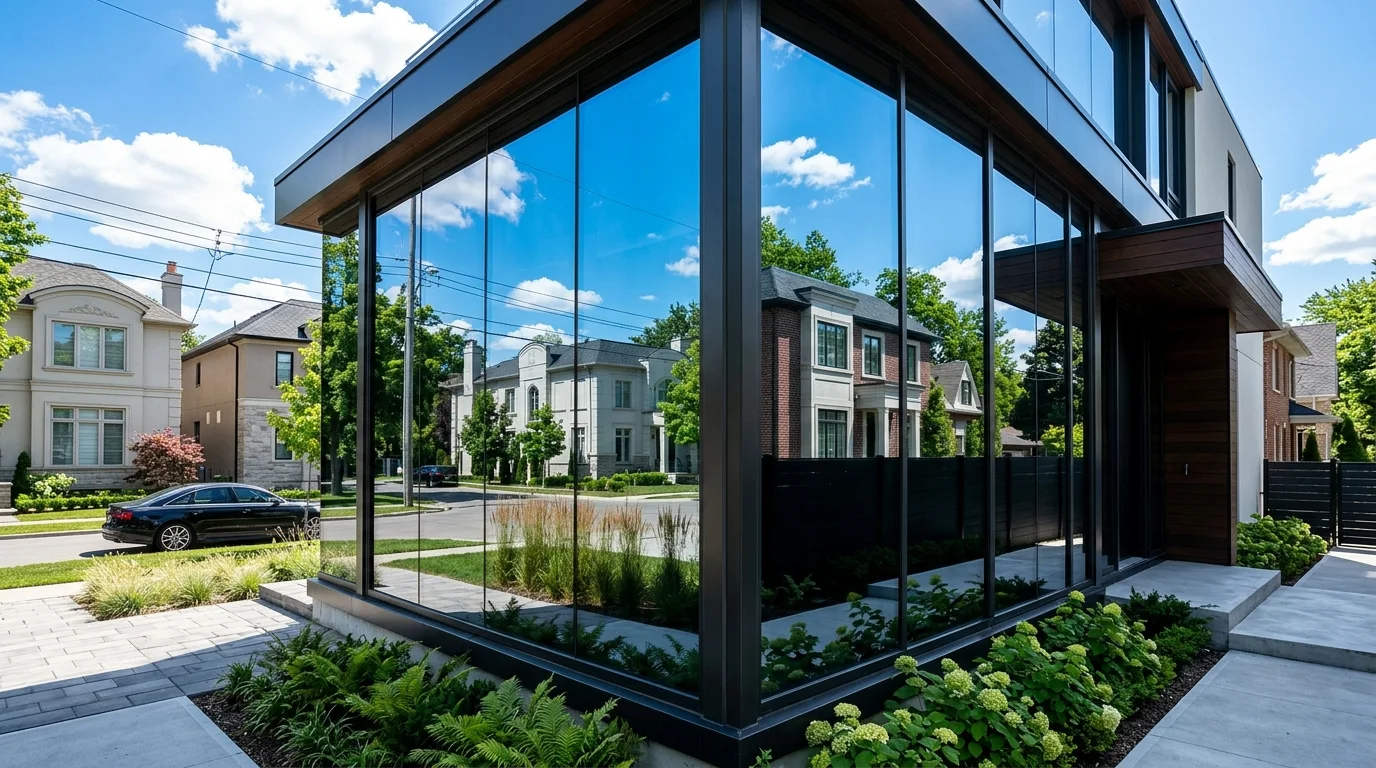
The premier daytime privacy solution for luxury estates where 100% daytime visibility is essential, particularly for living rooms and home offices facing estate roads or adjacent homes. These films feature precision micro-sputtered metallic coatings with high exterior reflectance (30% to 42%). The exterior appears as an elegant architectural mirror reflecting greenery and sky, while interior occupants enjoy completely clear, natural views looking out.
2. Deep Nano-Ceramic and Polarized Films
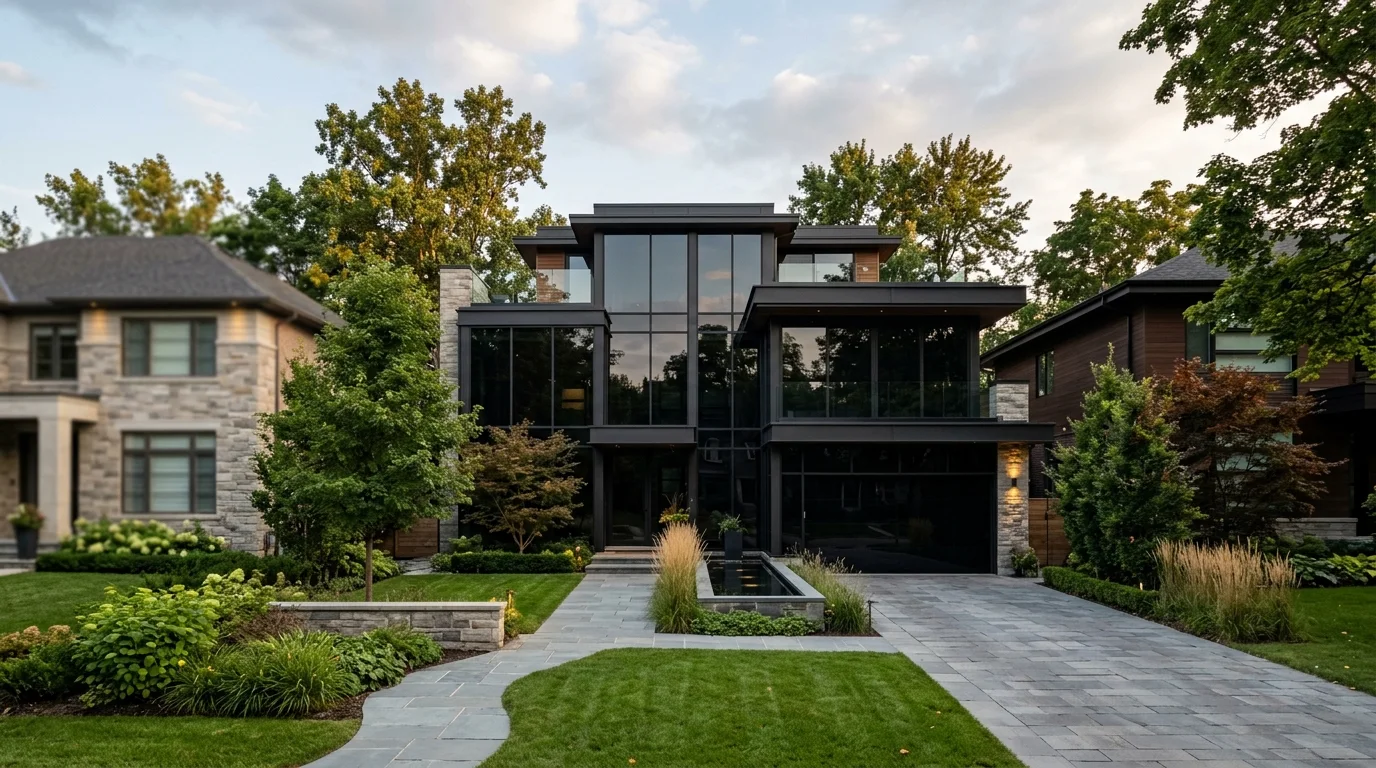
Designed for homeowners favoring modern loft, modern tropical, or minimalist aesthetics who want to avoid an exterior mirrored sheen. Premium nano-ceramic films like MAXXMA Polarized and Black Panther in 80% to 90% darkness (VLT 5% to 8%) absorb excess glare and minimize light transmittance. From outside, the glass presents a sophisticated deep graphite appearance with no inward visibility. From inside, residents enjoy clear, glare-free views with zero distorted reflections.
3. Luxury Sheer Linen Curtains and Voile
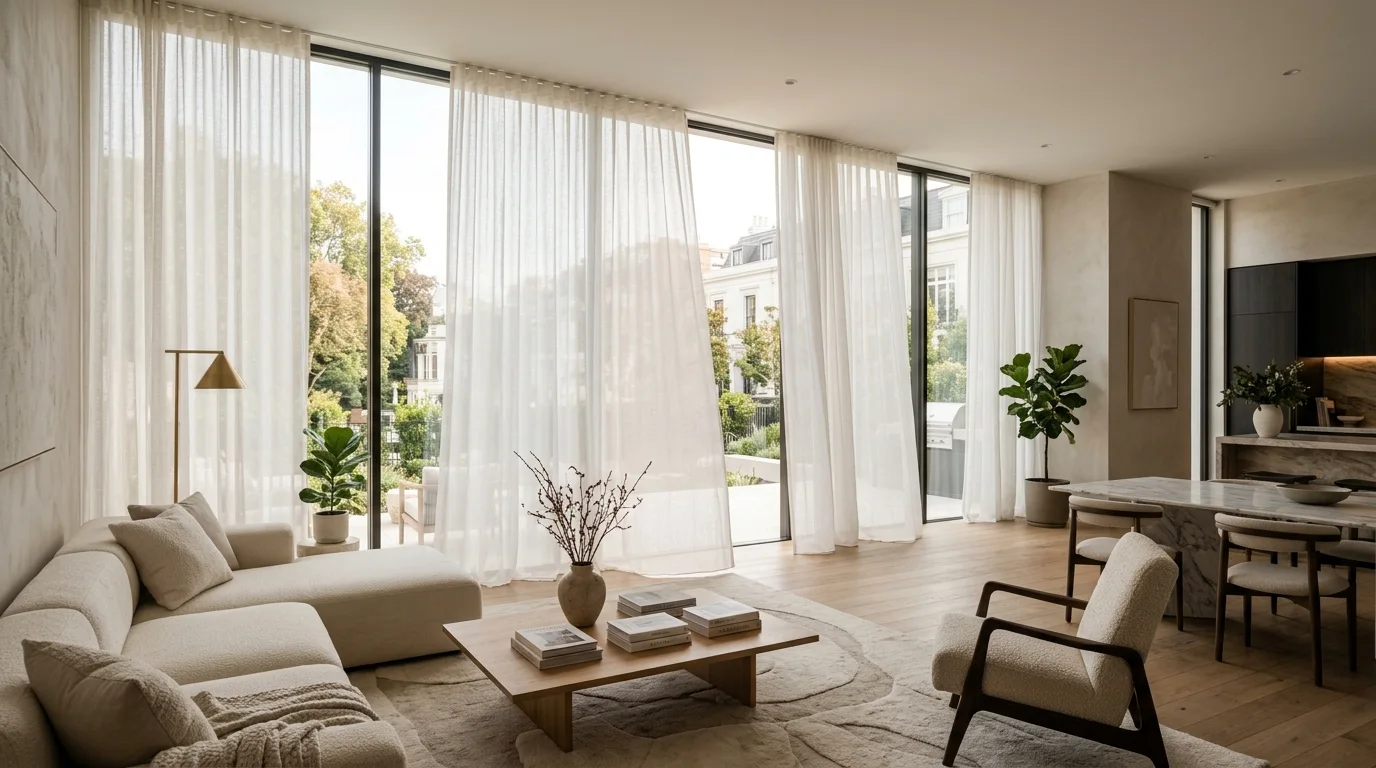
The art of a layered privacy strategy involves pairing window film with floor-to-ceiling sheer linen or voile drapery suspended from recessed ceiling tracks. Sheer curtains softly diffuse intense daylight, creating an inviting ambient glow while obscuring interior details. In the evening when interior lights are switched on, sheer drapery acts as a gentle first line of privacy without the visual heaviness of solid blackout curtains.
4. Biophilic Landscaping and Natural Screening
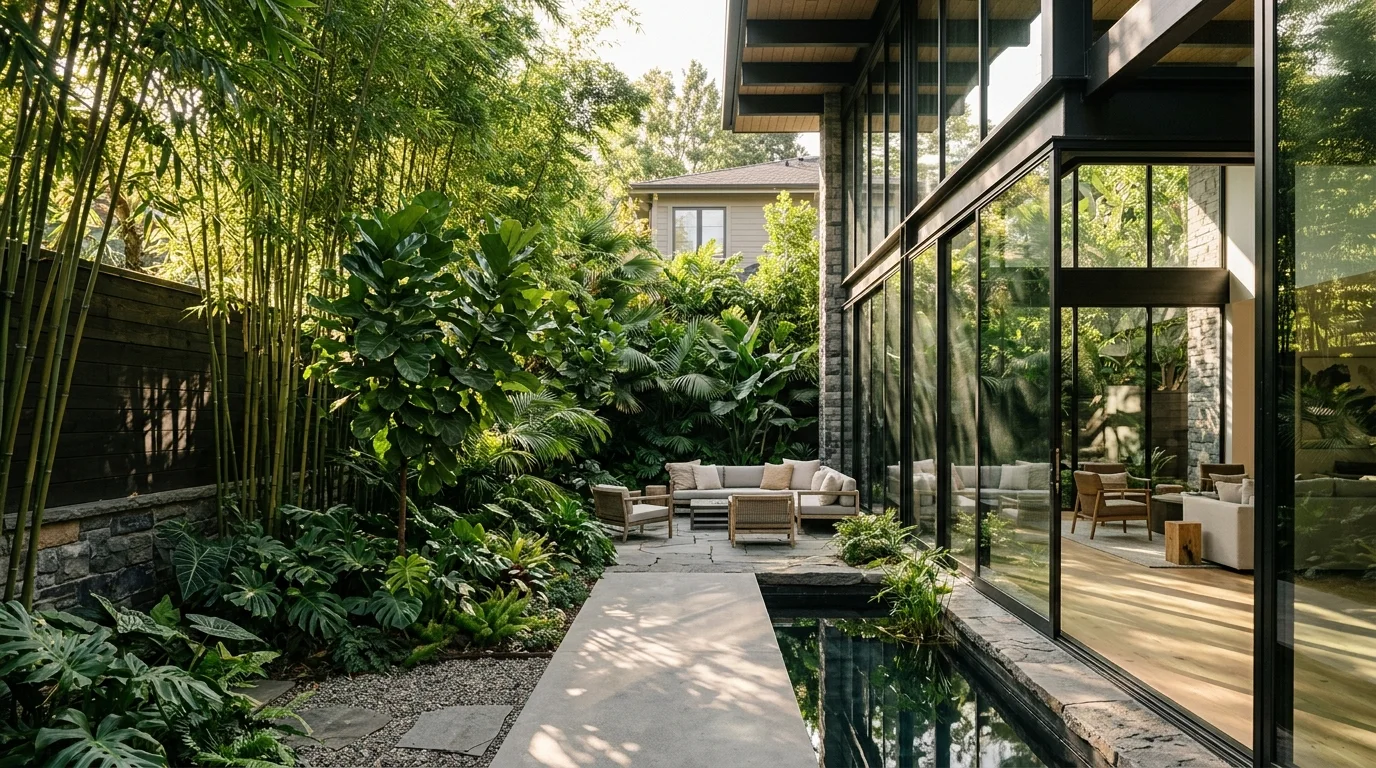
Integrating nature into architectural glazing through strategic landscape buffers, such as clumping bamboo, broadleaf tropical plants, or vertical green walls aligned with property boundaries. This organic buffer gently intercepts sightlines from neighboring second-floor windows while casting soothing, dappled shadow patterns indoors and lowering exterior ambient temperatures.
MAXXMA Window Film Specification Matrix for Architectural Privacy
The following technical specifications have been tested under international testing standards to assist homeowners, architects, and interior designers in selecting the ideal film balance:
| Film Series (Model) | Core Material | Darkness | VLT | Ext Refl | Int Refl | IR Rejection | Total Solar (TSER) | Privacy Rating |
|---|---|---|---|---|---|---|---|---|
| Refined MX-BL05 | Sputtered Metallized Ceramic | 80% | 5% | 42% | 15% | 88% | 90% | Maximum (Crisp One-Way) |
| Refined MX-BL20 | Sputtered Metallized Ceramic | 60% | 20% | 32% | 20% | 77% | 80% | High (One-Way Bright View) |
| Refined MX-CG05 | Sputtered Metallized Ceramic | 80% | 5% | 14% | 8% | 80% | 88% | Very High (Classic Charcoal) |
| Refined MX-CG20 | Sputtered Metallized Ceramic | 60% | 20% | 20% | 15% | 75% | 78% | Medium (Translucent Charcoal) |
| Polarized MX-PR05 | Premium Nano-Ceramic | 80% | 5% | 6% | 6% | 99% | 97% | Very High (Low-Reflective Dark) |
| Polarized MX-PR20 | Premium Nano-Ceramic | 60% | 20% | 6% | 6% | 99% | 91% | High (Anti-Glare Comfort) |
| Black Panther MX-BP05 | Nano-Carbon Ceramic | 90% | 8% | 7% | 7% | 90% | 91% | Very High (Deep Stealth Black) |
| Black Panther MX-BP20 | Nano-Carbon Ceramic | 60% | 20% | 7% | 7% | 85% | 83% | High (Smoked Graphite) |
To explore complete architectural film product lineups and test certifications, visit our MAXXMA Architectural Window Films portal.
Real InstallationReal Installation Showcase: Witnessing Clarity and Privacy On Site
Experience the real-world performance and aesthetic results of MAXXMA window film installed on a luxury detached home at Setthasiri Krungthep Kreetha by our master installation team:
On-site video demonstration of MAXXMA window film installed for enhanced privacy, heat rejection, and optical clarity at Setthasiri Krungthep Kreetha.
5-Point Pre-Installation Checklist for Lighting and View Angles
Before finalizing your window film selection, audit your home environment with this practical 5-point checklist:
- Sun Exposure Orientation: Are target glass panes facing west or south where intense afternoon solar heat strikes? If so, prioritize high thermal rejection (TSER exceeding 80%).
- Pedestrian and Neighbor Distance: How far do pedestrians or neighbors stand from the glass? If the distance is under 3 to 5 meters, films with exterior reflectance of 30% or higher provide the most reliable daytime concealment.
- Indoor Illumination Needs: Does the room require ample natural daylight for reading or office work? If so, select a VLT 20% shade rather than an ultra-dark VLT 5% shade.
- Nighttime Lighting Placement: Avoid positioning high-wattage floor lamps or spotlights aimed directly at glass surfaces, as this produces harsh interior reflections that impair outward night vision.
- On-Site Sample Evaluation: Always request certified technicians to apply real film swatch samples directly onto target windows to inspect tint, tone, and visibility under real lighting conditions.
Frequently Asked Questions (FAQ)
Does one-way privacy film provide complete 24-hour privacy?
One-way film functions according to light intensity differentials. During daytime hours when outdoor light is brighter, it provides total privacy. At night when indoor lights are activated, the interior becomes brighter, allowing people outside to see in. We recommend pairing window film with sheer curtains, blinds, or exterior landscape uplighting for seamless evening privacy.
Will reflective window film create disturbing glare for neighbors?
MAXXMA architectural films are engineered within international residential reflectance standards (30% to 42%). This delivers excellent daytime privacy screening without producing harsh mirror glare that could inconvenience neighboring properties.
Can automotive window film be used on residential building glass?
While raw material foundations are related, architectural glass features greater thickness, larger surface areas, and higher thermal stress loads than automotive glass. Selecting specialized architectural films and certified installation prevents glass fracture risks from thermal expansion. Learn more in our guide on Automotive vs. Architectural Window Film Material Science.
Will installing privacy window film harm indoor houseplants?
No. Houseplants require visible light (within the 400 to 700 nanometer spectrum) for photosynthesis, which MAXXMA films transmit according to the selected VLT rating. Filtering out harmful ultraviolet rays and excessive infrared heat protects delicate indoor foliage from sun scorch.
How long is the lifespan and warranty of MAXXMA architectural window film?
MAXXMA architectural films deliver a durable lifespan of 5 to 7+ years without bubbling, peeling, or fading, backed by official warranty coverage. Review warranty terms and registration details at the MAXXMA Warranty Portal.
💬 Complimentary Consultation with MAXXMA Architectural Film Specialists Need tailored advice on selecting one-way privacy film, reflective solar control, or a custom glass measurement quote? Contact our technical team directly on LINE Official: @maxxma
Talk to the MAXXMA team
and choose the right film for your project
References and Standards
- Lawrence Berkeley National Laboratory (LBNL), Window and Daylighting Group: Research on optical properties, visible light transmittance (VLT), and energy performance of fenestration systems: https://windows.lbl.gov/
- International Window Film Association (IWFA), Architectural Solar Control Film Guidebook: Guidelines on solar control, glare mitigation, and privacy standards for architectural glazing: https://iwfa.com/
- National Fenestration Rating Council (NFRC), Standard Test Procedures for Determining Fenestration Product Solar Heat Gain Coefficient and Visible Transmittance at Normal Incidence: https://www.nfrc.org/
Ready to protect your home or vehicle?
Consult with MAXXMA experts to select the perfect film for your needs, or find an authorized dealer near you.