
The Dilemma of Modern Glass Living: Craving Natural Light, Trapped in an Oven
There is an undeniable romance in modern glass architecture. Floor-to-ceiling panoramic windows dissolve the boundary between indoor sanctuary and the lush greenery outside. Morning sunlight pours across polished stone floors, filling the living space with life, airiness, and effortless luxury.
Yet, as mid-afternoon arrives in a tropical climate, that architectural dream often meets an uncomfortable reality. Sunlight carries immense radiant heat. Within hours, expansive glass walls turn from an aesthetic masterpiece into a greenhouse heat trap:
- Indoor temperatures inside sunrooms and glass living halls can climb 5 to 10 degrees Celsius higher than shaded outdoor spaces.
- Air conditioners run continuously at maximum capacity, driving up electricity bills while the room still feels stifling and humid.
- Cherished reading corners and dining spaces next to the windows become unusable during the brightest hours of the day.
- Homeowners often feel forced to draw heavy, blackout curtains, instantly sacrificing the garden views and natural daylight they built the room to enjoy.
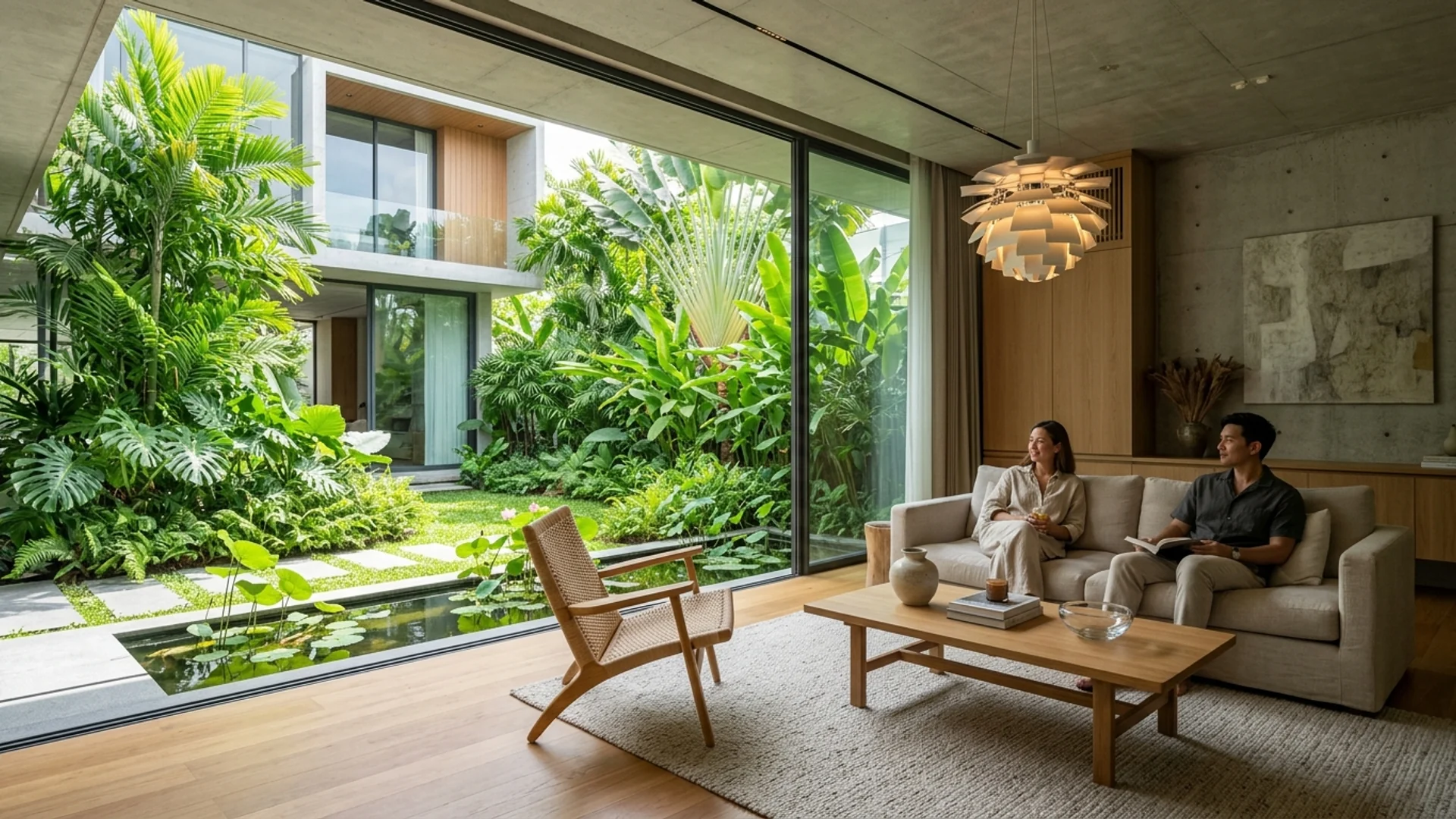
This brings us to one of the most important questions in modern interior architecture: How can we cool a sun-drenched glass home effectively, maintaining serene thermal comfort and energy efficiency, without losing a single inch of our panoramic view?
Thermal PhysicsThe Science of Heat Transfer: Why Standard Glass Traps Intense Warmth
To solve the heat problem gracefully, we must first appreciate how solar energy interacts with glass surfaces. In building physics, solar heat moves through three primary channels:
- Solar Radiation (The Invisible Energy): Solar energy consists of 53% Near-Infrared rays (the primary source of burning heat), 44% Visible Light (illumination), and 3% Ultraviolet rays (the cause of fabric fading and skin aging). When unshielded glass lets these rays pass through, the energy is absorbed by your floors, rugs, and furniture. These surfaces re-radiate that energy as far-infrared heat waves, which cannot easily escape back through standard glass, creating the classic greenhouse effect.
- Thermal Conduction (Direct Contact): Hot ambient outdoor air heats the exterior surface of the window pane. The glass conducts that heat directly through its material thickness to the interior side. Standard single-pane float glass has minimal thermal resistance, making conduction rapid and continuous.
- Air Convection (Trapped Air Currents): Warm air naturally expands, becomes lighter, and rises toward the ceiling. In glass rooms without dedicated ventilation pathways, layers of superheated air accumulate beneath glass roofs and upper ceilings, creating persistent thermal stagnation.
True thermal serenity requires a layered approach: blocking radiant heat before it penetrates the living zone while curating surrounding airflow and interior aesthetics.
5 Step Systematic Solution5 Thoughtful Ways to Cool a Glass House Without Compromising Your View
From structural architectural details to state-of-the-art optical material science, here are 5 proven methods to restore cool tranquility to your glass sanctuary:
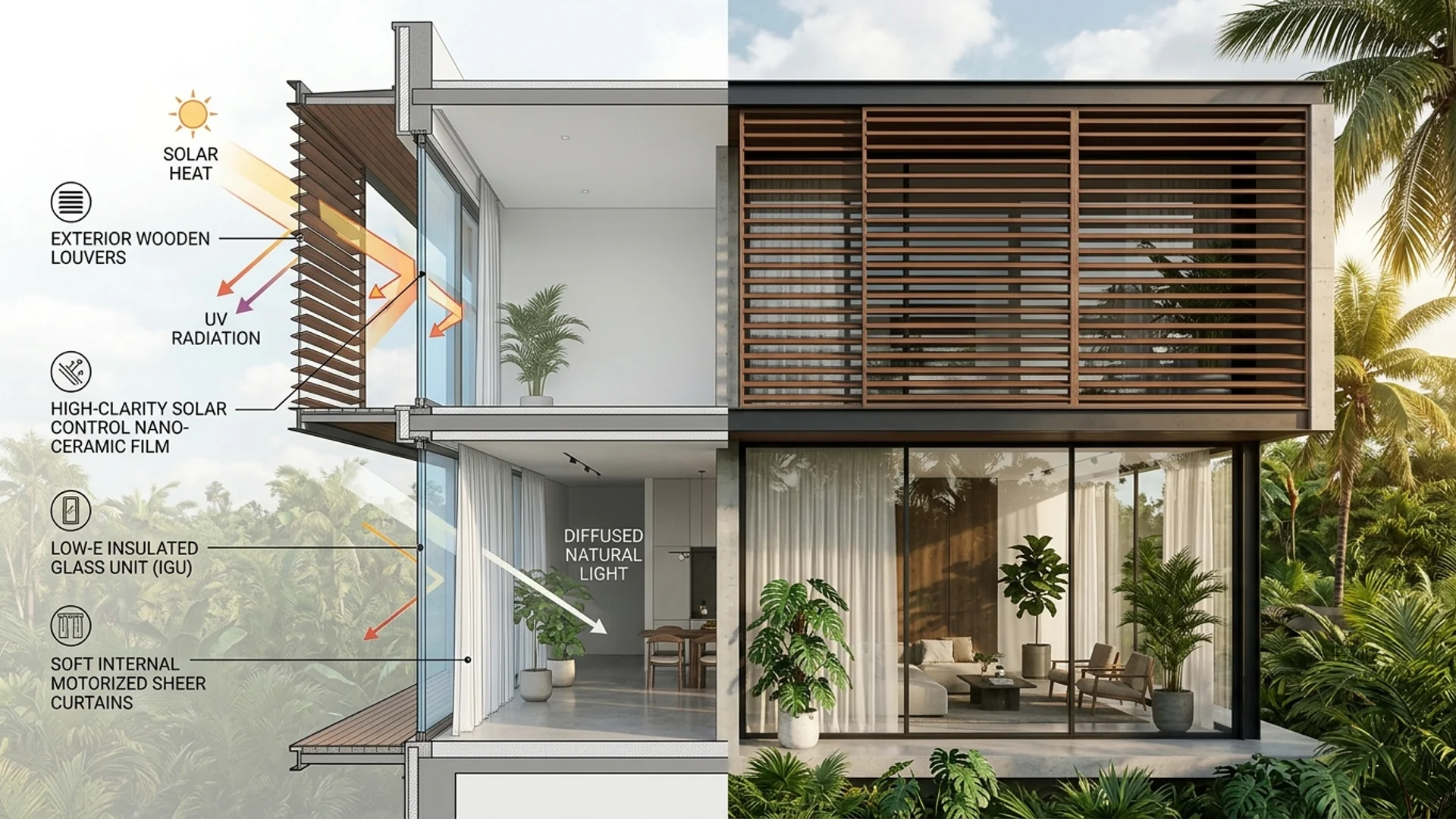
Method 1: Exterior Shading and Architectural Overhangs
The most effective rule of architectural thermodynamics is simple: intercept solar rays before they ever strike the glass surface.
- Deep Eaves and Horizontal Louvers: For south-facing glass walls where the tropical sun rides high overhead at midday, an overhang extending 1.2 to 1.5 meters can shield more than 60% of direct overhead solar rays.
- Vertical Timber or Aluminum Fins: Ideal for east and west orientations, where morning and late-afternoon sunlight strikes at low angles.
- Bioclimatic Landscaping: Planting mature canopy trees or sculptural tropical palms creates organic dappled shade along western facades. Natural leaf transpiration cools the microclimate around your home by 2 to 3 degrees Celsius.
The Benefit: Stops heat before it touches the glass, keeping the building envelope cooler. The Trade-off: Requires exterior land footprint, may alter clean facade lines, and involves significant construction investment.
Method 2: Passive Natural Cross-Ventilation
Many sunrooms become unbearable simply because they are designed as completely sealed, fixed glass boxes with nowhere for rising thermal pockets to escape:
- Upper Stack-Effect Openings: Because hot air naturally rises, installing high-level awning windows, motorized clerestory louvers, or discreet ceiling vents allows trapped heat to exhaust automatically through natural buoyancy.
- Low-Level Breeze Inlets: Positioning openable floor-to-waist vents along the path of prevailing seasonal breezes pulls in cooler ground-level air, creating gentle, continuous air movement.
The Benefit: Uses zero electricity, refreshes indoor air quality, and prevents stuffiness. The Trade-off: Ineffective on stagnant windless days or during humid rainstorms, and must be closed when outdoor particulate pollution (PM2.5) levels are elevated.
Method 3: Internal Blinds, Louvers, and Sheer Window Treatments
Interior window coverings remain a beloved choice for soft ambiance, privacy, and light modulation:
- Linen Sheer Drapes: Soften blinding glare into a warm, gentle glow while allowing subtle silhouettes of the garden to filter through.
- Adjustable Wooden Venetian Blinds: Allow you to angle the horizontal slats to bounce direct sunlight upward toward the ceiling, reducing eye strain.
- Solar Screen Roller Blinds: Engineered from specialized woven fibers with a 3% to 5% openness factor, cutting harsh glare while letting you look through the fabric during daylight hours.
The Benefit: Offers flexible mood lighting and enriches interior texture. The Trade-off: Fabric and blinds sit inside the glass, meaning solar heat has already entered the room. Trapped heat builds up between the glass and curtain, eventually radiating into the living space unless paired with a high-performance solar film.
Method 4: High-Performance Insulated Low-E Glass Units (IGU)
For homes in the design phase or undergoing major renovations, upgrading the core glazing specification yields profound long-term insulation:
- Double Glazed Insulated Glass (IGU): Two panes separated by a sealed cavity filled with dry air or inert argon gas, creating an exceptional barrier against thermal conduction and outdoor noise.
- Low-Emissivity (Low-E) Coatings: Microscopically thin metallic coatings that reflect long-wave infrared heat back outside while welcoming natural daylight.
The Benefit: Superior thermal resistance (low U-value) and whisper-quiet acoustic insulation. The Trade-off: Heavier glass requires reinforced structural window frames, costs 3 to 5 times more than standard glass, and is costly to retrofit into completed homes.
Method 5: Optical Nano-Ceramic Solar Control Window Films
For homeowners seeking maximum heat rejection with 100% crystal-clear garden views without structural disruptions, retrofitting Architectural Window Films is the most sophisticated, direct, and cost-effective solution.
MAXXMA Nano-Ceramic Architectural Films utilize inorganic ceramic nano-particles deposited onto optical-grade polyester (PET):
- Up to 99% Infrared Heat Rejection (IR): Blocks the primary source of burning solar heat right at the glass surface.
- Flawless High-Definition Clarity: Available in balanced Visible Light Transmittance (VLT) options from airy 40% to 60% high-clarity films to elegant 5% to 20% executive privacy tones, ensuring your landscaped views remain vivid and undistorted.
- 99% Complete UV Shield: Protects Italian leather sofas, teak wood furniture, imported wool rugs, and artwork from premature fading, cracking, and sun bleaching.
- Balanced Thermal Stress Compatibility: Specially engineered for architectural flat glass with balanced solar reflectance and low absorption, keeping standard float and tempered panes entirely safe from heat-stress fractures.
The Benefit: Fast, non-invasive installation, instant noticeable temperature drop, zero structural modification, and immediate energy savings on monthly cooling costs.
Comparison MatrixComparing the 5 Glass House Cooling Strategies
To help you choose the ideal balance for your home, here is how each solution performs across key lifestyle and comfort metrics:
1. Exterior Overhangs and Shading
- Heat Rejection
- Very High (Exterior)
- View Preservation
- Partial (Angled cut)
- Natural Daylight
- Directional
- Investment Level
- Moderate to High
2. Passive Cross-Ventilation
- Heat Rejection
- Moderate (Air Exhaust)
- View Preservation
- 100% Clear
- Natural Daylight
- Full Passage
- Investment Level
- Low to Moderate
3. Interior Curtains and Blinds
- Heat Rejection
- Low to Moderate
- View Preservation
- Lost When Closed
- Natural Daylight
- Customizable
- Investment Level
- Low to Moderate
4. Low-E Double Glazed (IGU)
- Heat Rejection
- Very High
- View Preservation
- 100% Clear
- Natural Daylight
- High Passage
- Investment Level
- Very High
★ 5. MAXXMA Architectural Film
- Heat Rejection
- Up to 99% IR
- View Preservation
- 100% HD Clarity
- Natural Daylight
- Glare-Free Soft Light
- Investment Level
- Cost-Effective & Fast
| Cooling Strategy | Heat Rejection | View Preservation | Natural Daylight | Investment & Installation |
|---|---|---|---|---|
| 1. Exterior Overhangs & Shading | Very High (Exterior Line) | Partial (Angle Reduced) | Directional Sunlight | Moderate to High Cost |
| 2. Passive Cross-Ventilation | Moderate (Air Exhaust) | 100% Unobstructed | Full Natural Passage | Low to Moderate Cost |
| 3. Interior Curtains & Blinds | Low to Moderate | Lost When Closed | Modulated Light | Low to Moderate Cost |
| 4. Low-E Insulated Glazing (IGU) | Very High | 100% Unobstructed | High Natural Light | Very High (Full Replacement) |
| ★ 5. MAXXMA Architectural Film | Up to 99% IR Rejection | 100% HD Optical Clarity | Glare-Free Soft Light | Highly Cost-Effective & Fast |
Curated MAXXMA Film Collections for Every Glass House Aesthetic
Selecting the right film specification depends on your room orientation, lighting desires, and lifestyle priorities:
MAXXMA Polarized Series
High-definition nano-ceramic film tailored for living spaces where preserving vivid, true-to-life garden colors and cutting harsh outdoor glare is paramount.
- IR Rejection
- 99%
- UV Block
- 99%
- Max TSER
- 97% (MX-PR05)
- VLT / Warranty
- 5-60% / 5 Years
MAXXMA Independent Plus Series
Engineered with complete 100% UV400 spectrum block, safeguarding bespoke European leather upholstery, natural teak cabinetry, and valuable fine art from photodegradation.
- UV400 Block
- 100%
- IR Rejection
- 97-99%
- Max TSER
- 95% (MX-IP10)
- VLT / Warranty
- 10-55% / 5 Years
MAXXMA Black Panther Series
Deep architectural charcoal exterior profile paired with crisp, crystal-clear interior sightlines. The perfect solution for road-facing master suites and private home offices.
- Technology
- Nano Carbon
- IR Rejection
- 83-87%
- Max TSER
- 91% (MX-BP05)
- VLT / Warranty
- 5-35% / 5 Years
MAXXMA Refined Series
Ceramic metallized hybrid film built specifically for unforgiving western afternoon sun, utilizing reflective micro-layers to bounce thermal waves back outward.
- Technology
- Ceramic Metal
- IR Rejection
- 70-80%
- Max TSER
- 88% (MX-CG05)
- VLT / Warranty
- 5-35% / 5 Years
Preparing for Your Architectural Consultation and On-Site Audit
To ensure the most accurate film recommendation for your residence, having a few initial details ready will help our architectural specialists tailor the ideal configuration:
Video guide demonstrating the professional on-site evaluation process and material swatch audit with MAXXMA specialists.
- Sun Exposure Orientation: Identify the primary compass direction your glass walls face (e.g. south, southwest, or west) to calculate peak sun angles.
- Glass Type and Thickness: Note whether your existing windows are clear float, green-tinted solar, tempered, or laminated, ensuring complete thermal stress safety.
- Room Intent and Lifestyle Focus: Clarify whether the space is designed for entertaining, garden viewing, glare-free computer work, or restful sleeping.
- Energy Efficiency Forecast: Estimate your potential cooling energy reduction and payback timeline using the MAXXMA Building Energy Calculator.
Frequently Asked Questions (FAQ)
1. Which area of an overheated glass house should be prioritized first?
Building engineers recommend beginning with glass walls exposed to intense afternoon sun (south and southwest facades). Applying high-performance nano-ceramic film to these primary zones stops heat at the threshold, immediately easing the cooling load across adjacent living areas.
2. Can clear window film genuinely reject intense heat?
Yes. Modern nano-ceramic films, such as the MAXXMA Polarized Series (MX-PR40 / MX-PR60), are engineered to selectively reject up to 99% of infrared radiation (the invisible heat wavelength) while permitting generous visible light transmittance (VLT). This ensures cool indoor comfort without darkening your rooms or distorting garden views.
3. Will installing window film reduce the need to resize my air conditioning?
Applying high-performance solar control film significantly lowers the room’s total cooling load. Your existing air conditioner can reach its thermostat setpoint much faster and cycle down smoothly, reducing compressor wear and tear and lowering monthly power bills without requiring costly HVAC replacements.
4. Can automotive window film be applied to residential architectural glass?
No. Automotive films are formulated primarily around heat absorption, relying on the vehicle’s forward motion and airflow to dissipate absorbed heat. On static architectural glass, excessive heat absorption can cause dangerous thermal expansion differences across the frame, leading to thermal stress glass breakage. Always choose films formulated specifically for architectural flat glass.
Related Guides and Insights
- Bright and Beautiful Glass Living: 5 Decor Ideas for Sunlit Homes Without Heat Trap
- Glass House Privacy Without Heavy Drapes: Modern Screening Solutions
- Glass House Safety Guide: What to Do If Glass Breaks
- MAXXMA Building Energy Calculator Tool
- Explore All MAXXMA Architectural Window Film Collections
Transform Your Overheated Glass House into a Cool Sanctuary
Consult with MAXXMA architectural glazing specialists to discover tailored window film solutions that preserve your garden views. Enjoy complimentary on-site audits and customized estimates.
Ready to protect your home or vehicle?
Consult with MAXXMA experts to select the perfect film for your needs, or find an authorized dealer near you.