
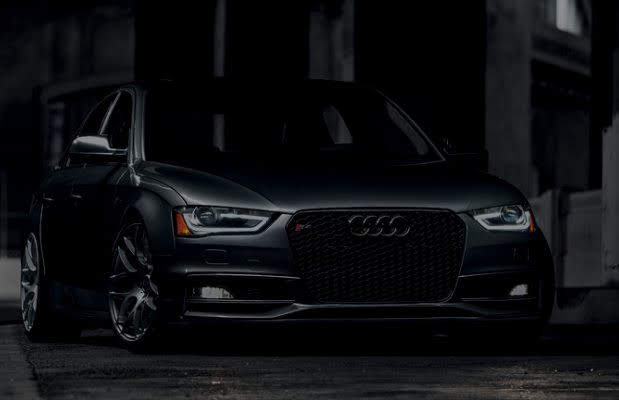
01 The Hook: The Free Dealer Film Trap — The Most Expensive “Freebie” in Car Ownership
You just drove your brand new car out of the showroom. The new car smell still lingers in the cabin. The dealer smiles and hands you a special offer: “Free window film for the entire car.” You’re delighted to get a freebie worth thousands without opening your wallet.
Six months later…
You start to notice that every time you park in the noon sun, the cabin feels like an oven. The AC has to be cranked to the max and takes much longer to cool down. The rearview mirror starts getting foggy, and worst of all, the film that used to be pitch black is turning a purplish-red. Nighttime visibility has noticeably worsened.
You drive back to the film shop. The shop tells you: “The film has degraded. It needs to be stripped and reinstalled.”
This is the moment you realize that the “freebie” is the most expensive, because you have to pay a lump sum to strip the old film—a glue removal process that might damage the rear window defroster lines—and then install completely new film. The total cost is several times higher than installing good film in the first place.
This article will take you deep into every dimension of comparing budget window film with premium film: from production mechanisms, technological differences, and the science of heat, to a checklist for choosing a film that is worth the long-term investment.
02 The Deep-Dive: Exploring Film Technology — Why Does Cheap Film Fail Sooner Than You Think?
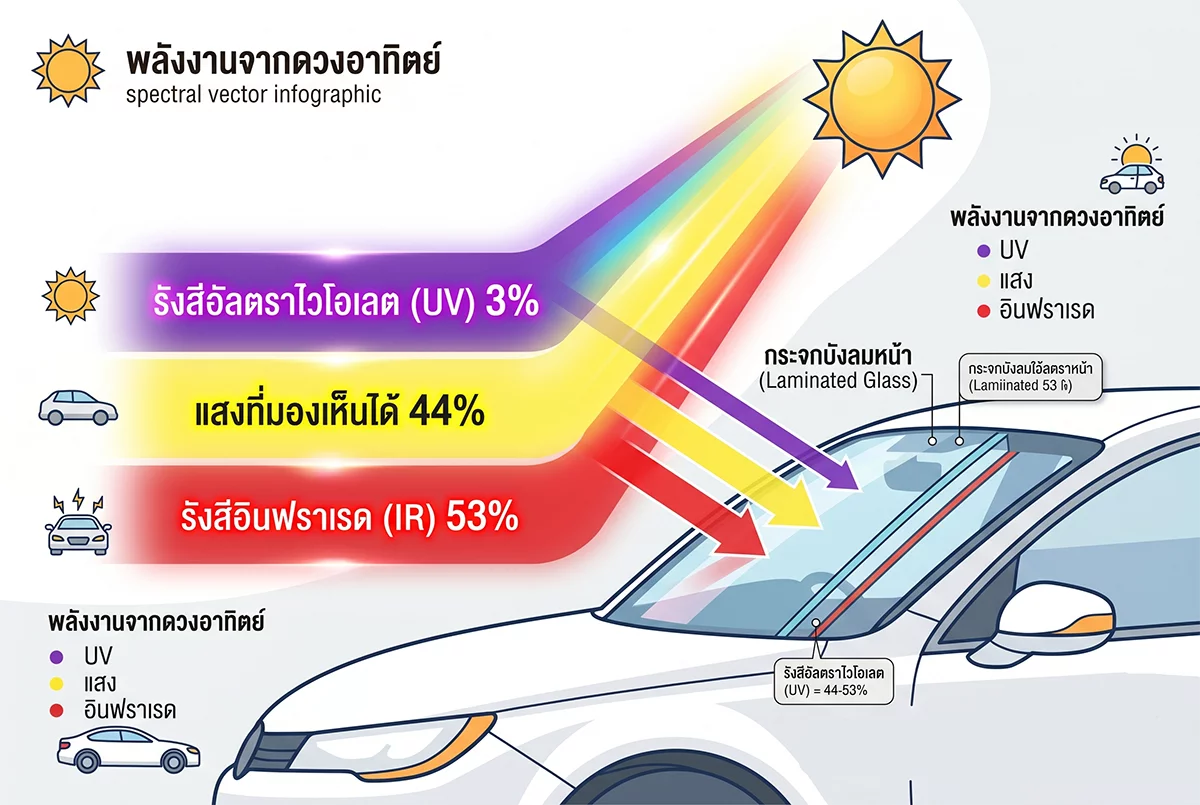
To understand why cheap film fails to block heat, we first need to know that the sunlight entering the car consists of 3 types of rays:
UV Rays — 3%
The main culprit that destroys skin collagen, causing premature aging, blemishes, freckles, and increasing the risk of skin cancer. It also causes consoles, dashboards, and leather seats to fade and crack.
Visible Light — 44%
The light used to see the road and surroundings. If it’s too intense, visibility is reduced, risking accidents at night.
Infrared (IR) Rays — 53%
The “big boss” responsible for heat. These are invisible heat waves that the skin feels directly, making the car stifling hot and forcing the AC to work hard.
Budget Film Technology: Dyed Film — Dark but Not Cool
Most budget films are produced using a “Dyed Polyester” process, where a clear polyester sheet is dipped in dye to make it darker simply to reduce the amount of Visible Light. This type of film:
- Cannot effectively block Infrared (IR) rays — The dye in the film is not designed to filter infrared heat waves. As a result, you get a film that looks dark, but heat still floods into the car completely. It’s like wearing a thick black shirt in the sun—dark, but so hot you sweat profusely.
- Lacks a high-quality UV filter layer — Standard dyed films typically only have a thin UV inhibitor on the surface, which degrades rapidly under continuous strong sunlight. Once the UV layer loses its effectiveness, UV rays penetrate, damaging skin and the cabin interior.
- Dye Degradation occurs very quickly in hot and humid climates like Thailand — Dye molecules break down and oxidize with long-term UV exposure, causing the film to change from black to purple (Purple Film Syndrome). Within just 6-18 months, the film will start fading, become uneven in color, and visibility will drop significantly.
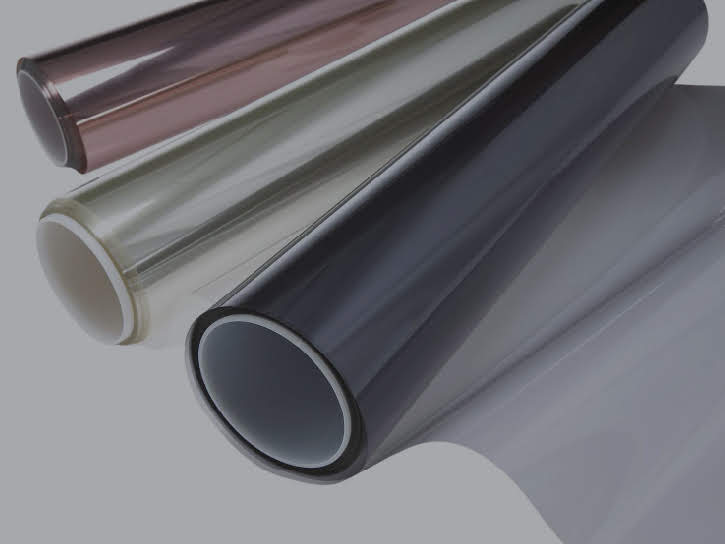
Premium Film Technology: Nano Ceramic — Truly Cool Without Being Too Dark
Premium films use entirely more advanced manufacturing technologies:
- Sputtering and Nano Ceramic Technologies: Nanometer-sized ceramic particles are embedded into high-quality polyester film using molecular-level control processes. These ceramic particles act as “light frequency filters” that selectively allow visible light to pass through while reflecting and absorbing infrared heat rays. This gives the film high clarity while delivering superior heat rejection.
- Permanent UV Filter Layer: Premium ceramic films have UV inhibitors embedded deep within the film’s entire thickness (not just a thin surface coating), allowing them to block 99%+ of UV rays for the film’s entire lifespan.
- Color Stability: Because they don’t use dyes for darkness, ceramic films never turn purple. The film’s color remains stable throughout its long lifespan of 7-10 years.
03 The Science & Fallacy: Debunking 4 Myths About Cheap vs. Premium Film
❌ Myth #1: “Dark Film = Good Heat Rejection”
✅ Scientific Fact: Heat rejection capability doesn’t depend on visible “darkness” but is measured by TSER (Total Solar Energy Rejected). A cheap black dyed film might have a low VLT of 5-20% (looking very dark) but a TSER of only 20-35%. Meanwhile, a clear nano-ceramic film with a VLT of 40-60% can have a TSER as high as 70-90% — a clearer film can block heat many times better than a cheap dark film.
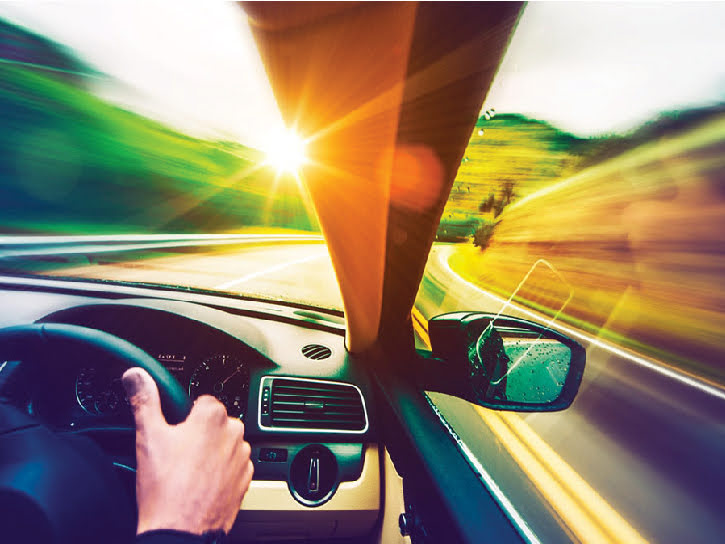
❌ Myth #2: “Cheap film is fine for 2-3 years, replace it when it degrades”
✅ Fact: This logic actually costs more money because of: (1) The cost of stripping the old film, which requires labor and chemicals to remove glue, risking damage to the rear window defroster lines (thousands of baht to repair); (2) The cost of installing new film at full price again; and (3) Opportunity costs over the 2-3 years of enduring a hot car, overworked AC, wasted fuel/battery, and rapid deterioration of the console and leather seats.
❌ Myth #3: “All ceramic films are the same, they just differ in price”
✅ Fact: The quality of ceramic particles, coating density, types of adhesives, and the quality of the base polyester film vary massively. Low-grade films often develop “Haze”, peeling, and blurred visibility. All MAXXMA film models select premium raw materials and control production to international standards, delivering high clarity and maintaining performance throughout the warranty period.
❌ Myth #4: “Cheaper film saves more money”
✅ Fact: If looking only at the initial installation cost, cheaper film is cheaper. But when applying the Total Cost of Ownership (TCO) concept over 7 years, the picture changes entirely (see table below).
| Item | Budget Film (Dyed Film) | Premium MAXXMA Film (Nano Ceramic) |
|---|---|---|
| Initial Installation Cost | 2,000 - 5,000 THB | Varies by selected model |
| Number of Replacements in 7 Years | 2-3 times (degrades every 2-3 years) | 0 times (Guaranteed 7 years) |
| Cost of Stripping + Re-installing (Each Time) | 3,000 - 8,000 THB | None |
| Risk of Rear Window Damage | High (frequent glue removal) | Very low |
| Increased AC/Fuel Cost from Degraded Film | Accumulates every month | None — Film retains performance |
| Car Resale Value | Decreases (faded console/seats) | Maintains good condition |
| Estimated Total Cost over 7 Years | 12,000 - 29,000+ THB | Pay once, done |
This is why “cheap film” is always more expensive in the long run — the price tag on day one is not the true cost.
04 The Ultimate Defense: MAXXMA Window Film Technology Designed for Thai Roads
MAXXMA offers window film technology specifically developed to handle Thailand’s hot and humid climate. Every model comes with a maximum 7-year quality warranty:
MAXXMA POLARIZED (MX-PR) — Flagship · Clarity, Nano Ceramic
MAXXMA’s flagship nano-ceramic film is suited for those seeking maximum protection:
- Technology: 100% Genuine Nano Ceramic, completely metal-free
- Infrared (IR) Rejection: Up to 99%
- UV Rejection: 99%
- Highlights: Optical Grade maximum clarity for excellent visibility day and night. Very Low Internal Reflectivity, ensuring no interference with touchscreens or Head-Up Displays. Pitch black on the outside, bright and clear on the inside.
- Best For: Electric Vehicle (EV) users with large panoramic glass roofs, luxury cars, those prioritizing night driving safety, and those wanting maximum protection without sacrificing visibility.
View more details on MAXXMA POLARIZED →
MAXXMA BLACK PANTHER (MX-BP) — Dark Sport, Nano Carbon Ceramic
A film that blends a sporty black tone with superior heat rejection performance:
- Technology: Nano Carbon Ceramic
- Infrared (IR) Rejection: 83–87% (up to 87% on MX-BP05)
- UV Rejection: 99%
- Highlights: Premium sporty pitch-black tone, providing an aggressive look and high daytime privacy from the outside, while maintaining clear outward visibility. Controls internal light dispersion (Low Internal Reflectivity) to reduce screen glare.
- Best For: Sports cars, SUVs, and those wanting a Dark Sport look coupled with practical cooling.
View more details on MAXXMA BLACK PANTHER →
MAXXMA REFINED (MX-R) — Color Style, Ceramic Metallized
A film chosen for the colour and look of the glass, on the same price list as BLACK PANTHER:
- Technology: Ceramic Metallized
- Infrared (IR) Rejection: Up to 88% (MX-BL05)
- UV Rejection: 99%
- Highlights: Classic dark (CG), metallic blue (BL) and green (GN) tones in one series. It contains metal, so it affects GPS navigation and Easy Pass, most of all in the high-metal codes MX-BL05, MX-BL20 and MX-CG05.
- Best For: Drivers who choose film by colour and the character of the car, and want blue, green, or glossy dark glass.
View more details on MAXXMA REFINED →
MAXXMA Automotive Film Comparison Table
| Feature | POLARIZED (MX-PR) | BLACK PANTHER (MX-BP) | REFINED (MX-R) |
|---|---|---|---|
| Technology | Nano Ceramic | Nano Carbon Ceramic | Ceramic Metallized |
| IR Rejection | Up to 99% | Up to 87% | Up to 88% |
| UV Rejection | 99% | 99% | 99% |
| Warranty | 7 Years | 7 Years | 7 Years |
| Level | Flagship · Clarity | Dark Sport | Color Style |
View the comparison table for all MAXXMA films →
05 Social Proof and Media: MAXXMA on Social Media
MAXXMA is a window film brand trusted by drivers across Thailand. Follow real installation reviews, heat rejection test videos, and special promotions at:
- Facebook: MAXXMACarFilm — Real customer reviews, latest promotions, and new product info
- YouTube: @MaxxmaFilm — Heat rejection testing videos with infrared lamps, demonstrations by professional installers, and comparisons of different film models
- YouTube Shorts: @MaxxmaFilm — Short clips demonstrating quick, easy-to-understand tests in 60 seconds
06 Buyer’s Checklist: 6 Steps to Choosing the Best Value Window Film
- 1Don’t blindly trust “free film” without checking quality first: Ask the dealer what brand/model the free film is, what its TSER and IR Rejection values are, and if it has a warranty card. If it’s just a “generic dark film” with unclear specs, it’s more cost-effective to pay for an upgrade to high-quality film from day one.
- 2Look at TSER and IR Rejection, not just darkness: Films with TSER over 50% and IR Rejection over 80% are films that truly block heat. Don’t let “darkness” fool your eyes.
- 3Choose technology suited to your use: EVs or cars with ADAS/navigation → Genuine Nano Ceramic (won’t block GPS/5G/Wi-Fi). Want a dark sporty look → Nano Carbon Ceramic. Want to choose the colour and look of the glass → Ceramic Metallized (contains metal, so it can affect GPS and Easy Pass).
- 4Check the warranty period: Good quality films should have at least a 5-7 year warranty covering fading, peeling, and bubbling.
- 5Choose a standard installation shop: The best film is worthless if installed by unskilled technicians. The installation room should be a Clean Room, installers must use proper tools, and there should be a portfolio/reviews to verify.
- 6Consider total cost over the lifespan, not just initial price: Use the Total Cost of Ownership principle, factoring in future stripping and re-installation costs. You will find that cheap film is always “more expensive” in the long run.
07 Frequently Asked Questions (FAQ)
Can free dealer film be upgraded to MAXXMA film? How much extra does it cost?
Yes! Simply tell your dealer you want to upgrade to MAXXMA instead of the free film. You’ll only pay the price difference for the chosen film, which depends on the model and car size. We recommend contacting a MAXXMA dealer near you for an exact price quote — Find a dealer here.
I’ve had cheap film for 1 year and it’s starting to turn purple. Should I replace it now?
If the film starts changing color, bubbling, or visibility worsens, it should be replaced immediately. Degraded film not only fails to block heat but can also be dangerous for driving, especially at night. You should choose a high-quality ceramic film from MAXXMA to avoid facing this problem again for at least 7 years.
Is dark film illegal in Thailand? Will I get fined if it’s too dark?
According to Thai law, the front windshield must allow at least 70% light transmission, and the front side windows at least 40%. If installed too dark, you face a maximum fine of 5,000 THB and may be ordered to remove the film. MAXXMA offers films with various darkness levels and clearly states the VLT values — consult an expert to choose a legal level suitable for your driving.
Do Electric Vehicles (EVs) require special window film?
Absolutely! EVs must avoid films containing metal (Metallized Film) because the metal layer acts like a Faraday Cage, blocking GPS, 5G, Wi-Fi, and Bluetooth signals that Autopilot and navigation systems rely on. MAXXMA POLARIZED (100% Genuine Nano Ceramic) and BLACK PANTHER (Nano Carbon Ceramic) are designed not to interfere with any signals. REFINED (Ceramic Metallized) contains metal, so it affects GPS navigation and Easy Pass, most of all in MX-BL05, MX-BL20 and MX-CG05 — Read more on choosing film for EVs (Thai).
How should I maintain newly installed window film?
For the first 3-5 days after installation, do not roll the windows up or down to allow the film to set and the glue to completely dry. After that, you can clean it normally with ammonia-free glass cleaner and a soft microfiber cloth. Do not use sharp or abrasive materials, do not attach stickers or suction cup devices directly to the film, and avoid parking continuously in strong sunlight during the first 1-2 weeks.
What does “99% Heat Rejection” in ads actually mean?
MAXXMA POLARIZED’s “99% Heat Rejection” refers to the IR Rejection value, not TSER (Total Solar Energy Rejected). Because infrared is the main heat carrier (53% of solar energy), blocking 99% of IR significantly reduces cabin heat. The TSER value varies depending on the film’s darkness. All MAXXMA models list TSER values tested to international standards — learn more at The Science of TSER (Thai).
08 Closing: Time to Choose “Cheap but Expensive” or “Value from Day One”
Deciding on window film for your favorite car isn’t just about comparing prices today; it’s a decision that impacts driving comfort, energy costs, interior condition, and the safety of you and your family for the next 7-10 years.
Paying for quality today means saving on hidden costs and daily frustrations tomorrow.
Good film lets you drive with peace of mind and safety, without having to return to the film shop over and over again.
Start Today:
- Find a MAXXMA Dealer Near You → — Let our experts recommend the film that fits your car and budget, complete with professional installation services.
- Compare All MAXXMA Film Models → — View detailed spec comparison tables to choose the film that’s right for you.
- Read the Window Film 101 Article → — A complete guide for anyone wanting to know everything about window film before making a decision.
Free Expert Consultation, No Obligations
The MAXXMA team is ready to advise on choosing the most suitable film for your car. Contact us via LINE @maxxma or visit Facebook MAXXMACarFilm to view real user reviews and the latest promotions.
Ready to protect your home or vehicle?
Consult with MAXXMA experts to select the perfect film for your needs, or find an authorized dealer near you.